
Deep Microbe Life in Impact Crater Hot Springs
Jenn Hoskins
20th September, 2025


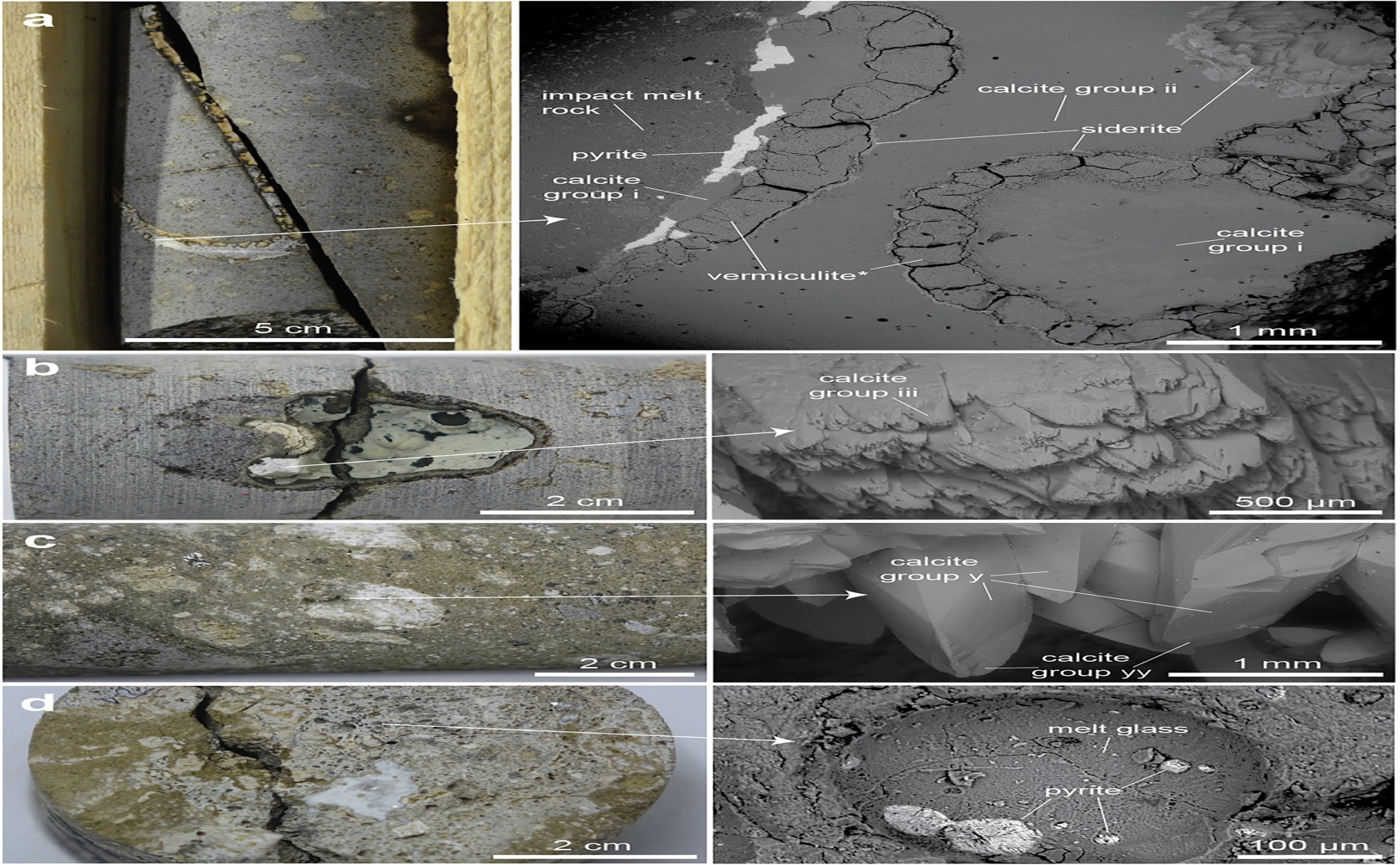
Drill core and scanning electron microscopy imaging identify distinct generations of secondary calcite and pyrite filling fractures and vugs within the impactites (a–d), establishing the petrographic succession of mineral phases that host the isotopic biosignatures of deep microbial colonization.
Key Findings
- In Finland’s Lappajärvi crater, formed 77.85 million years ago, researchers found direct evidence of microbial life colonizing rocks soon after the impact
- Microbial activity, specifically sulfate reduction, began within the crater’s fractured rocks approximately 73.6 million years ago, as shown by isotopic signatures
- The hydrothermal system created by the impact supported microbial life for over 10 million years, with later activity involving methane production and consumption
References
Main Study
1) Deep microbial colonization during impact-generated hydrothermal circulation at the Lappajärvi impact structure, Finland
Published 17th September, 2025
https://doi.org/10.1038/s41467-025-63603-y
Related Studies
2) The origin and emergence of life under impact bombardment.
Journal: Philosophical transactions of the Royal Society of London. Series B, Biological sciences, Issue: Vol 361, Issue 1474, Oct 2006
3) The Role of Meteorite Impacts in the Origin of Life.
4) Cell proliferation at 122 degrees C and isotopically heavy CH4 production by a hyperthermophilic methanogen under high-pressure cultivation.
5) Timing and origin of natural gas accumulation in the Siljan impact structure, Sweden.
Related Articles
 29th May, 2024 | Jenn Hoskins