Fluorescent tagging reveals hidden genetic traits in red apple varieties

Jim Crocker
9th January, 2026

Fluorescent tagging reveals hidden genetic traits in red apple varieties

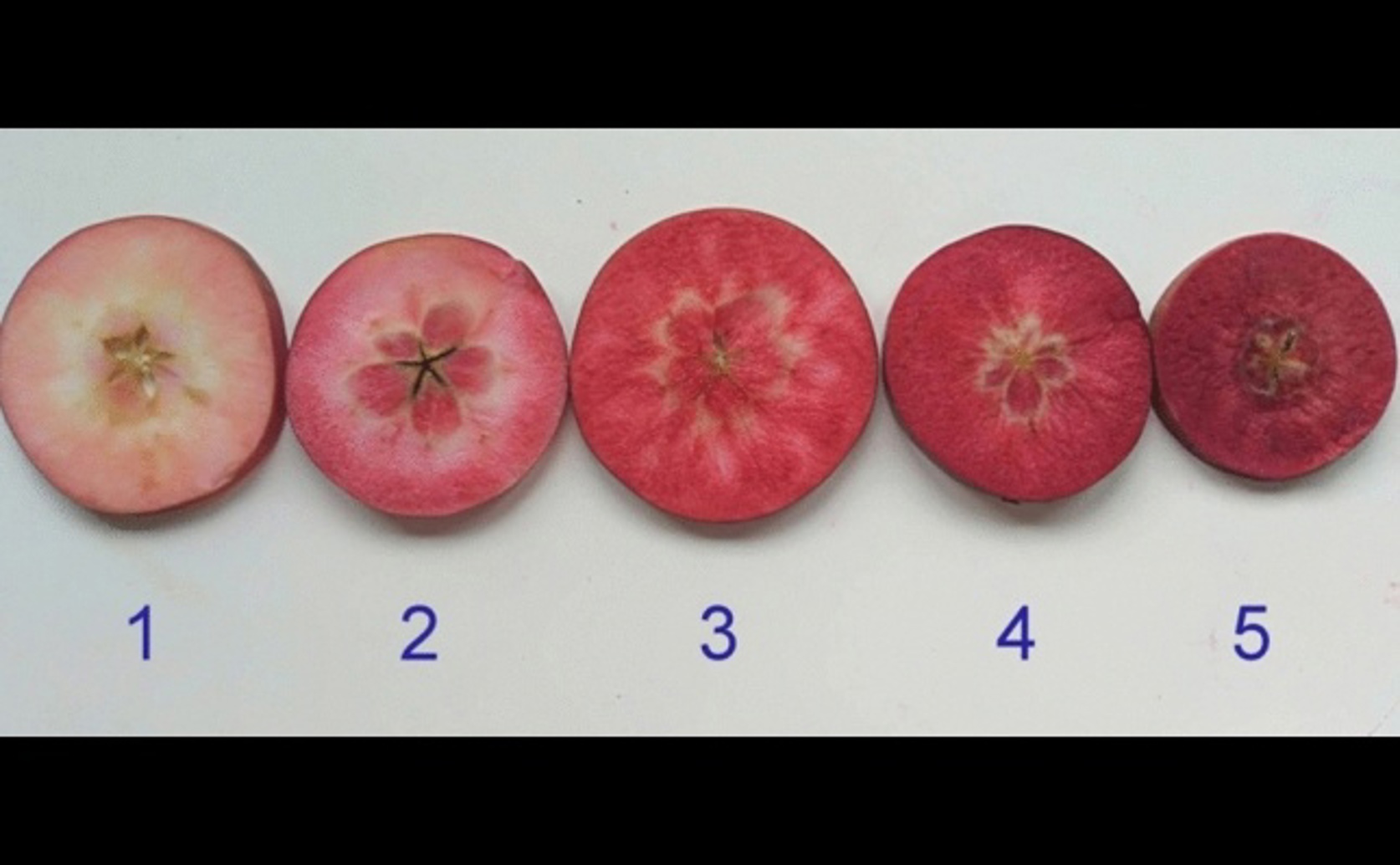
Classes of visually assessed red-flesh color intensity in apple, scored on a scale of 1 (faint pinkish tinge), 2 (moderate pink), 3 (pink-red), 4 (moderate red), and 5 (dark red).

Image adapted from: Szendy et al. / CC BY (Source)

Key Findings

  • This study focused on 80 new red-fleshed apple hybrids in Hungary to improve breeding and understand genetic diversity
  • All red-fleshed hybrids possessed a specific gene variant (R6 allele of MdMYB10) confirming their red color and potential health benefits
  • A streamlined DNA analysis method accurately identified 16 different S-alleles, revealing inconsistencies in plant family records and offering tools for better breeding strategies
Apple breeding has increasingly focused on developing varieties with unique characteristics, such as red flesh, driven by consumer demand and potential health benefits. However, successful breeding relies on understanding the genetic compatibility of parent plants to ensure effective pollination and fruit set. A key factor governing this compatibility is the S-locus, which controls self-incompatibility – a mechanism preventing self-pollination and promoting genetic diversity[2]. Researchers at the Hungarian University of Agriculture and Life Sciences recently conducted a study[1] to refine the genotyping of apple hybrids, specifically those with red flesh, and to assess their potential for broadening the genetic diversity of apple breeding programs. The core problem in apple breeding is accurately determining the S-genotype of each plant. The S-locus is complex, with multiple alleles (different versions of the gene) and a system known as S-RNase-based gametophytic self-incompatibility (GSI). This system relies on proteins called S-RNases to prevent pollen tube growth if the pollen shares the same S-allele as the flower’s pistil. Identifying these alleles is crucial for predicting successful crosses. Traditional methods for S-genotyping can be time-consuming and prone to error, often involving restriction enzyme digestion and gel electrophoresis. The study focused on 80 newly developed red-fleshed apple hybrids and six white-fleshed controls, along with their parent cultivars. All red-fleshed hybrids were confirmed to carry the R6 allele of the MdMYB10 gene, a gene known to be responsible for the red-fleshed phenotype. The primary goal was to optimize a faster and more accurate method for determining the S-genotype of these hybrids. The researchers refined a high-throughput S-genotyping protocol, streamlining the process to rely solely on PCR (polymerase chain reaction) – a technique used to amplify specific DNA sequences – eliminating the need for restriction enzyme digestion. This PCR-only workflow significantly improved accuracy, achieving single base-pair resolution. To identify the S-alleles present in each hybrid, the researchers used allele-specific primers, which are designed to bind to specific S-allele sequences. When ambiguous results were obtained, DNA sequencing was employed for confirmation. This process identified 16 distinct S-alleles within the hybrid population. A key finding was the identification of inconsistencies between pedigree records (documented ancestry of the plants) and the actual S-genotypes determined by molecular analysis. This highlights the importance of using genetic markers like S-alleles to validate breeding records and pollination events. Interestingly, two American heritage apple cultivars were found to carry three S-alleles, despite being diploid – meaning they should only have two sets of chromosomes (and therefore, typically two S-alleles). This suggests the presence of segmental duplications, where a portion of a chromosome has been duplicated, leading to extra copies of the S-locus gene. Furthermore, the study revealed that the distribution of S-alleles in the new hybrids differed significantly from that found in traditional Hungarian and international apple germplasm (collections of genetic material). This is particularly significant because a wider range of S-alleles increases the potential for successful crosses and the introduction of new traits into breeding programs. Earlier research[2] had already demonstrated the potential of Tunisian apple resources for crop improvement, identifying frequent S-alleles like S2, S3, S7, and S28 and noting a correlation between flowering period and pollen tube growth. The findings of build on this by showing how new hybrids can contribute even more diversity to the S-allele pool, potentially overcoming compatibility barriers. The use of BLAST[3] for rapid sequence comparison could be valuable in future studies to further characterize novel S-alleles identified in these hybrids, providing a faster means of understanding their genetic relationships and potential for cross-compatibility. The work by[4] on anthocyanin accumulation and the role of MYB transcription factors, while not directly related to S-genotyping, illustrates the broader genomic approaches being used to improve apple breeding, and the identification of MYB110a demonstrates the complexity of genetic control in apple traits. Finally, detailed S-RNase sequence data from 63 apple cultivars[5] provides a valuable resource for comparative analysis of the S-alleles identified in the current study, aiding in the understanding of their evolutionary relationships and functional characteristics.

FruitsGeneticsPlant Science

References

Main Study

1) Direct fluorescent S-genotyping reveals genetic diversity and pedigree inconsistencies in red-fleshed apple hybrids and American heritage varieties

Published 6th January, 2026

https://doi.org/10.1007/s00425-025-04918-4


Related Studies

2) Self-(in)compatibility in Tunisian apple accessions [Malus domestica. Borkh]: S-genotypes identification and pollen tube growth analysis.

https://doi.org/10.1007/s00425-024-04418-x


3) Basic local alignment search tool.

Journal: Journal of molecular biology, Issue: Vol 215, Issue 3, Oct 1990


4) An ancient duplication of apple MYB transcription factors is responsible for novel red fruit-flesh phenotypes.

https://doi.org/10.1104/pp.112.206771


5) Characterization of 25 full-length S-RNase alleles, including flanking regions, from a pool of resequenced apple cultivars.

https://doi.org/10.1007/s11103-018-0741-x


Related Articles

An unhandled error has occurred. Reload 🗙