Understanding How Kiwifruit Ripens: Key Genetic Networks Revealed

Greg Howard
28th October, 2024

Understanding How Kiwifruit Ripens: Key Genetic Networks Revealed

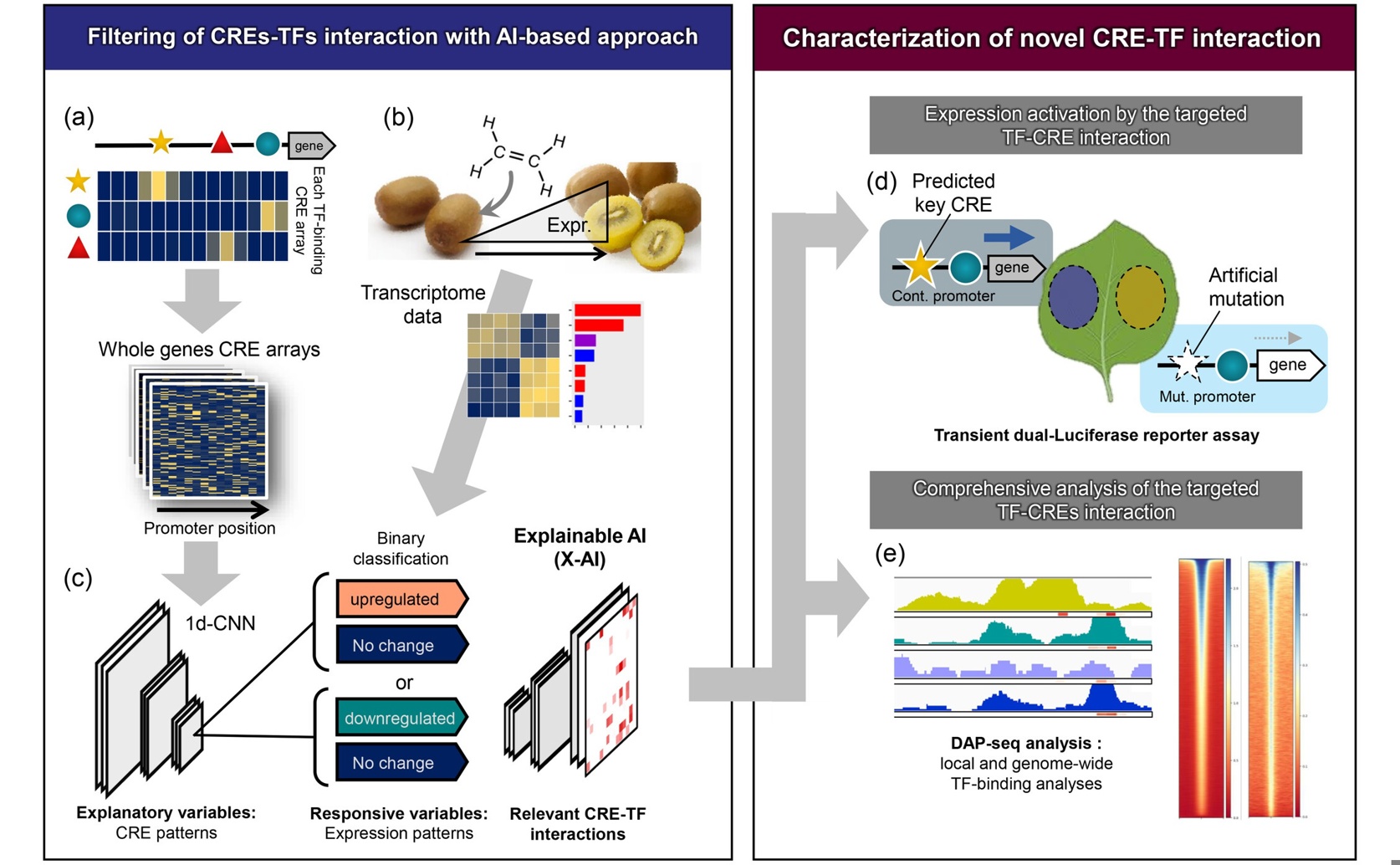
This study outlines an integrated workflow for identifying novel gene regulatory networks in kiwifruit ripening, which combines deep learning to predict interactions between genes and their regulators (a–c) with subsequent laboratory experiments to validate these findings (d, e).

Image adapted from: Kuwada et al. / CC BY (Source)

Key Findings

  • Researchers from Okayama University used deep learning to study gene expression networks in kiwifruit ripening
  • They discovered new regulatory relationships involving specific transcription factors that affect ethylene-induced ripening
  • The study's findings could lead to targeted genetic modifications to improve fruit traits and agricultural productivity
Fruit ripening is a complex process influenced by various genetic and environmental factors. Understanding the underlying mechanisms can significantly impact crop improvement and agricultural productivity. Recent research from Okayama University has employed advanced deep learning (DL) techniques to elucidate the gene expression networks specific to the ripening process in kiwifruit, a climacteric fruit that ripens in response to ethylene[1]. Previous studies have highlighted the importance of cis-regulatory elements (CREs) and transcription factors (TFs) in the evolution of lineage-specific traits in plants[2]. These CREs are non-coding DNA sequences that regulate the expression of nearby genes, often in response to specific TFs. Despite the conserved nature of the ripening process across various fruit species, the gene expression networks involved can differ significantly. This study aims to bridge this gap by using explainable deep learning frameworks to predict expression patterns based on CREs in promoter sequences. The researchers initially screened potential CRE-TF interactions that influence kiwifruit ripening. They identified novel regulatory relationships affecting ethylene-induced fruit ripening, specifically involving ABI5-like bZIP, G2-like, and MYB81-like TFs. These TFs were found to modulate the expression of key ethylene signaling and biosynthesis-related genes such as ACS1, ERT2, and ERF143. The findings were validated using transient reporter assays and DNA affinity purification sequencing (DAP-Seq) analyses, confirming the CRE-TF interactions and their regulatory roles. This approach contrasts with traditional co-expression network analyses, which often rely on the simultaneous expression of genes to infer regulatory relationships. The DL-based screening demonstrated that it could identify regulatory networks independently of co-expression patterns, offering a more nuanced understanding of the ripening process. The study aligns with earlier research that has explored the genetic and molecular basis of fruit ripening. For instance, a study on tomato fruit used convolutional neural networks (CNNs) to predict genome-wide expression patterns from DNA sequences in gene regulatory regions, identifying nucleotide residues critical to specific expression patterns[2]. This tomato study highlighted the potential of machine learning techniques in understanding and manipulating gene expression networks, a concept further expanded upon by the current kiwifruit research. Additionally, structural variants (SVs) have been shown to play a significant role in crop improvement by affecting gene dosage and expression levels, thereby influencing traits like fruit flavor, size, and production[3]. Understanding the CRE-TF interactions in kiwifruit could similarly pave the way for targeted genetic modifications to enhance desirable traits. The findings also resonate with research on the dual ripening mechanisms in kiwifruit, which involve both ethylene-dependent and low-temperature-modulated pathways[4]. The identification of specific TFs and their target genes provides a more detailed map of the ethylene-dependent pathway, complementing the existing knowledge of the low-temperature pathway. Furthermore, the study's use of DL frameworks to uncover novel regulatory relationships could have broader implications for other climacteric fruits. For example, in kiwifruit lines where ACC oxidase (ACO) genes were suppressed, resulting in reduced ethylene production and altered ripening behavior, the application of continuous exogenous ethylene re-initiated typical ripening processes[5]. The current study's insights into the CRE-TF interactions could help refine such interventions, making them more precise and effective. In summary, the research from Okayama University demonstrates the utility of explainable deep learning approaches in identifying novel CRE-TF interactions involved in fruit ripening. These findings suggest that fruit crop species may have evolved lineage-specific regulatory networks, offering new avenues for crop improvement and a deeper understanding of the genetic basis of fruit ripening.

FruitsGeneticsPlant Science

References

Main Study

1) Identification of lineage-specific cis-trans regulatory networks related to kiwifruit ripening initiation.

Published 27th October, 2024

https://doi.org/10.1111/tpj.17093


Related Studies

2) Genome-wide cis-decoding for expression design in tomato using cistrome data and explainable deep learning.

https://doi.org/10.1093/plcell/koac079


3) Major Impacts of Widespread Structural Variation on Gene Expression and Crop Improvement in Tomato.

https://doi.org/10.1016/j.cell.2020.05.021


4) Comparative transcriptome analysis reveals distinct ethylene-independent regulation of ripening in response to low temperature in kiwifruit.

https://doi.org/10.1186/s12870-018-1264-y


5) Dissecting the role of climacteric ethylene in kiwifruit (Actinidia chinensis) ripening using a 1-aminocyclopropane-1-carboxylic acid oxidase knockdown line.

https://doi.org/10.1093/jxb/err063


Related Articles

An unhandled error has occurred. Reload 🗙