Genetic Variation in Expansin Protein Affects Apple Firmness at Harvest

Greg Howard
21st January, 2025

Genetic Variation in Expansin Protein Affects Apple Firmness at Harvest

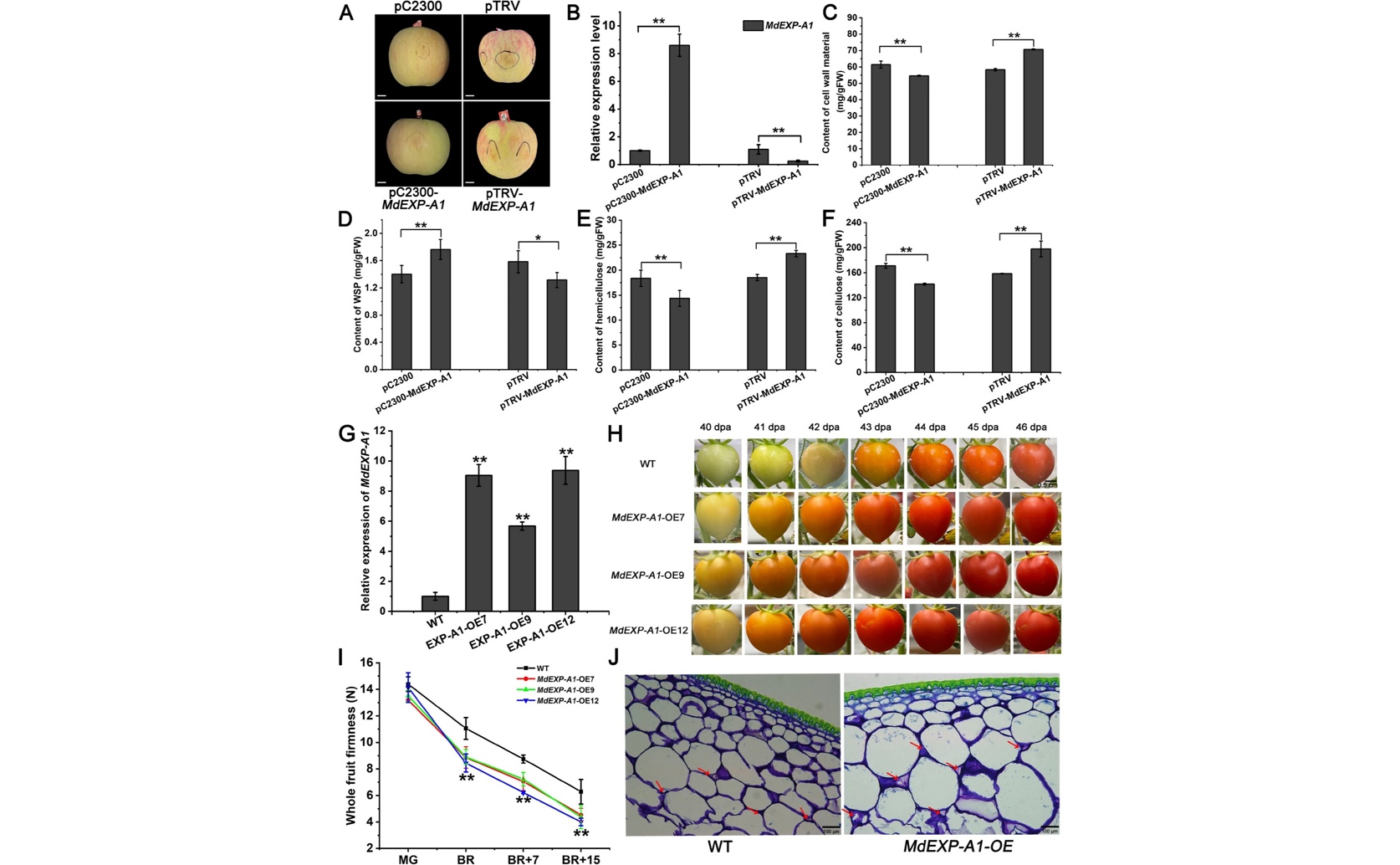
Functional experiments confirmed that the MdEXP-A1 gene promotes fruit softening by accelerating ripening and reducing firmness in both apple (Malus × domestica) (a–f) and transgenic tomato (Solanum lycopersicum) (g–j), validating its identified role in controlling apple texture.

Image adapted from: Su et al. / CC BY (Source)

Key Findings

  • Researchers at Northwest A&F University studied the genetic factors influencing apple firmness using advanced genetic analysis methods
  • They identified 11 candidate intervals on various chromosomes and a major QTL on chromosome 16 linked to apple firmness
  • The gene MdEXP-A1, associated with cell wall loosening, was found to play a key role in fruit softening, with a specific promoter deletion linked to super-hard apple phenotypes
Apple flesh firmness is a critical trait for breeders due to its impact on ripening and storage quality. Recent research by Northwest A&F University has delved into the genetic basis of firmness formation using advanced genetic analysis methods[1]. This study aims to uncover the genetic factors influencing apple firmness, which could significantly enhance apple breeding programs. The researchers collected phenotypic data from 251 F1 hybrids derived from 'Ruiyang' and 'Scilate' over two years, noting extensive segregation in flesh firmness at harvest. Through bulked segregant analysis sequence (BSA-seq) and comparative transcriptome analysis (RNA-seq), they identified 11 candidate intervals on chromosomes 03, 05, 06, 07, 13, and 16. A major QTL on chromosome 16 was characterized, and a candidate gene encoding expansin, MdEXP-A1, was identified. Expansins are proteins that play a role in cell wall loosening, which is crucial for fruit softening. The study found that the genotype Del-1166 (homozygous deletion) in the MdEXP-A1 promoter was closely associated with super-hard apple phenotypes. This finding suggests that Del-1166 could serve as a functional marker for marker-assisted selection (MAS) in apple breeding. Functional identification showed that MdEXP-A1 expedited fruit softening in both apples and tomatoes that overexpressed this gene. The researchers also validated that the promoter sequence TE-1166 contained two binding motifs for MdNAC1, a regulator that promotes the expression of MdEXP-A1. The absence of the MdEXP-A1 promoter fragment reduced its transcription activity, underscoring the gene's role in regulating flesh firmness. These findings provide new insights into the genetic control of apple firmness and could lead to more efficient breeding programs. By understanding the genetic basis of firmness, breeders can develop apple varieties with desired firmness traits more effectively. Previous studies have also explored the genetic and environmental factors affecting apple firmness. For instance, research on Bayesian QTL linkage mapping has shown that analyzing multiple full-sib families can increase the probability of detecting QTLs and provide insights into their magnitude across different genetic backgrounds[2]. This approach has been validated in studies on apple fruit firmness, where strong evidence for multiple QTLs was found, supporting the importance of genetic factors in determining firmness. Moreover, environmental factors also play a significant role in fruit quality traits. A study on the 'Royal Gala' × 'Braeburn' population demonstrated that the environment could influence traits like firmness, maturation timing, and dry matter content[3]. This research highlighted the complexity of genetic control and the need to consider environmental effects when developing new apple varieties. The current study by Northwest A&F University builds on these findings by providing a deeper understanding of the genetic mechanisms underlying apple firmness. By identifying specific genes and promoter sequences involved in firmness, this research offers valuable tools for apple breeders to enhance fruit quality through targeted genetic selection.

FruitsGeneticsPlant Science

References

Main Study

1) Allelic variation in an expansin, MdEXP-A1, contributes to flesh firmness at harvest in apples.

Published 20th January, 2025

https://doi.org/10.1186/s43897-024-00121-3


Related Studies

2) Bayesian QTL analyses using pedigreed families of an outcrossing species, with application to fruit firmness in apple.

https://doi.org/10.1007/s00122-014-2281-3


3) Genetic and environmental control of fruit maturation, dry matter and firmness in apple (Malus × domestica Borkh.).

https://doi.org/10.1038/hortres.2014.46


Related Articles

An unhandled error has occurred. Reload 🗙