
What mammoths ate and where they lived: Clues from ancient California fossils
Jenn Hoskins
8th January, 2026


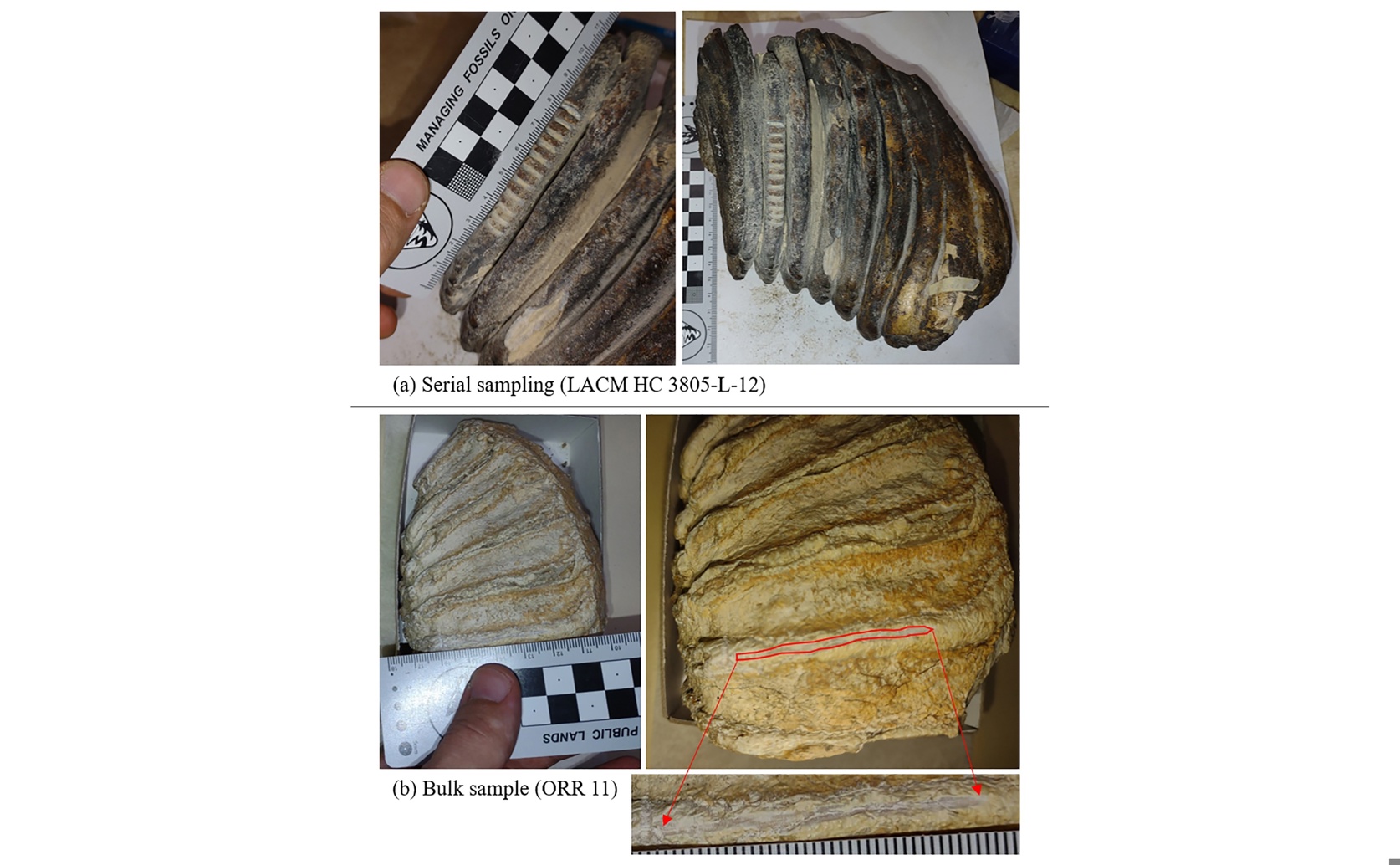
To reconstruct the diets and environments of mammoths over different timescales, enamel powder was collected from teeth using either serial drilling to capture seasonal variations (a) or bulk drilling for a long-term average (b).
Key Findings
- This study analyzed teeth from mammoths on California’s Channel Islands and mainland to understand their diets and environment around 13,000 years ago
- Both pygmy and Columbian mammoths primarily ate C3 plants, but some individuals consumed C4 plants, CAM plants, or plants stressed by drought
- Mainland mammoths likely lived in drier conditions than island mammoths, as indicated by their diets, suggesting environmental flexibility but potential vulnerability to climate shifts
References
Main Study
1) Diets and environments of late pleistocene pygmy and Columbian mammoths: Isotopic evidence from Southern California
Published 7th January, 2026
https://doi.org/10.1371/journal.pone.0338674
Related Studies
2) Sea-level and deep-sea-temperature variability over the past 5.3 million years.
3) Pre-Younger Dryas megafaunal extirpation at Rancho La Brea linked to fire-driven state shift.
4) Evidence for an extraterrestrial impact 12,900 years ago that contributed to the megafaunal extinctions and the Younger Dryas cooling.
Journal: Proceedings of the National Academy of Sciences of the United States of America, Issue: Vol 104, Issue 41, Oct 2007
5) Carbon isotope compositions of terrestrial C3 plants as indicators of (paleo)ecology and (paleo)climate.
Related Articles
 18th December, 2025 | Jenn Hoskins