Fossil plant leaves reveal ancient history of calcium buildup

Jenn Hoskins
18th December, 2025

Fossil plant leaves reveal ancient history of calcium buildup

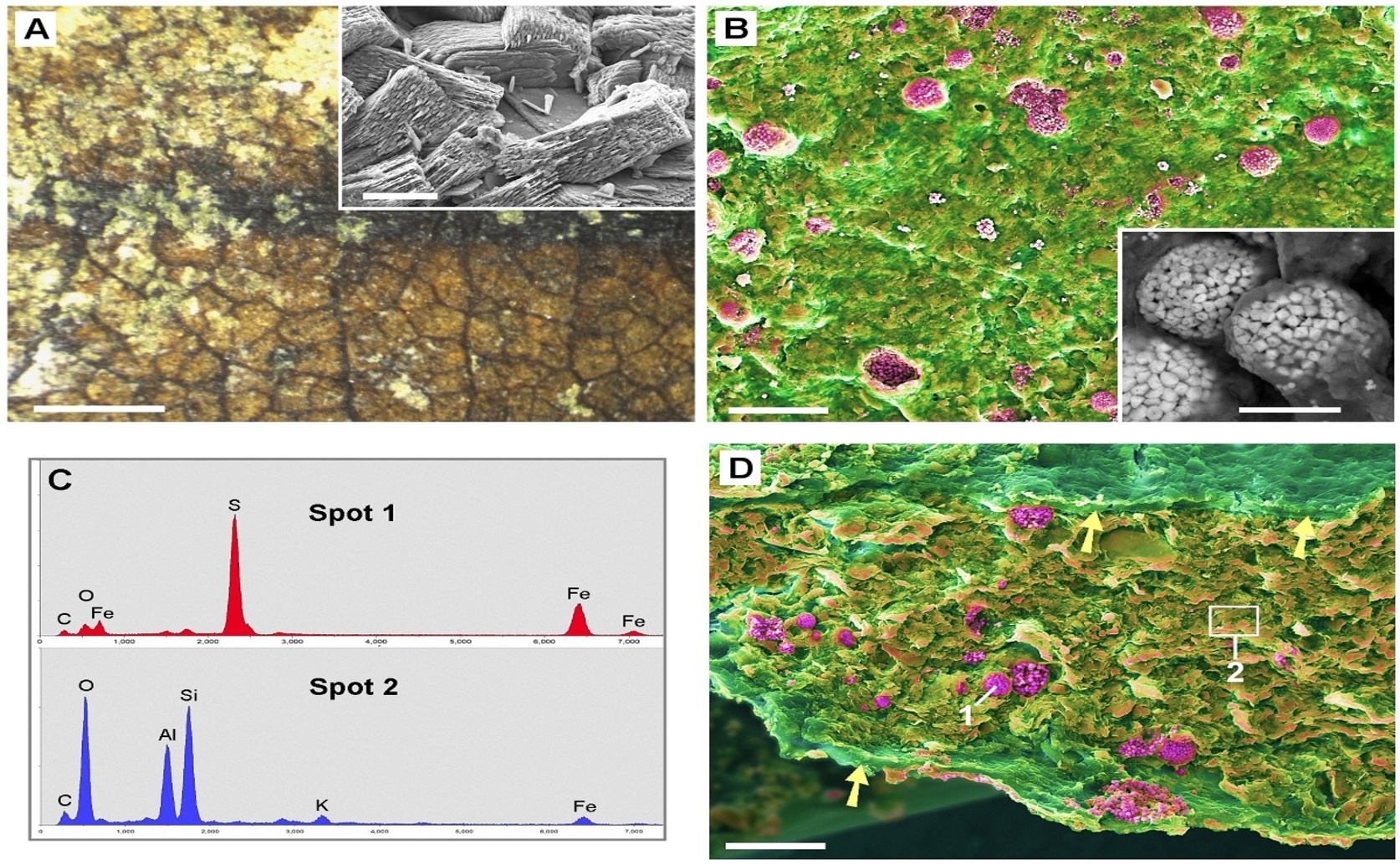
Microscopic and chemical analysis of a Middle-Eocene angiosperm leaf reveals that the original calcium oxalate druses were replaced during fossilization by granular pyrite framboids located within the leaf's internal tissue (a–d).

Image adapted from: Malekhosseini et al. / CC BY (Source)

Key Findings

  • Researchers identified potential evidence of calcium oxalate (CaOx) crystals in plant fossils ranging from 400 million to 20 million years ago
  • Fossil structures resembling CaOx druses were found within leaves of early seed ferns and Ginkgo relatives, mirroring patterns in modern plants
  • While the original crystals decayed, their shape and location were preserved as mineral replacements like pyrite, iron oxide, and silica, revealing a long history of CaOx in plant evolution
Calcium oxalate (CaOx) crystals are common components of plant tissues, playing roles in calcium regulation and defense against herbivores[2]. However, these crystals rarely survive the fossilization process, making it difficult to understand their prevalence and function in ancient plants. Researchers at the University of Bonn, along with colleagues from the University of Wisconsin-Milwaukee, Hessisches Landesmuseum Darmstadt, and CNRS-University of Lille[1], have now identified potential evidence of CaOx crystals in plant fossils spanning from the Devonian period (around 400 million years ago) to the Neogene period (the last 20 million years). The study focused on granular structures found within fossilized leaves. These structures, observed across a wide range of plant groups including early seed ferns and Ginkgo relatives, bore a striking resemblance to CaOx druses – crystal aggregates – found in the leaves of modern plants. Druses are particularly common in the leaves of dicotyledon angiosperms, often ranging in size from 20 to 100 micrometers. To determine if these fossil structures were indeed remnants of CaOx crystals, the research team compared their morphology (shape and form) and distribution patterns to those observed in extant (currently living) gymnosperms and angiosperms. They found significant similarities, with the fossil structures mirroring the arrangement of CaOx druses in modern leaves, specifically along leaf veins and within leaf tissues. The challenge lay in the fact that the original CaOx crystals themselves were no longer present. Over millions of years, they had been replaced by other minerals and materials, such as pyrite, iron oxide, silica, and organic matter. The specific replacement material depended on the chemical environment surrounding the fossil during fossilization. This explains why previous attempts to identify CaOx in fossils have been limited, often only revealing “ghost crystals” – empty cavities where the crystals once resided[3]. The research builds on earlier work showing that even when CaOx crystals don’t persist, their former presence can sometimes be detected as cavities or altered mineral deposits in fossil gymnosperm leaves[3]. However, this new study significantly expands the timeframe for potential CaOx detection, pushing it back to the Paleozoic and Mesozoic eras, periods where CaOx evidence was previously unknown. Furthermore, the study highlights the importance of understanding the diverse patterns of CaOx deposition in living plants as a prerequisite for recognizing their traces in fossils. A refined method for visualizing CaOx in fresh leaves, involving ashing and microscopic analysis, has also been developed to aid in this process[4]. Interestingly, a separate study on conifers revealed that CaOx crystal accumulation in stems can act as a defense mechanism against bark beetles[5]. While this study didn't directly investigate fossilized stems, it provides a context for understanding the potential ecological role of CaOx in ancient plants. The patterns of CaOx deposition, whether intracellular or extracellular, varied significantly between different conifer lineages[5]. The findings of represent a crucial first step toward a more comprehensive understanding of the evolution of calcium biominerals in plants and their role in paleoecological reconstructions. By identifying these previously overlooked traces of CaOx druses, the researchers open up new avenues for investigating the ecophysiology of fossil plants and their interactions with their environment.

EcologyPlant ScienceEvolution

References

Main Study

1) Detection of traces of calcium oxalate druses in fossil leaves of angiosperms and gymnosperms from different sites and geological periods

Published 17th December, 2025

https://doi.org/10.1371/journal.pone.0332423


Related Studies

2) Physiological and ecological significance of biomineralization in plants.

https://doi.org/10.1016/j.tplants.2013.11.002


3) Traces of calcium oxalate biomineralization in fossil leaves from late Oligocene maar deposits from Germany.

https://doi.org/10.1038/s41598-022-20144-4


4) Visualisation of calcium oxalate crystal macropatterns in plant leaves using an improved fast preparation method.

https://doi.org/10.1111/jmi.13187


5) Distribution of calcium oxalate crystals in the secondary phloem of conifers: a constitutive defense mechanism?

https://doi.org/10.1046/j.1469-8137.2003.00839.x


Related Articles

An unhandled error has occurred. Reload 🗙