How Tree Communities Shape Insect Interaction Networks and Their Evolution

Greg Howard
27th February, 2025

How Tree Communities Shape Insect Interaction Networks and Their Evolution

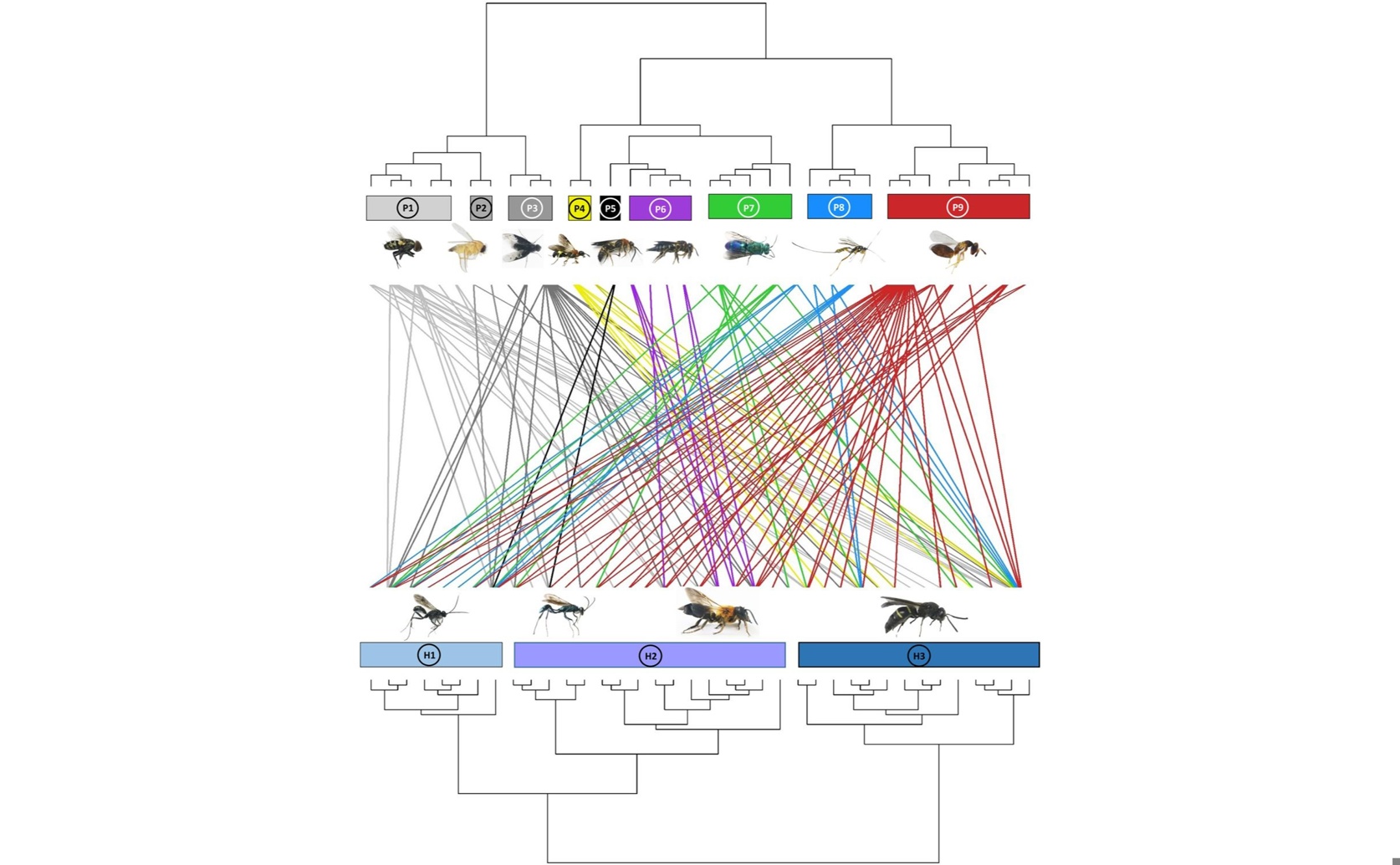
The Parafit analysis demonstrates a significant, nonrandom phylogenetic congruence between hosts and parasitoids, confirming that evolutionary history plays a crucial role in structuring these interactions within the forest ecosystem.

Image adapted from: Wang et al. / CC BY (Source)

Key Findings

  • The Chinese Academy of Sciences found that diverse tree species in subtropical forests shape the variety and interactions of bees, wasps, and their parasitoids
  • Evolutionary relationships among species lead to structured, non-random interactions between hosts and parasitoids
  • Higher tree diversity and more canopy cover make these ecological networks more complex and stable
Understanding how different species interact within ecosystems is crucial for effective conservation and restoration efforts. One key aspect of these interactions involves host-parasitoid relationships, where parasitoids rely on host species for their development. The Chinese Academy of Sciences conducted a comprehensive study to explore how various environmental factors influence these intricate networks over time[1]. The study addressed a significant gap in ecological research: the impact of both biotic factors, such as plant diversity and the functional and phylogenetic composition of consumers, and abiotic factors like microclimate, on the structure and dynamics of host-parasitoid communities. To achieve this, researchers utilized a five-year dataset from trap-nesting bees and wasps along with their parasitoids, collected from a large-scale, controlled subtropical tree biodiversity experiment. One of the primary focuses was to examine how tree species richness and diversity influence the diversity and interactions of both host and parasitoid species. Building on findings from earlier research[2], which highlighted the importance of functional diversity in promoting long-term forest productivity, the study investigated whether similar principles apply to higher trophic levels. The researchers considered not only the number of tree species but also their phylogenetic relationships and functional traits, assessing how these factors collectively shape the community structure of bees, wasps, and their parasitoids. Using advanced statistical models, the team analyzed the species and phylogenetic diversity within host and parasitoid communities. They also mapped the interaction networks to understand how these relationships are organized. The findings revealed that multiple aspects of tree diversity, including species richness and phylogenetic diversity, significantly influenced both the species composition and the structure of interaction networks between hosts and parasitoids. Additionally, canopy cover emerged as a critical abiotic factor affecting these communities. A notable result was that the interactions between hosts and parasitoids were not random but rather structured in a way that reflected the phylogenetic relationships of the species involved. This aligns with insights from previous studies[3][4], which emphasized the role of phylogeny in shaping ecological networks and community assembly. Specifically, the study found that compartmentalization—where species are grouped into distinct clusters based on their interactions—was prevalent in the host-parasitoid networks. These compartments were influenced by the phylogenetic relationships among the tree species, suggesting that evolutionary history plays a significant role in determining which species interact. Furthermore, the research demonstrated that tree species richness and phylogenetic diversity directly impacted the overall structure of the host-parasitoid networks. Higher tree diversity provided a more complex habitat, supporting a greater variety of interactions and enhancing the stability of the ecosystem. This supports the earlier findings from forest restoration studies[2], where increased functional diversity was shown to boost ecosystem services like productivity and carbon storage. In the context of the current study, diverse tree communities not only support more species but also facilitate more intricate and resilient interaction networks. The methodology involved using trap-nesting techniques to systematically collect data on bees, wasps, and their parasitoids over five years. This long-term approach allowed the researchers to observe changes and trends in the community dynamics and interaction networks as the tree biodiversity experiment progressed. By integrating phylogenetic and functional data, the study provided a comprehensive view of how different species coexist and interact within a diverse ecosystem. The implications of this research are significant for forest restoration and biodiversity conservation efforts. By demonstrating that plant diversity and canopy cover are crucial for maintaining diverse and stable host-parasitoid networks, the study suggests that restoration projects should prioritize planting a variety of tree species with diverse functional traits. This approach not only enhances ecosystem productivity and resilience but also supports the complex web of interactions that sustain biodiversity[2][3][4]. Moreover, the study highlights the importance of considering both biotic and abiotic factors in ecological research. Understanding how these elements interact to shape community structure can lead to more effective strategies for managing and preserving ecosystems, especially in the face of rapid global changes. The use of phylogenetic information, as emphasized in previous research[4], proved valuable in uncovering the non-random patterns of species interactions, offering deeper insights into the evolutionary and ecological processes driving community assembly. In conclusion, the Chinese Academy of Sciences' study provides valuable evidence that tree diversity and canopy cover are key determinants of host-parasitoid network structure and community dynamics. By integrating phylogenetic and functional perspectives, the research builds on earlier findings and advances our understanding of the complex factors that influence ecological interactions. This knowledge is essential for developing informed conservation and restoration practices that promote biodiversity and ecosystem health in diverse and changing environments.

EcologyPlant ScienceEvolution

References

Main Study

1) Multidimensionality of tree communities structure host-parasitoid networks and their phylogenetic composition

Published 25th February, 2025

https://doi.org/10.7554/eLife.100202


Related Studies

2) Functional diversity effects on productivity increase with age in a forest biodiversity experiment.

https://doi.org/10.1038/s41559-021-01564-3


3) Network topology: patterns and mechanisms in plant-herbivore and host-parasitoid food webs.

https://doi.org/10.1111/j.1365-2656.2010.01778.x


4) The merging of community ecology and phylogenetic biology.

https://doi.org/10.1111/j.1461-0248.2009.01314.x


Related Articles

An unhandled error has occurred. Reload đź—™