Changing Climate Adaptations of Chin Cacti: Did Ice Ages Set the Stage

Jim Crocker
22nd May, 2025

Changing Climate Adaptations of Chin Cacti: Did Ice Ages Set the Stage

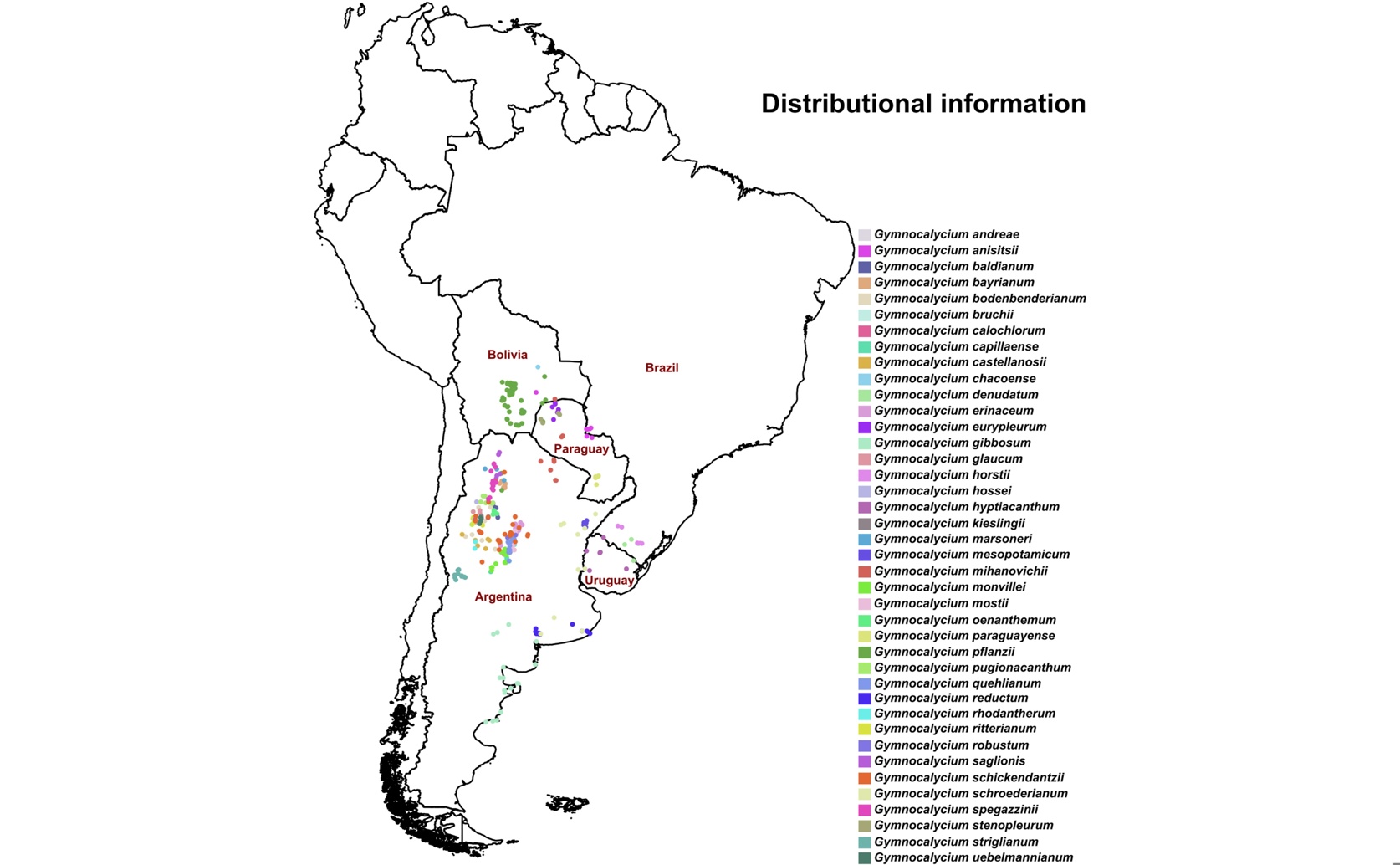
The mapped distribution of 40 Gymnocalycium species across southern South America illustrates their range across diverse bioregions, providing the spatial framework used to determine that precipitation niches have remained largely conserved while thermal niches have evolved in response to historical climatic shifts.

Image adapted from: Nair et al. / CC BY (Source)

Key Findings

  • University of Kansas studied South American Gymnocalycium cacti to understand how temperature and rainfall influence their evolution
  • They found that cacti with limited ranges are actively adapting to changing climates, with temperature and precipitation traits evolving differently
  • Evolution patterns vary by region and historical climate events, highlighting the need for targeted conservation to protect vulnerable cactus species
Cacti are renowned for their resilience and diverse forms, yet their rapid diversification poses intriguing questions for scientists. Despite their slow growth rates and long generation times, cacti have evolved into a wide array of species in relatively short geological periods. Researchers at the University of Kansas conducted a study[1] to understand the factors driving this swift evolution, focusing on the ecological niches of Gymnocalycium species, a prominent genus within the cactus family. The primary goal of the study was to investigate how environmental factors such as temperature and precipitation have influenced the evolutionary paths of Gymnocalycium species. By examining these climatic dimensions, the researchers aimed to uncover patterns of niche conservatism—where species retain ancestral ecological traits—and niche evolution, where species adapt to new environmental conditions. Understanding these patterns is crucial for predicting how these plants might respond to ongoing climate changes. To achieve this, the research team employed the binned ancestral range coding method, a technique that allows scientists to reconstruct the climatic niches of ancestral species based on current data. This method involves categorizing environmental variables into discrete bins and mapping these onto the phylogenetic tree of the species being studied. Through this approach, the team was able to trace the evolutionary history of temperature and precipitation preferences in Gymnocalycium. The findings revealed several key insights. Firstly, the climatic niches of narrow-ranged Gymnocalyulum species are not highly conserved across their evolutionary history. This indicates that these species have been actively adapting to changing environmental conditions rather than maintaining stable ecological preferences. Secondly, the study found that the evolutionary dynamics of thermal (temperature-related) and precipitation niches do not follow similar patterns. This suggests that different environmental factors may drive niche evolution in distinct ways. Additionally, the research identified a bioregion-specific pattern of niche evolution. Gymnocalycium species in different geographical regions exhibited unique evolutionary responses to their local climates, highlighting the role of regional environmental conditions in shaping species diversity. The study also linked major climatic events, specifically the Early–Middle Pleistocene glaciations, to patterns of lineage divergence in Gymnocalycium. These glaciations likely created new environmental pressures that triggered the evolution of diverse climatic niches among cactus species. These results align with previous research that emphasizes the importance of environmental variables in the diversification of plant lineages. For instance, a study by Universidad Nacional de Córdoba[2] demonstrated that soil pH, temperature seasonality, and precipitation significantly influenced the evolution of Epithelantha species, a close relative of Gymnocalycium. Similarly, research from Oklahoma State University[3] highlighted how factors like diurnal temperature range and soil composition contribute to cactus diversification. The University of Kansas study builds on these findings by providing a more detailed analysis of how specific climatic factors drive niche evolution in Gymnocalycium. The implications of this research are significant for conservation efforts. The study suggests that Gymnocalycium species with specialized root systems, such as those with fascicular roots, may be particularly vulnerable to environmental changes and thus require targeted conservation strategies. Moreover, species distributed in regions like the South American transition zone, South Brazilian dominion, and Chacoan dominion may face increased risks due to climate warming. These areas are expected to undergo significant climatic shifts, which could disrupt the delicate balance of temperature and precipitation niches that these cacti depend on. Furthermore, the study highlights a "more tight-less tight" pattern in conserving precipitation and temperature niches. This means that conservation efforts might need to prioritize maintaining the integrity of one climatic variable while allowing more flexibility in the other. Such a strategy could help preserve critical environmental conditions necessary for the survival of Gymnocalycium species, even as other aspects of their habitat change. The University of Kansas research not only enhances our understanding of the evolutionary history of Gymnocalycium but also underscores the broader importance of ecological factors in shaping plant diversity. By integrating phylogenetic methods with detailed environmental data, the study provides a comprehensive view of how climatic niches evolve over time. This approach is essential for developing effective conservation strategies, especially in the face of rapid climate change. In summary, the study conducted by the University of Kansas offers valuable insights into the evolutionary dynamics of Gymnocalycium species. It demonstrates that climatic niches are actively evolving in response to environmental pressures and that different regions exhibit unique patterns of niche adaptation. By building on earlier research, this study provides a deeper understanding of the complex interactions between climate and plant diversification, highlighting the need for informed conservation efforts to protect these resilient yet vulnerable cacti.

EcologyPlant ScienceEvolution

References

Main Study

1) ‘More tight-less tight’ Patterns in the Climatic Niche Evolution of Gymnocalycium (Cactaceae): Were Pleistocene Glaciations a Prelude?

Published 20th May, 2025

https://doi.org/10.1371/journal.pone.0323758


Related Studies

2) The importance of environmental conditions in maintaining lineage identity in Epithelantha (Cactaceae).

https://doi.org/10.1002/ece3.7347


3) Identifying the multiple drivers of cactus diversification.

https://doi.org/10.1038/s41467-024-51666-2


Related Articles

An unhandled error has occurred. Reload 🗙