New tests improve detection of melioidosis bacteria in soil

Jenn Hoskins
6th January, 2026

New tests improve detection of melioidosis bacteria in soil

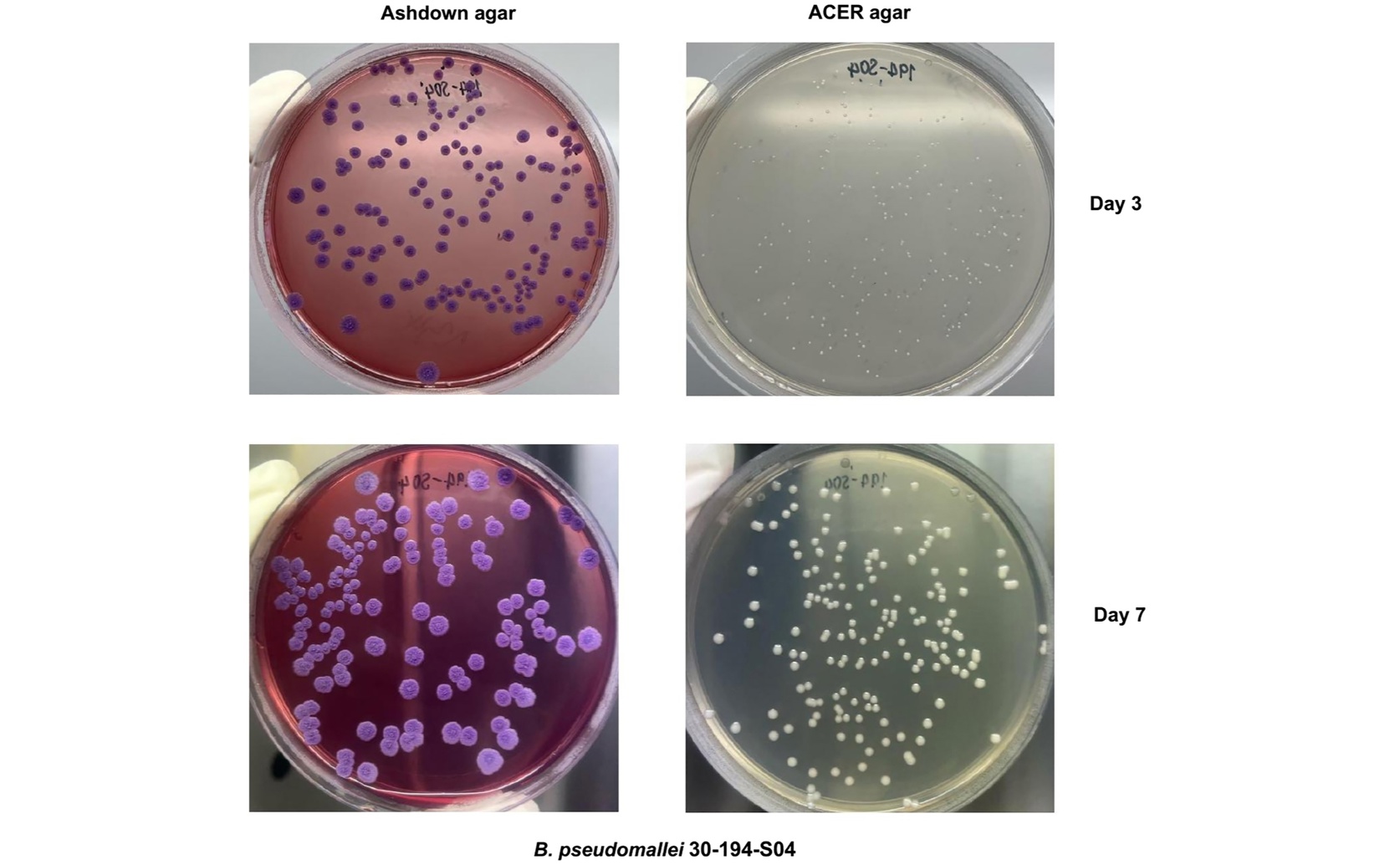
Burkholderia pseudomallei exhibits a distinct, rough, purple colony morphology on Ashdown agar that is more easily identifiable than the smooth, white colonies on ACER agar, demonstrating why Ashdown agar was selected as the superior medium for environmental surveillance.

Image adapted from: Suttisak et al. / CC BY (Source)

Key Findings

  • In Northeast Thailand, a study evaluated methods to detect Burkholderia pseudomallei in soil to understand infection risk
  • Enriching soil samples with ACER broth before culturing significantly improved B. pseudomallei detection compared to direct culturing
  • Detecting B. pseudomallei in soil wasn’t strongly linked to antibody levels in people, suggesting other factors influence infection risk
Melioidosis is a severe infectious disease caused by the bacterium Burkholderia pseudomallei[2]. It’s particularly prevalent in tropical regions like Southeast Asia and Northern Australia, where the bacterium lives in the soil and water[2][3]. Infection occurs through breaks in the skin or inhalation, and can be fatal if not treated quickly, with the bacterium being resistant to many common antibiotics[2]. Diagnosing melioidosis is challenging due to its varied symptoms and difficulties in identifying the bacterium[3]. Researchers from Mahidol University, University of Nevada, Reno, and University of Florida recently conducted a study[1] to improve the detection of B. pseudomallei in soil, aiming to better understand infection risk. The core problem is that knowing where the bacterium is present in the environment is crucial for targeted prevention and control measures. The study evaluated different laboratory methods for finding B. pseudomallei directly in soil samples. They tested several culture-based techniques, meaning they attempted to grow the bacterium from the soil, using different growth mediums like Ashdown agar, phosphate-buffered acidic erythritol (ACER) agar, and various broths. They also used real-time polymerase chain reaction (PCR), a technique that detects the bacterium’s genetic material. PCR works by amplifying specific DNA sequences, allowing for identification even when bacteria are present in low amounts. To assess whether these detection methods correlated with actual infection risk, the researchers collected soil samples from the homes of individuals in Amnat Charoen, Northeast Thailand. These individuals were categorized based on their antibody levels to a B. pseudomallei protein called Hemolysin coregulated protein 1 (Hcp1). Antibodies are proteins the body produces to fight off infection; higher levels suggest previous exposure to the bacterium. The results showed that enriching soil samples in ACER broth before culturing on Ashdown agar significantly improved the recovery of B. pseudomallei compared to direct culturing alone. This suggests that the bacterium is often present in low concentrations in the soil, making it difficult to detect without this initial enrichment step. PCR confirmed the presence of the bacterium in only a small number of the culture-positive samples. Interestingly, the study found a limited association between detecting B. pseudomallei in the soil and the antibody levels in people living in those households. While more B. pseudomallei was found in soil samples from homes of people with antibodies (10.9%), the difference wasn't statistically significant (5.5% in homes of those without antibodies). This suggests that environmental presence doesn’t automatically translate to infection, and other factors likely play a role. These findings build upon earlier research[4] which demonstrated a strong link between the geographic distribution of B. pseudomallei in soil and the incidence of melioidosis in Thailand. The study[4] found that the northeastern region of Thailand had the highest prevalence of the bacterium in the soil, and correspondingly, the highest infection rate in patients. However, the new study highlights that simply finding the bacterium in the soil isn’t enough to predict infection risk, and that the relationship is complex. The study[3] estimated a global burden of 165,000 melioidosis cases per year, emphasizing the underreporting of the disease and the need for improved surveillance. The current study contributes to this goal by refining detection methods, but also emphasizes the need for a more comprehensive approach. The researchers conclude that a combination of methods, alongside understanding factors beyond environmental presence, is necessary for effective melioidosis surveillance.

AgricultureEnvironmentBiotech

References

Main Study

1) Evaluation of culture- and PCR-based methods for detecting Burkholderia pseudomallei in soil samples in Thailand

Published 2nd January, 2026

https://doi.org/10.1371/journal.pntd.0013840


Related Studies

2) Comprehensive approaches for the detection of Burkholderia pseudomallei and diagnosis of melioidosis in human and environmental samples.

https://doi.org/10.1016/j.micpath.2022.105637


3) Predicted global distribution of Burkholderia pseudomallei and burden of melioidosis.

https://doi.org/10.1038/nmicrobiol.2015.8


4) Epidemiology of Burkholderia pseudomallei in Thailand.

Journal: The American journal of tropical medicine and hygiene, Issue: Vol 60, Issue 3, Mar 1999


Related Articles

An unhandled error has occurred. Reload 🗙