How skipjack tuna use ocean temperatures to find spawning and wintering grounds

Greg Howard
6th December, 2025

How skipjack tuna use ocean temperatures to find spawning and wintering grounds

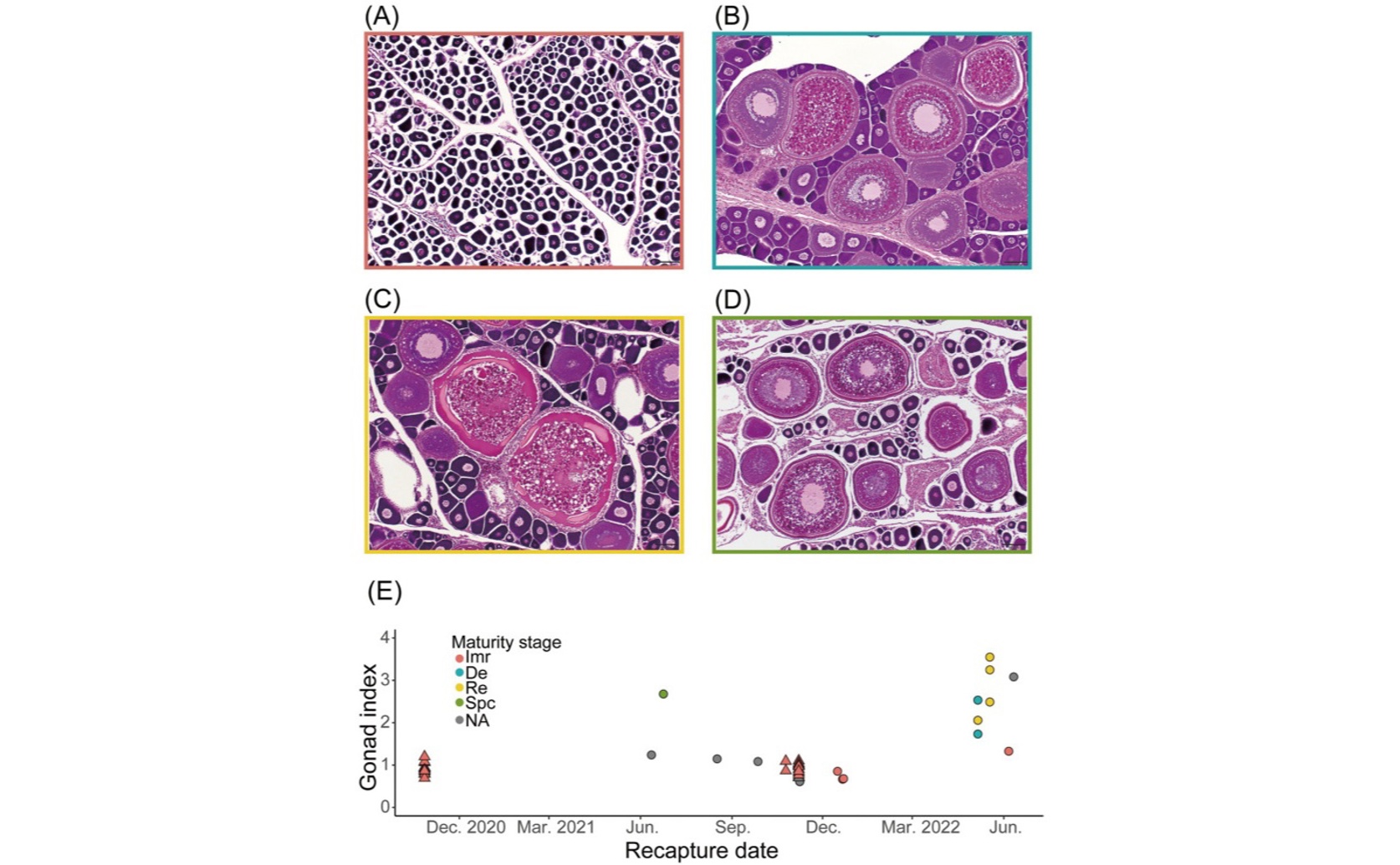
Gonadal index values and histological analysis (a–d, e) show that female Katsuwonus pelamis in the residence group remained reproductively immature for nearly nine months after release, supporting the conclusion that their southward movement was not initially for spawning.

Image adapted from: Ueda et al. / CC BY (Source)

Key Findings

  • This study off Japan revealed skipjack tuna exhibit two distinct migration patterns: one group heads to warmer waters likely for spawning, while another remains in cooler northern areas for feeding
  • Tuna in the spawning group reached unusually high body temperatures (up to 31°C) correlating with reproductive activity, suggesting a physiological link to spawning behavior
  • The group staying in northern waters moved south only when temperatures dropped, indicating thermal avoidance—seeking suitable temperatures—drives their migration, not necessarily reproduction
Skipjack tuna are a commercially important fish species found globally, and understanding their behaviour is crucial for effective fisheries management. A key aspect of this understanding is knowing where and when they spawn – reproduce – as this directly impacts population size and sustainability. Historically, skipjack tuna were thought to migrate south from cooler northern waters towards warmer tropical and subtropical regions primarily to spawn. However, the motivations behind these movements weren’t fully understood. Researchers at the Japan Fisheries Research and Education Agency[1] have recently investigated these southward movements using a combination of traditional plastic dart tags and more advanced archival tags, revealing a more complex picture than previously thought. The study focused on skipjack tuna in the northwestern Pacific Ocean, tracking their movements and physiological responses. Archival tags, implanted within the fish, record data like water temperature and, crucially, internal body temperature. This internal temperature data proved to be a key indicator of spawning activity. The research identified two distinct groups of skipjack tuna exhibiting different movement patterns. One group, termed the “spawning potential group”, demonstrated behaviours strongly linked to reproduction. These fish spent the majority of their time in waters warmer than 24°C – a temperature range known to be suitable for skipjack tuna spawning. Furthermore, individuals in this group experienced exceptionally high body temperatures, reaching up to 31°C, which correlated with known reproductive traits of the species. This strongly suggests these fish were actively engaged in spawning. The second group, labelled the “residence group”, behaved differently. These tuna remained in the northern habitat for extended periods – at least nine months – in waters generally too cold for spawning (below 24°C). Analysis of these fish showed they remained immature for over eight months after tagging, further supporting the conclusion that spawning wasn’t their primary motivation. Instead, this group appeared to be focused on feeding, taking advantage of the rich prey availability in the northern waters. However, as seasonal cooling occurred, and water temperatures approached the tuna’s thermal limit, they began a slow southward movement, seemingly to avoid the cold. This finding highlights a crucial distinction: not all southward movement is for spawning. The study demonstrates that thermal avoidance – seeking suitable water temperatures – can also drive migration. This aligns with earlier research on southern bluefin tuna, which showed individuals didn’t always return to the same foraging areas year after year, suggesting flexibility in response to environmental conditions[2]. The new study builds on this by identifying a specific physiological driver – thermal tolerance – for one of the movement patterns. Interestingly, the physiological data collected in this study provides a new level of insight. The extraordinarily high body temperatures recorded in the spawning potential group are particularly significant. This level of detail wasn’t available in earlier studies that relied on tracking movements alone. For example, previous work using archival tags on southern bluefin tuna analysed feeding patterns but found no clear link between feeding success and time spent in a particular area[3], highlighting the difficulty of interpreting habitat use without understanding the underlying physiological state of the fish. The current study overcomes this limitation by directly linking body temperature to reproductive activity. The findings also have implications for how we understand the spawning behaviour of other tuna species. Research on Atlantic bluefin tuna has revealed complex spawning migrations, with different sized individuals using different spawning grounds[4], and even challenging the assumption of complete spawning-site fidelity. The discovery of these two distinct movement groups in skipjack tuna adds to this growing body of evidence suggesting that tuna spawning strategies are more diverse and adaptable than previously thought. Finally, this research contributes to a broader understanding of how climate change may impact tuna populations. Studies have shown that tuna habitats are shifting poleward in response to warming waters[5], and understanding the thermal tolerances and movement patterns of different tuna species is essential for predicting how they will respond to these changes. The identification of the residence group’s sensitivity to cooling temperatures, and their subsequent southward movement, underscores the importance of considering thermal limits when assessing the vulnerability of tuna populations to climate change.

Animal ScienceOceanographyMarine Biology

References

Main Study

1) Thermal physiology and movements of skipjack tuna (Katsuwonus pelamis) from tag releases off the northern coast of Japan: Possible insights into spawning and wintering strategies

Published 2nd December, 2025

https://doi.org/10.1371/journal.pone.0336857


Related Studies

2) Migration dynamics of juvenile southern bluefin tuna.

https://doi.org/10.1038/s41598-018-32949-3


3) Feeding ecology of wild migratory tunas revealed by archival tag records of visceral warming.

https://doi.org/10.1111/j.1365-2656.2008.01437.x


4) Discovery of a spawning ground reveals diverse migration strategies in Atlantic bluefin tuna (Thunnus thynnus).

https://doi.org/10.1073/pnas.1525636113


5) Large-scale distribution of tuna species in a warming ocean.

https://doi.org/10.1111/gcb.14630


Related Articles

An unhandled error has occurred. Reload 🗙