New Sightings of Two Jellyfish Species in the Northwest Mediterranean Coast

Jim Crocker
12th July, 2024

New Sightings of Two Jellyfish Species in the Northwest Mediterranean Coast

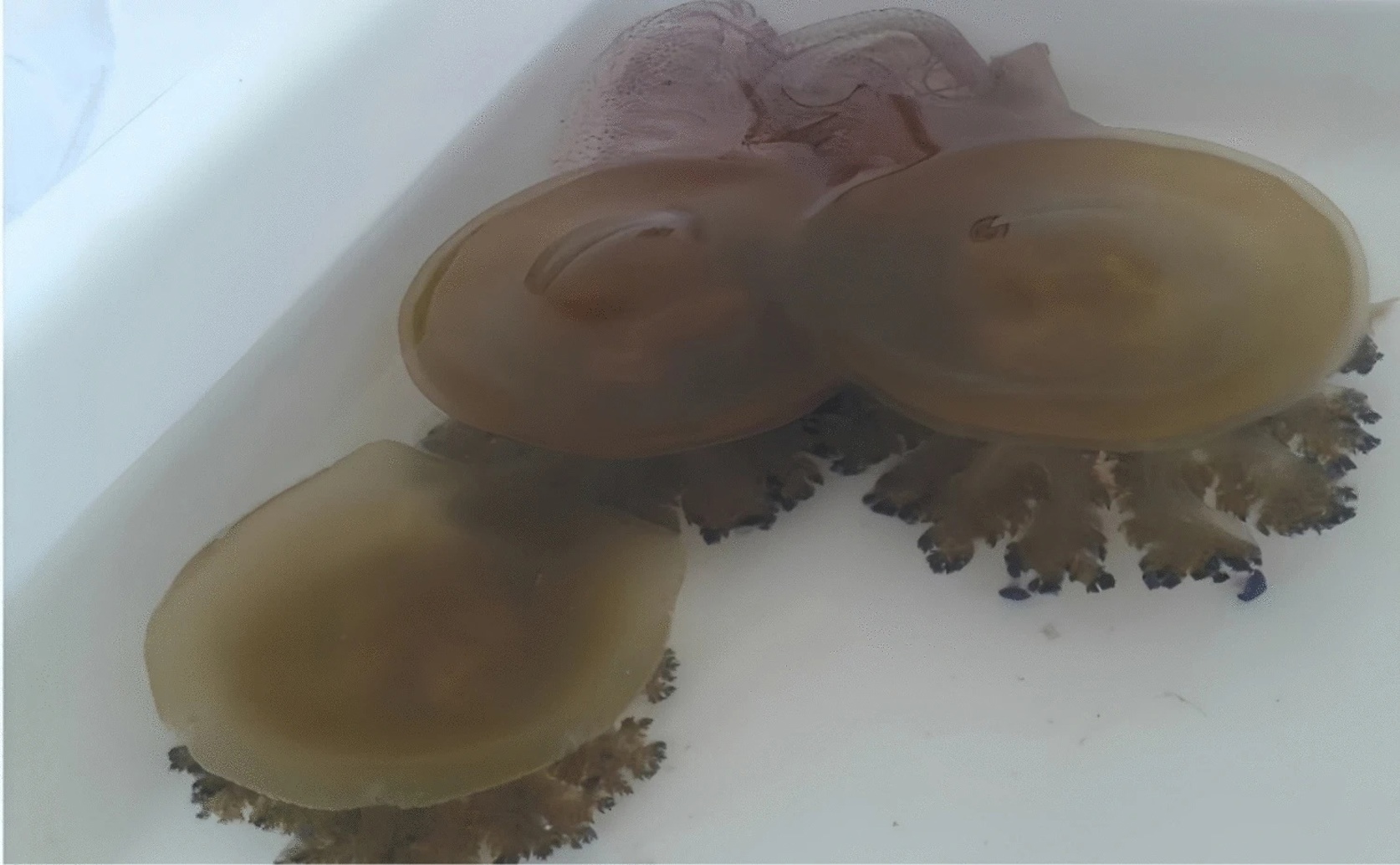
This photographed specimen of the fried egg jellyfish (Cotylorhiza tuberculata) from M’Diq and Cabonegro provides direct evidence for the first documented record of this species along the Moroccan northwest Mediterranean coast.

Image adapted from: Aouititen et al. / CC BY (Source)

Key Findings

  • Researchers from Beijing Forestry University documented two jellyfish species, Rhizostoma luteum and Cotylorhiza tuberculata, along the Moroccan Northwest Mediterranean coast for the first time
  • Rhizostoma luteum was observed in Fnideq in January 2014, while Cotylorhiza tuberculata was found between M'Diq and Cabonegro beach in August 2015
  • The presence of these jellyfish species, although rare, adds significant new information to the understanding of jellyfish distribution in the Mediterranean region
Jellyfish outbreaks along coastal regions have been increasingly reported worldwide, posing significant environmental and economic challenges. A recent study conducted by Beijing Forestry University has documented two jellyfish species along the Moroccan Northwest Mediterranean coast for the first time, providing new insights into jellyfish distribution in the Mediterranean[1]. During monitoring visits to the beaches of Fnideq, M'Diq, Cabo-Negro, and Martil, researchers observed Rhizostoma luteum at Fnideq in January 2014 and Cotylorhiza tuberculata between M'Diq and Cabonegro beach in August 2015. Although these species are less frequently encountered compared to Pelagia noctiluca, their presence marks a significant addition to the existing knowledge of jellyfish distribution in this region. Jellyfish blooms can have severe repercussions on tourism, as evidenced by a study that quantified tourism losses due to jellyfish outbreaks along the Catalan coast. Tourists were willing to spend an additional 23.8% of their travel time to avoid areas with high jellyfish risks, translating to an economic impact of approximately €422.57 million annually[2]. This highlights the importance of understanding and mitigating jellyfish blooms to protect coastal economies. The observed jellyfish species, Rhizostoma luteum, has a unique life cycle that was previously described in another study. This species undergoes a process of metagenesis, which includes stages from planula to young medusa. The study noted that R. luteum can form blooms under favorable environmental conditions, emphasizing the need for continuous monitoring and research to predict and manage such occurrences[3]. Additionally, research has shown that jellyfish can be affected by environmental pollutants such as nanoplastics. A study on the moon jellyfish Aurelia sp. revealed that exposure to negatively charged polystyrene nanoplastics impaired the pulsation mode of young ephyrae, indicating potential behavioral alterations due to pollution[4]. Understanding how pollutants affect jellyfish can help in developing strategies to mitigate their impact on marine ecosystems. The development of bioinspired robots, such as the Jelly-Z, offers innovative solutions for underwater monitoring and exploration without disturbing natural habitats. This jellyfish-inspired robot mimics the swimming motion of a moon jellyfish and can provide valuable data on jellyfish behavior and environmental conditions[5]. Such technology can enhance our ability to study and manage jellyfish populations effectively. In conclusion, the recent documentation of Rhizostoma luteum and Cotylorhiza tuberculata along the Moroccan Northwest Mediterranean coast by Beijing Forestry University adds valuable information to the understanding of jellyfish distribution in the Mediterranean. Integrating findings from previous studies on jellyfish impacts, life cycles, and environmental interactions can help develop comprehensive strategies to address the challenges posed by jellyfish blooms.

Animal ScienceOceanographyMarine Biology

References

Main Study

1) New records of two jellyfish species Rhizostoma luteum (Quoy and Gaimard 1827) and Cotylorhiza tuberculata (Macri 1778) in the Moroccan northwest Mediterranean coast

Published 11th July, 2024

https://doi.org/10.1007/s11084-024-09649-2


Related Studies

2) Analyzing Beach Recreationists' Preferences for the Reduction of Jellyfish Blooms: Economic Results from a Stated-Choice Experiment in Catalonia, Spain.

https://doi.org/10.1371/journal.pone.0126681


3) First description of the life cycle of the jellyfish Rhizostoma luteum (Scyphozoa: Rhizostomeae).

https://doi.org/10.1371/journal.pone.0202093


4) Nanoplastic uptake temporarily affects the pulsing behavior in ephyrae of the moon jellyfish Aurelia sp.

https://doi.org/10.1007/s10646-023-02669-0


5) Jelly-Z: swimming performance and analysis of twisted and coiled polymer (TCP) actuated jellyfish soft robot.

https://doi.org/10.1038/s41598-023-37611-1


Related Articles

An unhandled error has occurred. Reload 🗙