Strawberry genes control pigment and sugar production

Greg Howard
5th December, 2025

Strawberry genes control pigment and sugar production

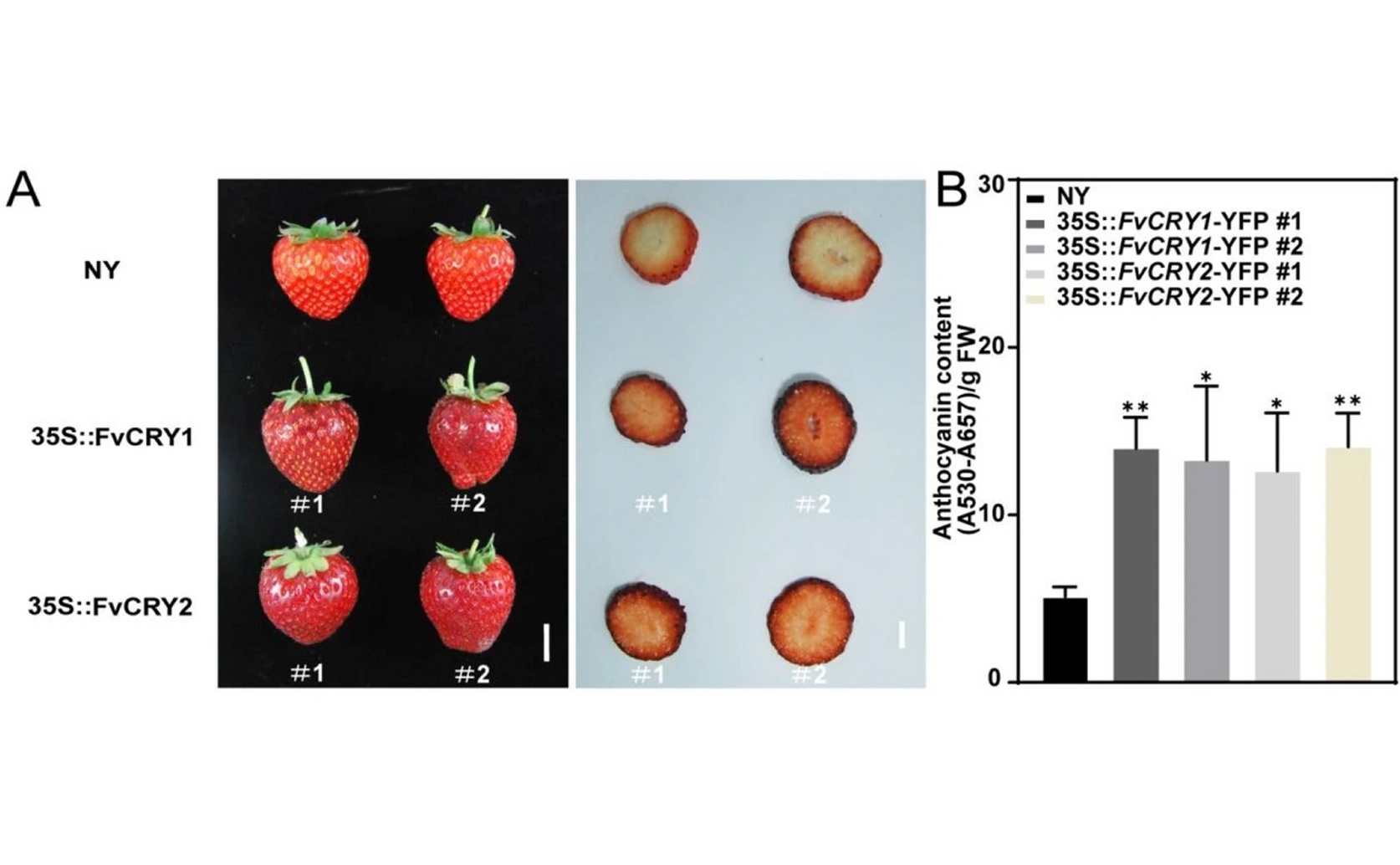
Study shows that overexpressing the blue light receptors FvCRY1 and FvCRY2 in cultivated strawberry (Fragaria × ananassa) promotes a deeper red fruit color by significantly increasing the accumulation of anthocyanin pigments (a, b).

Image adapted from: Zhang et al. / CC BY (Source)

Key Findings

  • This study, conducted on woodland strawberries, identified two proteins, FvCRY1 and FvCRY2, that act as blue light receptors
  • Increasing levels of FvCRY1 and FvCRY2 in cultivated strawberries led to significantly brighter red colour and sweeter fruit
  • These proteins directly bind to DNA in strawberry genes controlling colour and sugar production, activating them more effectively with blue light exposure
Strawberry quality, specifically the vibrant red colour and sweetness of the fruit, is heavily influenced by light exposure. While it’s known that light plays a crucial role, the precise molecular mechanisms controlling this process have remained unclear. Researchers at Shanghai Jiao Tong University have now identified key components in woodland strawberries that explain how light regulates both colour and sugar content[1]. The study focused on a class of proteins called cryptochromes, which are known to act as light receptors in plants. These proteins are sensitive to blue light, a part of the visible light spectrum. The researchers identified two cryptochromes in woodland strawberries, named FvCRY1 and FvCRY2, and confirmed they function as blue light receptors by testing their activity in Arabidopsis thaliana, a common model plant, where cryptochromes are already known to be important. To understand how these proteins affect strawberry quality, the team increased the levels of FvCRY1 and FvCRY2 in cultivated strawberries. This resulted in significantly higher levels of anthocyanins – the pigments responsible for the red colour – and increased soluble sugar content. This suggests that these cryptochromes directly contribute to improved fruit quality. Further investigation revealed a surprising mechanism. Unlike typical light signaling pathways, FvCRY1 and FvCRY2 don’t just trigger a cascade of events; they directly bind to specific regions of DNA within the strawberry’s genes. These regions, called E-box cis-elements, are found in the promoters of genes involved in both anthocyanin production (FvCHS2, FvDFR2, FvCHI) and sugar metabolism (FvSFP9, FvINV). A promoter is a region of DNA that controls when a gene is turned on or off. This direct binding activates these genes, leading to increased production of anthocyanins and sugars. Importantly, this DNA-binding ability is enhanced by blue light, meaning the proteins are more effective at activating genes when exposed to blue light. This finding challenges the conventional understanding of how light receptors work. Traditionally, it was thought that cryptochromes initiated signaling pathways that indirectly affected gene expression. This study demonstrates a “non-canonical” mechanism where the receptor protein directly interacts with DNA, acting as a transcriptional activator. The importance of sugar transport in plants is well established[2], and this study builds on that knowledge by showing how light, via FvCRY1 and FvCRY2, influences the genes controlling sugar metabolism. The study also connects to the broader understanding of how plants respond to environmental signals through epigenetic modifications[3]. While this study doesn’t directly address epigenetic changes, the regulation of gene expression by FvCRYs highlights the potential for light to influence these processes, ultimately affecting fruit quality. The researchers used several techniques to reach these conclusions. Yeast one-hybrid assays were used to confirm the DNA-binding ability of FvCRY1 and FvCRY2. Dual-luciferase assays measured the level of gene expression when FvCRYs were present. These assays, combined with the genetic manipulation of strawberry plants, provided strong evidence for the direct role of these cryptochromes in regulating anthocyanin and sugar metabolism.

FruitsBiochemPlant Science

References

Main Study

1) Strawberry cryptochrome FvCRY1 and FvCRY2 transcriptionally regulate anthocyanin biosynthesis and sugar metabolism

Published 2nd December, 2025

https://doi.org/10.1186/s43897-025-00197-5


Related Studies

2) Sugar transporters for intercellular exchange and nutrition of pathogens.

https://doi.org/10.1038/nature09606


3) Dynamic epigenetic modifications in plant sugar signal transduction.

https://doi.org/10.1016/j.tplants.2021.10.009


Related Articles

An unhandled error has occurred. Reload 🗙