Bird sperm shape linked to mating success in socially monogamous species

Greg Howard
1st December, 2025

Bird sperm shape linked to mating success in socially monogamous species

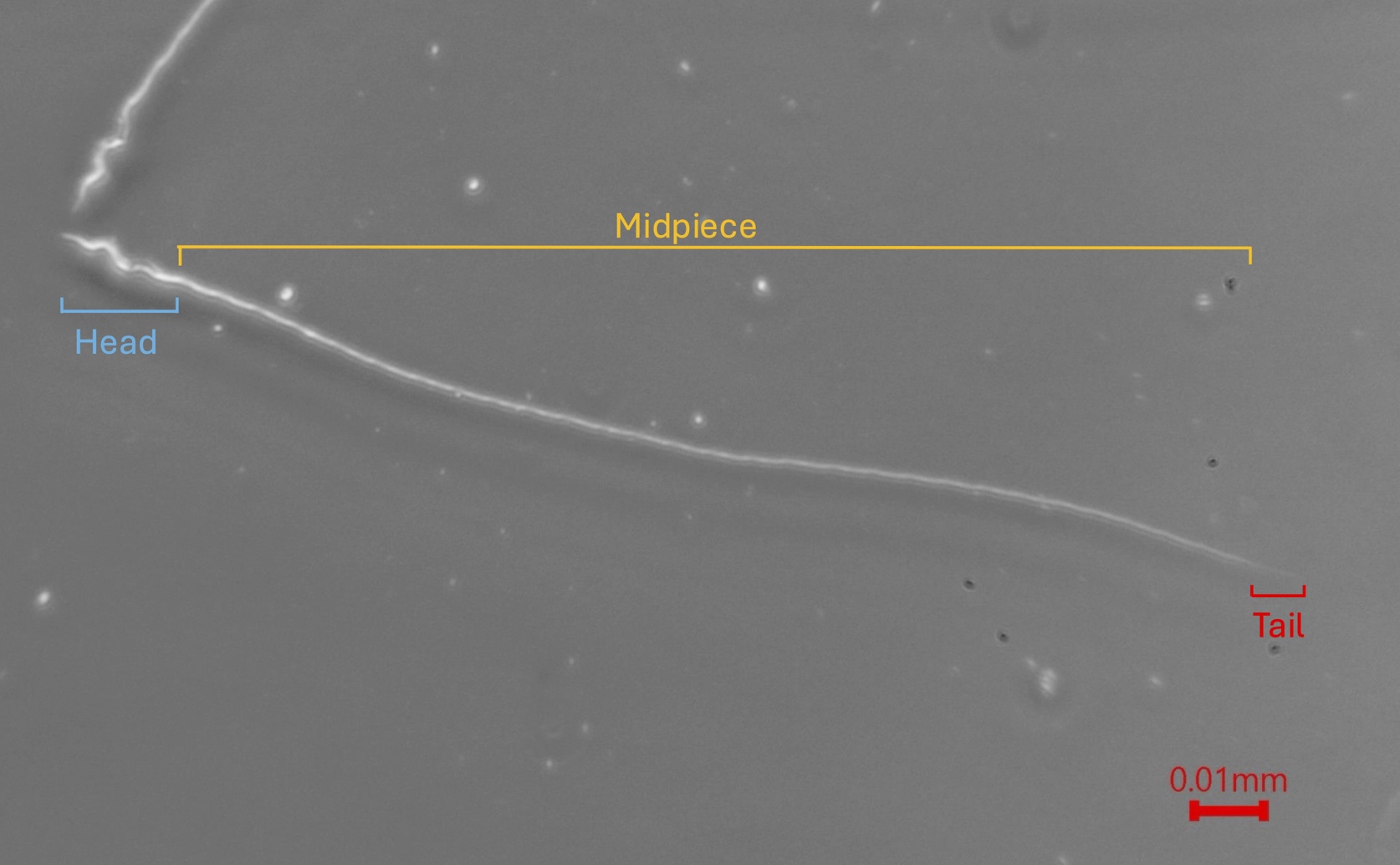
Mountain white-crowned sparrow sperm cell viewed at 40x using phase-contrast microscopy.

Image adapted from: Hawkins et al. / CC BY (Source)

Key Findings

  • This study, conducted on Mountain White-crowned Sparrows, investigated links between sperm characteristics and reproductive success
  • Males succeeding in extra-pair paternity had longer sperm flagella and total sperm length compared to those who did not
  • Males successfully defending paternity within their nests tended to have shorter sperm heads and a larger flagellum-to-head ratio
In many bird species, males and females form a pair bond and raise offspring together – a social monogamy. However, this doesn’t always mean exclusive mating. Extra-pair paternity (EPP), where a male fathers offspring with a female who is paired with another male, is surprisingly common in birds[2]. Understanding how males compete for reproductive success, both within their pair bond and outside of it, is a key area of research in evolutionary biology. The success of a male isn’t simply about how many eggs are laid in his nest, but also about ensuring those eggs contain his offspring, and potentially fathering young elsewhere. Researchers from the University of California Davis, the University of California Merced, and the University of Massachusetts[1] investigated whether specific characteristics of sperm cells could predict a male’s success in achieving reproductive success through these different tactics. The study focused on Mountain White-crowned Sparrows, a species known to exhibit both paternity defense within a pair bond and extra-pair mating behavior. The core idea is that sperm aren’t all created equal. Variations in sperm morphology – their physical characteristics like head length and tail (flagellum) length – could influence their ability to fertilize eggs. Previous work has shown that sperm velocity, a key factor in sperm competition, is linked to these morphological traits[3]. Specifically, longer flagella or a particular ratio between flagellum length and head size were predicted to increase sperm speed. This research builds on a broader understanding of sperm competition, where the sperm of multiple males compete to fertilize a female’s eggs, and postcopulatory sexual selection, where traits that affect fertilization success evolve[4]. The researchers measured several sperm characteristics in Mountain White-crowned Sparrows, including the length of the sperm head, the length of the flagellum (the tail-like structure that propels the sperm), the total length of the sperm cell, and the ratio between flagellum and head length. They then correlated these measurements with two key measures of reproductive success: whether a male successfully defended paternity within his own nest, and whether he successfully sired offspring with females outside of his pair bond. The study revealed a fascinating pattern. There was no overall correlation between sperm morphology and a male’s total reproductive success – meaning that simply having ‘better’ sperm (according to the measured traits) didn’t guarantee more offspring. However, different sperm characteristics appeared to be linked to success in different reproductive strategies. Males who successfully fathered offspring outside of their pair bond had longer flagella and longer total sperm length compared to those who did not. Conversely, males who successfully defended their paternity within their nest tended to have shorter sperm heads and a larger ratio of flagellum length to head length. This suggests that sperm morphology may be subject to selection pressures favoring different traits depending on the context of mating. Longer sperm, with their longer flagella, might be better suited for competing with the sperm of other males in an extra-pair mating scenario, potentially due to increased velocity[3]. Shorter sperm heads and a larger flagellum-to-head ratio might be advantageous in the context of paternity defense, perhaps by allowing for more efficient sperm transport or increased fertilization success with the male’s own mate. Interestingly, earlier research[5] found a weak positive correlation between behaviors males use to guard their mates or frequently copulate with them and their actual share of paternity. This study adds another layer to this understanding, suggesting that sperm characteristics might be another tool males use to influence their reproductive success. The finding that ‘higher quality’ males (those considered more attractive to females) exhibited less paternity protection behavior[5] also aligns with the current study’s findings, as these males might rely more on sperm competition to achieve reproductive success. It’s important to note that the researchers caution that these findings are preliminary, due to the exploratory nature of the study and the relatively small sample size. Further research is needed to confirm these patterns and to understand the underlying mechanisms driving these associations. However, this study provides valuable insights into the complex interplay between sperm morphology, mating strategies, and reproductive success in birds.

GeneticsAnimal ScienceEvolution

References

Main Study

1) Post-copulatory competition in a social monogamy system: Sperm morphology correlates with components of reproductive success

Published 1st December, 2025

https://doi.org/10.1371/journal.pone.0337846


Related Studies

2) Extra-pair paternity in birds.

https://doi.org/10.1111/mec.15259


3) Sperm morphology and sperm velocity in passerine birds.

https://doi.org/10.1098/rspb.2008.1645


4) Sperm in competition: not playing by the numbers.

Journal: Trends in ecology & evolution, Issue: Vol 20, Issue 1, Jan 2005


5) Mate guarding and frequent copulation in birds: A meta-analysis of their relationship to paternity and male phenotype.

https://doi.org/10.1111/evo.13081


Related Articles

An unhandled error has occurred. Reload 🗙