50 Years of Research Reveals How Kissing Bugs Stay Separate Species

Jim Crocker
2nd November, 2025

50 Years of Research Reveals How Kissing Bugs Stay Separate Species

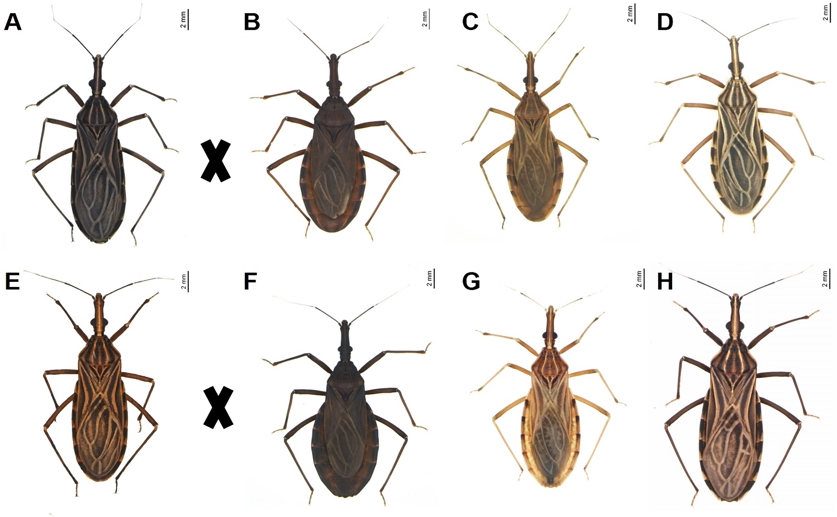
Species used in experimental crosses.A.R. prolixus ♀; B.R. neivai ♂; C.R. nasutus ♂; D.R. robustus ♂; E.R. prolixus ♂; F.R. neivai ♀; G.R. nasutus ♀; H.R. robustus ♀.

Image adapted from: Alevi et al. / CC BY (Source)

Key Findings

  • This study, conducted in Brazil, investigated how different Rhodnius bugs - important for spreading Chagas disease - relate to each other
  • While interbreeding is possible between R. prolixus and other Rhodnius species, resulting hybrids often have reduced survival or cannot reproduce, suggesting they are distinct species
  • Gene flow likely occurs between R. prolixus and R. neivai or R. robustus due to successful hybridization, potentially impacting Chagas disease transmission
Chagas disease, a parasitic illness prevalent in the Americas, is transmitted to humans primarily by triatomine bugs, often called “kissing bugs”[2]. These insects harbor a complex relationship with bacterial symbionts that provide essential nutrients missing from their blood-only diet, and recent research has even explored manipulating these symbionts to make the bugs resistant to carrying the parasite that causes Chagas disease[3]. However, accurately understanding the spread and control of Chagas disease is hampered by difficulties in identifying the specific types of triatomine bugs involved, and how they relate to each other. Researchers from the University of Sao Paulo (USP), Oswaldo Cruz Institute (IOC), and São Paulo State University (UNESP)[1] have investigated the relationships between different species within the Rhodnius genus, a group of triatomine bugs particularly important in transmitting Chagas disease. Rhodnius prolixus is a key domestic vector – meaning it frequently lives near and feeds on humans – and has historically presented challenges in accurate identification, with discrepancies between traditional methods based on physical characteristics and more modern genetic analyses. Previous work[4] has highlighted the need for a more robust understanding of the evolutionary relationships within the Rhodnius and related genera, even suggesting reclassification of some species. The study focused on whether different Rhodnius species could successfully breed with each other. This is a crucial indicator of how closely related they are; species that can easily interbreed are considered more similar than those with reproductive barriers. The researchers performed controlled breeding experiments between R. prolixus and three other closely related species: R. nasutus, R. neivai, and R. robustus. They found that, with one exception (R. prolixus females bred with R. neivai males), all crosses produced hybrid offspring – meaning viable offspring with mixed ancestry. However, these hybrids often faced problems. Except for crosses between R. prolixus females and R. robustus males, the resulting generations showed issues like reduced viability (meaning fewer survived), sterility (inability to reproduce), or “hybrid collapse” – where subsequent generations failed to develop. These barriers suggest that while interbreeding is possible, it’s not always successful, and the resulting hybrids are often not fully fit. This supports the idea that R. nasutus, R. neivai, and R. robustus are distinct species, reproductively isolated from R. prolixus to a significant degree. The findings also shed light on the possibility of genetic exchange, or “introgression,” between these species. Introgression occurs when genes from one species are incorporated into the gene pool of another through repeated hybridization. The researchers suggest that introgression is unlikely between R. prolixus and R. nasutus due to the strong reproductive barriers observed. However, R. neivai and R. robustus appear capable of exchanging genetic material with R. prolixus under natural conditions. This is significant because gene flow between species can influence their evolution and potentially affect their ability to transmit Chagas disease. Furthermore, the study reviewed existing literature on crosses involving other Rhodnius species, confirming that R. pictipes and R. neglectus are also reproductively isolated from R. prolixus. The researchers also noted reproductive barriers even between different populations of R. prolixus itself, suggesting that this species may be more complex than previously thought. To fully resolve these complexities, the researchers emphasize the need for a comprehensive genetic study – a “phylogenomic study” – that analyzes the entire genetic makeup of R. prolixus populations collected across its entire geographical range. This would help clarify the evolutionary history and taxonomic relationships within the species, and potentially refine our understanding of Chagas disease transmission dynamics.

GeneticsAnimal ScienceEvolution

References

Main Study

1) More than half a century of evolutionary studies in Rhodnius prolixus Stål, 1859 (Hemiptera, Triatominae): revisiting and discussing old and new data on intra- and interspecific reproductive barriers

Published 31st October, 2025

https://doi.org/10.1371/journal.pone.0335238


Related Studies

2) The epidemiology of Chagas disease in the Americas.

https://doi.org/10.1016/j.lana.2024.100881


3) Bacterial symbiosis and paratransgenic control of vector-borne Chagas disease.

Journal: International journal for parasitology, Issue: Vol 31, Issue 5-6, May 2001


4) Molecular phylogeny of Triatomini (Hemiptera: Reduviidae: Triatominae).

https://doi.org/10.1186/1756-3305-7-149


Related Articles

An unhandled error has occurred. Reload 🗙