How mosquito smell receptors develop and control their sensitivity to odors

Jim Crocker
28th November, 2025

How mosquito smell receptors develop and control their sensitivity to odors

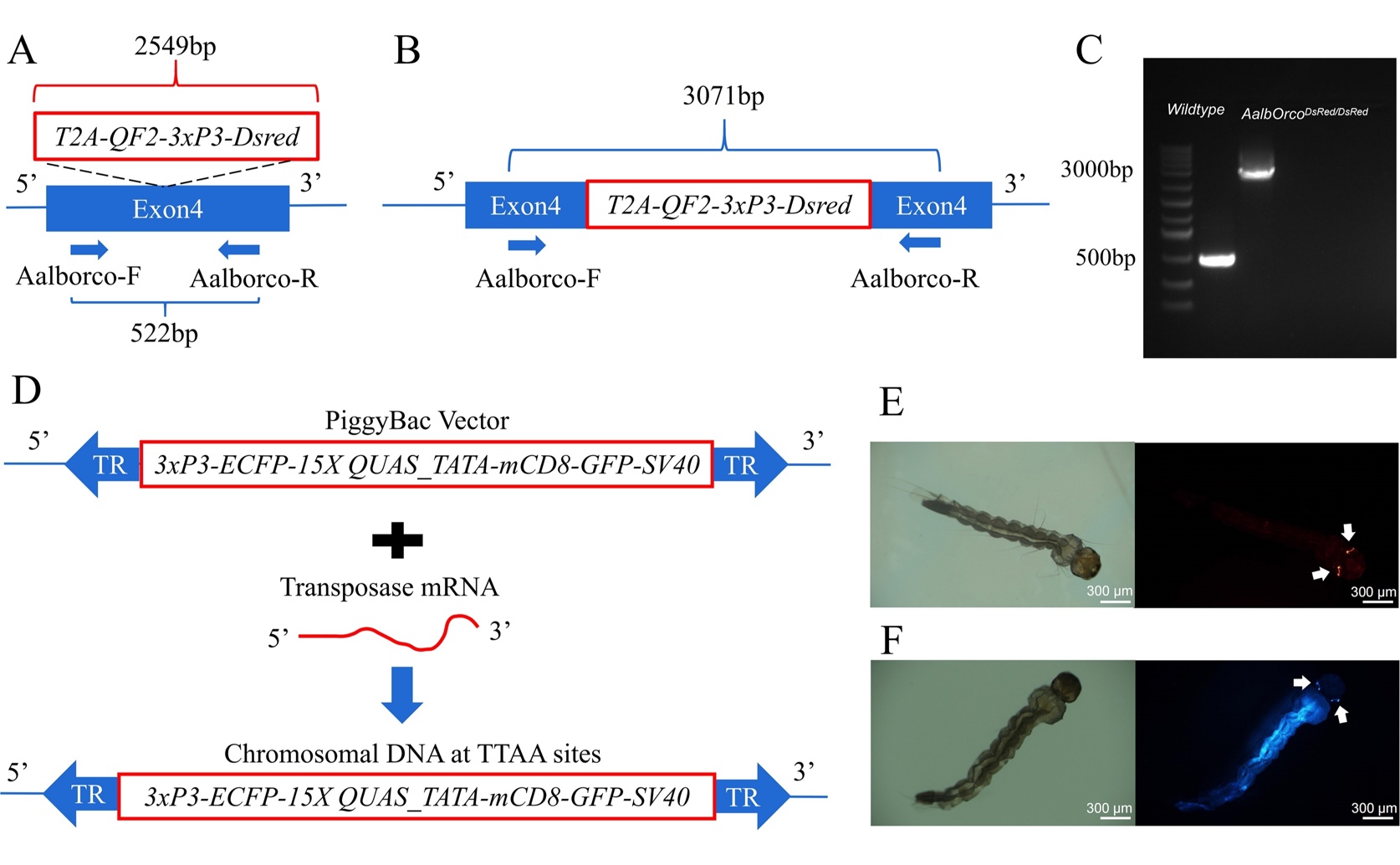
Genetic engineering successfully created stable transgenic Aedes albopictus driver (AalbOrco-QF2) and effector (QUAS-mCD8:GFP) lines, confirmed by genomic analysis and fluorescent eye markers (a–f), which together form a Q system to visualize Orco-expressing neurons.

Image adapted from: Yao et al. / CC BY (Source)

Key Findings

  • Researchers found that the Asian tiger mosquito begins developing its sense of smell very early, even within the egg, with increasing numbers of olfactory neurons as it grows
  • Disrupting the Orco protein in mosquitoes significantly reduced their ability to detect human scents and successfully find hosts for blood meals, impacting disease transmission
  • The study revealed Orco isn’t just needed for smell receptors to work, but also plays a role in ensuring these receptors are produced and remain stable within the mosquito
Mosquitoes are responsible for transmitting diseases like dengue fever, Zika virus, and malaria, posing a significant global health threat. The Asian tiger mosquito, Aedes albopictus, is a particularly effective vector – an organism that transmits a disease – due to its ability to thrive in diverse environments and its aggressive feeding habits. Understanding how these mosquitoes find hosts and suitable breeding grounds is crucial for developing better control strategies. A recent study conducted by researchers at Shenzhen Bay Laboratory, Sun Yat-sen University, Zunyi Medical University, Guizhou Normal University, Guangdong Provincial Key Laboratory, and Kenya Agricultural and Livestock Research Organization (KALRO)[1] has shed light on a key protein involved in the mosquito’s sense of smell, and how disrupting it impacts their ability to find us. The study focuses on a protein called Orco, which is essential for the function of olfactory receptors (ORs). Olfactory receptors are proteins that detect odors in the environment. Insects, including mosquitoes, rely heavily on their sense of smell for various tasks, including finding food, locating mates, and identifying places to lay eggs. While it was already known that Orco was necessary for these receptors to work, the details of how it functions, where it’s located within the mosquito’s nervous system, and how its activity changes throughout the mosquito’s life were largely unknown. Researchers systematically examined which neurons – the cells that transmit information in the nervous system – express Orco during different stages of the mosquito’s development: embryonic, larval, and adult. They found that Orco-expressing neurons are present very early in development, even in the egg, and increase in number as the mosquito grows. In adult mosquitoes, these neurons were located in the antennae (the sensory organs on the head), as well as in structures on the mouthparts called the labella and maxillary palps, in both males and females. This distribution aligns with what’s been observed in other mosquito species, suggesting a conserved role for Orco across different types. To understand Orco’s function more directly, the researchers created mutant mosquitoes that lacked a functional Orco gene – known as a “knockout” mutant. Surprisingly, they discovered that these mutants didn’t just have a problem with their olfactory receptors; they had significantly fewer olfactory receptors overall. This suggests that Orco isn’t just involved in making the receptors work, but also in ensuring they are produced and remain stable within the mosquito’s olfactory system. Further experiments using electrophysiological recordings – which measure the electrical activity of neurons in response to stimuli – confirmed that the Orco mutants had a greatly reduced ability to detect human-related odors. This was then tested behaviourally, and the results showed that female Orco mutant mosquitoes were much less efficient at finding and feeding on blood, and showed a decreased preference for human scents. This is significant because female mosquitoes require blood meals to produce eggs, making blood-feeding a critical behaviour for their reproduction and the spread of diseases. These findings build upon earlier work that established Aedes albopictus as an increasingly important vector for diseases like dengue[2][3]. While Aedes aegypti was previously considered the primary dengue vector, research has shown that Aedes albopictus is spreading rapidly and is capable of transmitting the virus, particularly in areas where Aedes aegypti is less common[3][4]. The study highlights a potential target for controlling these mosquitoes by disrupting their ability to find hosts. The research also connects to our understanding of how sensory systems develop. A separate study on fruit flies (Drosophila) investigated the genetic changes that occur in sensory neurons during development[5], providing a framework for understanding how genes regulate the wiring and function of olfactory systems. The current study demonstrates a similar dynamic organization of olfactory neurons in mosquitoes, revealing stage-specific genes that could regulate their sensory responses. By identifying Orco as a critical component of the mosquito’s olfactory system, and demonstrating its impact on host-seeking behaviour, this research opens up new avenues for developing innovative vector control strategies. Targeting Orco, or the processes it regulates, could potentially disrupt the mosquito’s ability to find and feed on humans, reducing the transmission of mosquito-borne diseases.

GeneticsBiochemAnimal Science

References

Main Study

1) Unveiling the developmental dynamics and functional role of Odorant Receptor Co-receptor (Orco) in Aedes albopictus: A novel mechanism for regulating odorant receptor expression

Published 26th November, 2025

https://doi.org/10.1371/journal.pntd.0013753


Related Studies

2) The global distribution and burden of dengue.

https://doi.org/10.1038/nature12060


3) Critical review of the vector status of Aedes albopictus.

Journal: Medical and veterinary entomology, Issue: Vol 18, Issue 3, Sep 2004


4) Niche and Range Shifts of Aedes aegypti and Ae. albopictus Suggest That the Latecomer Shows a Greater Invasiveness.

https://doi.org/10.3390/insects14100810


5) Single-cell transcriptomes of developing and adult olfactory receptor neurons in Drosophila.

https://doi.org/10.7554/eLife.63856


Related Articles

An unhandled error has occurred. Reload 🗙