Tomato Plants: An Energy Switch for Light Adaptation

Jenn Hoskins
9th August, 2025

Tomato Plants: An Energy Switch for Light Adaptation

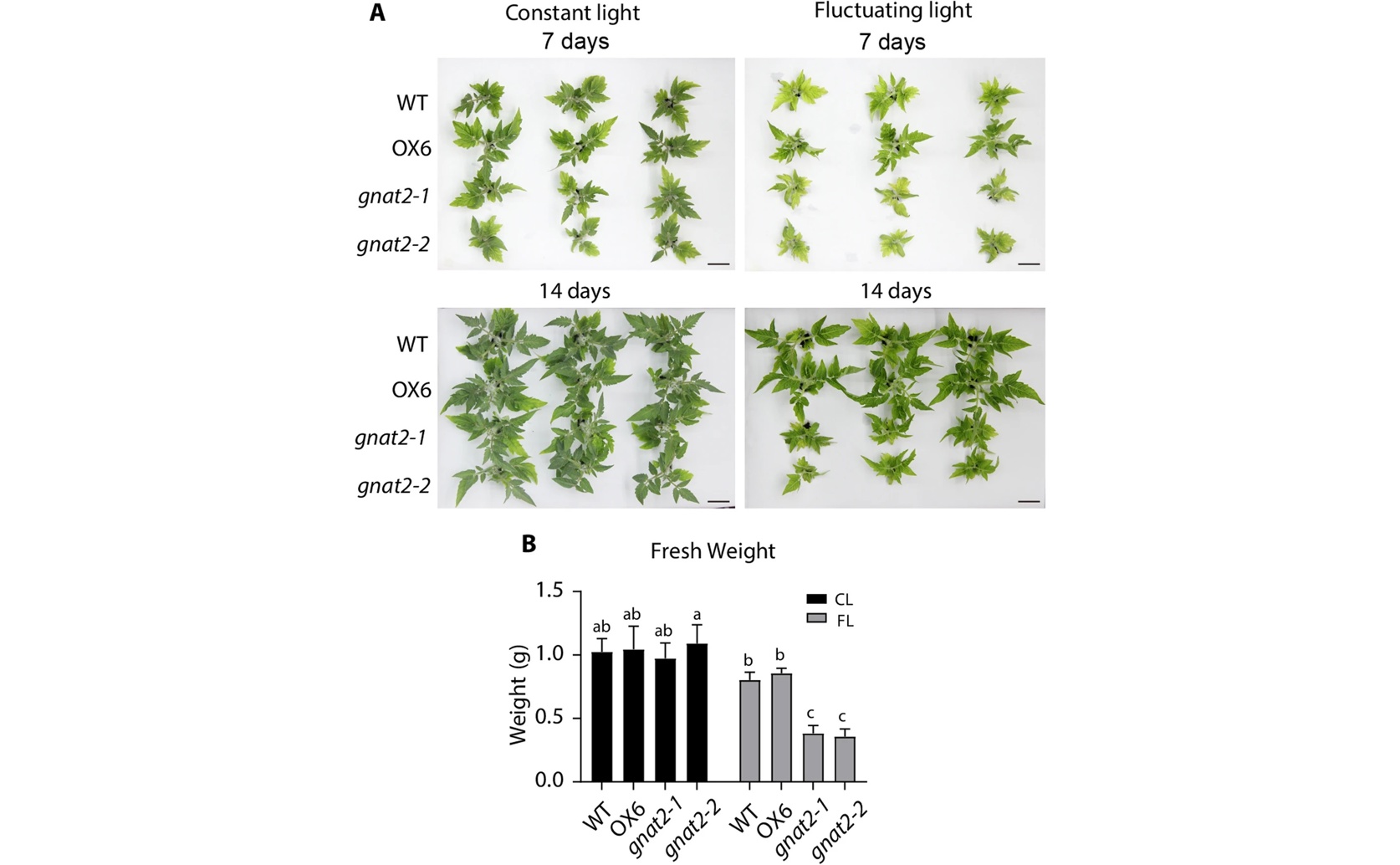
Tomato (Solanum lycopersicum) mutants lacking GNAT2 displayed significantly impaired growth (A) and reduced fresh weight (B) under fluctuating light compared to wild-type and overexpression lines, confirming that GNAT2 is essential for maintaining plant growth through the regulation of state transitions in changing light environments.

Image adapted from: Wang et al. / CC BY (Source)

Key Findings

  • Researchers at China Agricultural University discovered that a protein called SlGNAT2 is essential for tomato plants to adjust to changing light conditions and grow well
  • SlGNAT2 helps plants balance light energy by adding a chemical tag, called an acetyl group, to a key light-harvesting protein (SlLhcb2)
  • The plant's internal energy balance (redox state) controls SlGNAT2's activity, ensuring proper light energy distribution and protecting the plant
Plants, like all organisms that perform photosynthesis, depend on sunlight for their energy. However, the light conditions in their natural environments are rarely constant. They experience rapid shifts from bright sun to deep shade, or dramatic changes between day and night. These abrupt fluctuations can be damaging to the plant's internal machinery that captures light, particularly to Photosystem I (PSI), a vital protein complex involved in converting light energy into chemical energy[2]. To survive and thrive under such dynamic conditions, plants have evolved sophisticated protective strategies. One key adaptation is a process called "state transition." This allows plants to dynamically adjust how they collect and distribute light energy between their two main light-gathering systems, Photosystem II (PSII) and Photosystem I (PSI). PSII is primarily responsible for absorbing light and splitting water molecules, while PSI takes that energy for further steps in electron transport. Balancing the amount of light energy received by these two systems is crucial for maintaining efficient photosynthesis and preventing damage. A central component in state transitions is the Light-Harvesting Complex II (LHCII), which acts like an antenna, collecting light energy. State transitions involve the reversible movement of LHCII between PSII and PSI[3]. When PSII receives an excess of light energy compared to PSI, a signal is generated within the plant cell. This signal activates a specific type of enzyme called a kinase. In higher plants like Arabidopsis, this kinase is known as STN7, and it adds a phosphate group to LHCII proteins – a process called phosphorylation[3]. This phosphorylation causes LHCII to detach from PSII and relocate to PSI, effectively rebalancing the distribution of light energy. Conversely, when PSI is overstimulated, the process reverses, and LHCII moves back to PSII[3]. The activity of the STN7 kinase itself is known to be carefully regulated by the plant's internal "redox state," which reflects the balance of electrons within a component called the plastoquinone pool, and also by a system involving ferredoxin-thioredoxin proteins[4]. Indeed, studies have shown that if STN7 is deactivated, for example, by the overexpression of a protein called Trx m, LHCII phosphorylation is lost, and the plant's ability to perform state transitions is severely hampered, leading to impaired growth under fluctuating light conditions[3][4]. While phosphorylation is a well-established mechanism, the precise molecular details of all the processes governing state transitions, and how they contribute to overall plant protection, have not been fully understood. Recent research from China Agricultural University has shed new light on this complex process, identifying an additional layer of control over state transitions, involving a different type of chemical modification: acetylation[1]. In their study, researchers focused on an enzyme called SlGNAT2, a chloroplast acetyltransferase found in Solanum lycopersicum, commonly known as the tomato plant. Acetyltransferases are enzymes that add a small chemical tag called an acetyl group to other proteins, a process known as acetylation. The study found that tomato plants engineered to lack the SlGNAT2 enzyme were significantly deficient in their ability to perform state transitions. These mutant plants also exhibited stunted growth when exposed to fluctuating light conditions, much like the issues observed in plants with impaired STN7 phosphorylation pathways[3]. This strong correlation suggested that SlGNAT2 plays a critical role in the plant's adaptive response to dynamic light. Through detailed experiments, including enzyme activity tests and precise light measurement techniques, the researchers pinpointed a specific target for SlGNAT2: a particular lysine amino acid (6Lys) located on a protein called SlLhcb2. SlLhcb2 is a component of the larger LHCII complex, the very same complex whose movement is central to state transitions. This finding suggests that the acetylation of SlLhcb2 by SlGNAT2 is directly involved in mediating these crucial light-balancing adjustments. Crucially, the study also uncovered a fascinating regulatory link: the activity of SlGNAT2 itself is influenced by the chloroplast's internal redox state. Specifically, changes in the redox state around a particular cysteine amino acid (131Cys) within the SlGNAT2 enzyme directly affect its ability to acetylate SlLhcb2. This redox-dependent regulation, in turn, impacts the proper assembly of the PSI-LHCI-LHCII supercomplex – the larger structure that forms when LHCII associates with PSI during state transitions. Therefore, the researchers propose that the chloroplast's redox state acts as a sensor, regulating the activity of SlGNAT2. This regulation then dictates the acetylation of SlLhcb2, ultimately controlling the dynamic process of state transitions in higher plants. This mechanism provides a new piece of the puzzle, showing that plants utilize not just phosphorylation, but also acetylation, to fine-tune their response to light fluctuations. This new discovery expands our understanding of how plants protect themselves from light-induced damage[2]. While the STN7 kinase system relies on phosphorylation to regulate LHCII movement[3][4], the SlGNAT2 acetyltransferase system offers an additional, distinct, yet similarly redox-sensitive, mechanism to achieve the same goal: optimizing light energy distribution. The fact that both phosphorylation (via STN7) and acetylation (via SlGNAT2) are regulated by the internal redox state of the chloroplast highlights a common, fundamental strategy plants employ to sense and respond to their environment. By identifying SlGNAT2 and its role in this acetylation pathway, the China Agricultural University team has shed new light on the intricate and multi-layered regulatory networks that allow plants to thrive under the unpredictable light conditions of our planet.

BiochemPlant Science

References

Main Study

1) Chloroplast acetyltransferase GNAT2 acts as a redox-regulated switch for state transitions in tomato

Published 6th August, 2025

https://doi.org/10.1186/s43897-025-00164-0


Related Studies

2) Photoprotection of photosystems in fluctuating light intensities.

https://doi.org/10.1093/jxb/eru463


3) State transitions and light adaptation require chloroplast thylakoid protein kinase STN7.

Journal: Nature, Issue: Vol 433, Issue 7028, Feb 2005


4) Overexpression of thioredoxin m in tobacco chloroplasts inhibits the protein kinase STN7 and alters photosynthetic performance.

https://doi.org/10.1093/jxb/ery415


Related Articles

An unhandled error has occurred. Reload 🗙