Slime Breakdown Shapes Microbe Variety

Jim Crocker
30th July, 2025

Slime Breakdown Shapes Microbe Variety

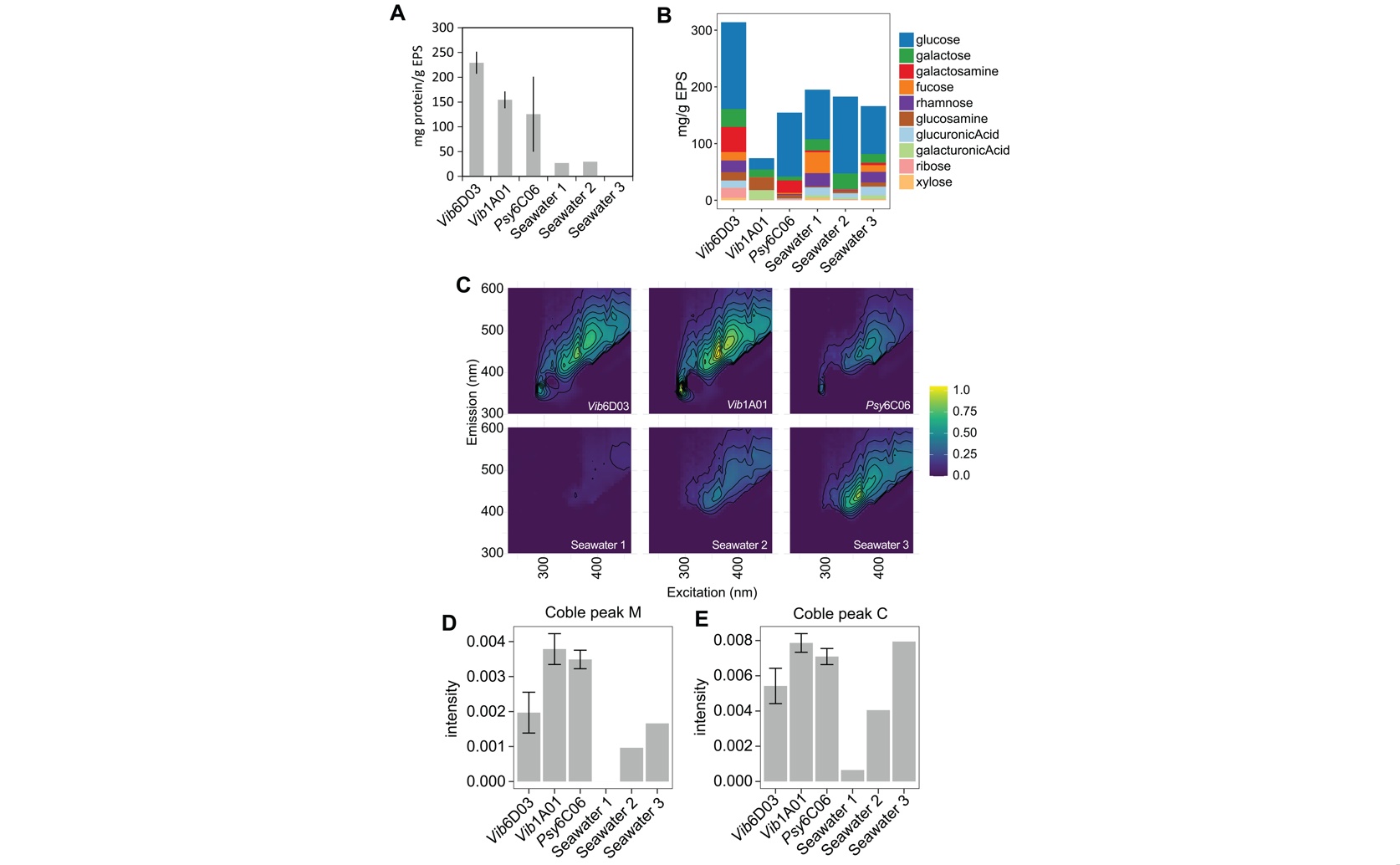
Demonstrating the chemical heterogeneity that drives distinct microbial community selection, the analysis revealed that extracellular polymeric substances from different sources vary significantly in protein (a) and polysaccharide (b) content, while exhibiting distinct fluorescent signatures indicative of humic-like substances (c–d).

Image adapted from: Pontrelli et al. / CC BY (Source)

Key Findings

  • In marine environments, a complex substance called EPS accounts for about 25% of the carbon released by chitin-degrading microbes, a significant food source
  • This EPS is not universally usable; its breakdown occurs in steps, with specialized microbes initially processing it into simpler forms for others
  • This sequential degradation creates diverse food opportunities over time, helping maintain the rich variety of microbial communities
Microbial communities, vast and intricate collections of microscopic life, thrive in nearly every corner of our planet, from the depths of the ocean to the soil beneath our feet, and even within the bodies of animals. These communities are remarkably diverse, often containing numerous species, including many that are closely related. A fundamental question in microbiology is how these diverse species, particularly those that might compete for the same resources, manage to coexist stably without one outcompeting all others. One crucial mechanism enabling this coexistence is known as "cross-feeding," where one microbe consumes a substance and then releases byproducts or waste that another microbe can use as food. Historically, the focus of cross-feeding research has largely been on simple, small molecules exchanged between microbes. However, a significant component of microbial environments, a complex substance called Extracellular Polymeric Substance (EPS), has remained largely overlooked in this context. Recent research conducted by scientists from ETH Zürich, KU Leuven, VIB-KU Leuven, University of Southern California, and Fred Hutchinson Cancer Research Center has shed new light on the role of EPS in shaping microbial communities[1]. EPS is a complex mixture primarily composed of proteins, polysaccharides (complex sugars), DNA, and other organic compounds. It forms a sticky, gel-like matrix that often surrounds microbial cells. The challenge in studying EPS has been the difficulty in accurately measuring its secretion and degradation compared to simpler metabolites. Using chitin-degrading microbes as a model system – chitin being a complex sugar found in insect exoskeletons and fungal cell walls – the researchers developed a specialized bicarbonate-buffered bioreactor. This advanced setup, combined with elemental analysis, allowed them to precisely quantify both EPS and small metabolite secretion. Their findings were significant: approximately 25% of the carbon released by the chitin-degrading microbes was in the form of EPS. This proportion remained consistent across various marine chitin-degrading isolates and natural seawater communities, underscoring the substantial contribution of EPS to the overall carbon flow in these environments, comparable to or even exceeding that of small metabolites. The study revealed that different types of EPS could select for distinct and diverse microbial communities. To understand how this happens, the team combined in vitro enzyme assays – experiments conducted in a test tube – with untargeted metabolomics, a technique used to identify and quantify a wide range of small molecules within a sample. This detailed analysis showed that EPS undergoes a sequential degradation process. Initially, large, complex molecules known as oligomers are broken down. These are then further degraded into smaller, simpler molecules called monomers, which are more broadly accessible to a wider range of microbes. This sequential breakdown of EPS creates a dynamic environment with a temporal succession of "metabolic niches." A metabolic niche refers to the specific set of resources and conditions that a particular microbe is best suited to utilize. In the context of EPS degradation, the initial, complex oligomers provide a niche for specialized species that possess the specific enzymes needed to break down these large molecules. As these specialists work, they transform the complex EPS into simpler monomers, which then become available for a more diverse community of "generalist" species that can utilize these simpler sugars. This shift from specialists to generalists, driven by the changing availability of resources, is a key factor in maintaining microbial diversity. These findings build upon and provide a concrete mechanism for concepts explored in earlier studies. For instance, previous research on soil ecosystems highlighted that soils are incredibly diverse, and this diversity is linked to the availability of complex substrate mixtures, rather than simple ones[2]. That study suggested that microbes exhibit "substrate specialization," meaning they utilize unique subsets of the complex pool of available metabolites. The current study provides a clear example of how such specialization and subsequent generalist utilization can unfold over time with a complex substrate like EPS. Similarly, in the honey bee gut, closely related Lactobacillus species were found to coexist stably when fed complex pollen, but not simple sugars[3]. This coexistence was attributed to resource partitioning, where each species utilized different pollen-derived carbohydrates. The new research on EPS provides a parallel mechanism for how complex resources facilitate such partitioning, showing how a single complex substance can generate a cascade of different food sources over time. Furthermore, the idea that resource allocation profoundly impacts microbiome structure, including those associated with living hosts, has been established[4]. That work emphasized the role of carbon utilization, niche partitioning, and cross-feeding in shaping communities. The current study expands on this by identifying EPS as a major, previously underappreciated, and highly dynamic contributor to these cross-feeding networks, effectively revealing a "hidden layer of complexity" in how microbial communities assemble and function across various ecosystems. The sequential degradation of EPS also echoes observations in natural communities like kefir, where stable coexistence is achieved through "spatiotemporal orchestration" – meaning processes unfolding differently across space and time – and where "early members open the niche for the followers" by making metabolites available[5]. The EPS study provides a clear molecular and temporal basis for this type of niche creation and succession. By identifying EPS as a significant and dynamic player in microbial cross-feeding, this research offers a deeper understanding of how microbial communities maintain their diversity and function. This knowledge could be crucial for managing microbial populations in various settings, from improving soil health and agricultural productivity to understanding and manipulating the microbiomes within our own bodies, or even in industrial fermentation processes.

EnvironmentBiochemEcology

References

Main Study

1) Degradation of extracellular polymeric substances shapes microbial community diversity

Published 29th July, 2025

https://doi.org/10.1371/journal.pbio.3003287


Related Studies

2) Exometabolite niche partitioning among sympatric soil bacteria.

https://doi.org/10.1038/ncomms9289


3) Niche partitioning facilitates coexistence of closely related honey bee gut bacteria.

https://doi.org/10.7554/eLife.68583


4) Metabolic interaction models recapitulate leaf microbiota ecology.

https://doi.org/10.1126/science.adf5121


5) Metabolic cooperation and spatiotemporal niche partitioning in a kefir microbial community.

https://doi.org/10.1038/s41564-020-00816-5


Related Articles

An unhandled error has occurred. Reload 🗙