Land Use's Effect on Mountain Soil Health

Greg Howard
17th July, 2025

Land Use's Effect on Mountain Soil Health

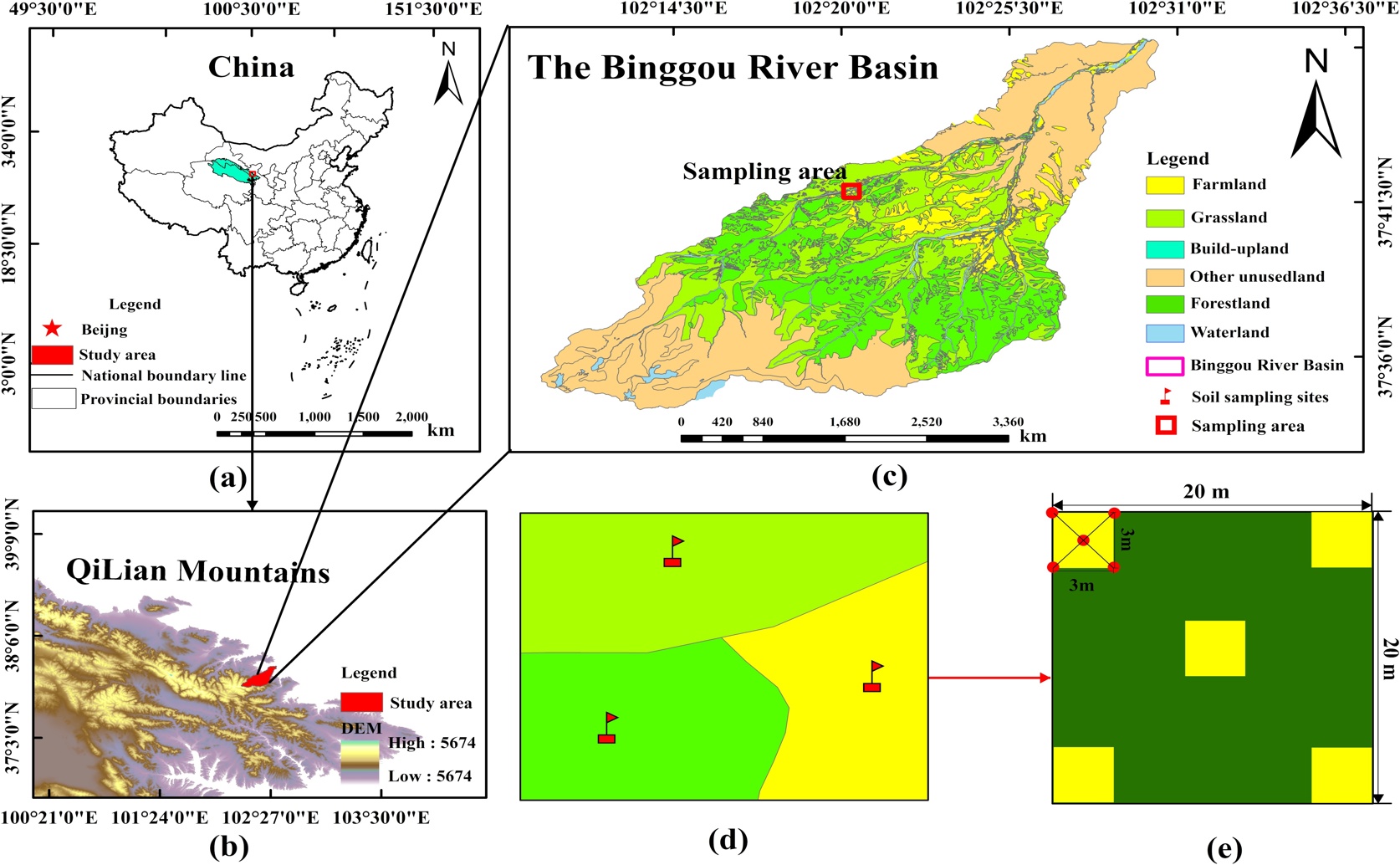
The sampling location and process of the Binggou River Basin on the Qilian Mountains.

Image adapted from: Xu et al. / CC BY (Source)

Key Findings

  • A study in China's Qilian Mountains found that converting natural forest and grassland into cropland significantly reduces the soil's ability to store carbon, turning these areas into carbon emitters
  • This land conversion also disrupts the balance of essential soil nutrients, leading to lower carbon-to-nutrient ratios in croplands, which hinders plant growth and overall soil health
The balance of essential nutrients like carbon (C), nitrogen (N), and phosphorus (P) in soil is fundamental to the health of ecosystems. These elements are not only vital for plant growth but also dictate the activity of microscopic organisms, known as microbes, which play a crucial role in cycling nutrients and carbon throughout the environment. Understanding how human activities, particularly different ways we use land, and natural climate variations influence these soil nutrients is key to managing our landscapes effectively and enhancing the beneficial services ecosystems provide, such as regulating climate. A recent study by researchers from Northwest Normal University, Key Lab of Resource Environment & Sustainable Dev., Gansu Engineering Research Center, Lanzhou University of Arts and Science, Dang River Basin Water Resources Management Bureau, and Shandong University[1] investigated these dynamics in the Binggou River Basin, located on the northern slope of the eastern Qilian Mountains. For two years (2018-2019), they continuously collected soil samples from forestland, grassland, and cropland to observe how soil C, N, and P levels and their ratios changed across these different land-use types and throughout the seasons. The study revealed significant differences. Forestland soils consistently held the highest average organic carbon content, followed by grassland, with cropland having the lowest. Total nitrogen was slightly higher in forestland than cropland, while grassland had the least. Interestingly, both organic carbon and total nitrogen in forestland and grassland were lowest during summer, though grassland's total nitrogen actually peaked in summer. Cropland soils, on the other hand, had the highest average total phosphorus. The ratios of these elements, known as stoichiometric ratios, are equally important. The study found that cropland soils had notably lower C:N (carbon to nitrogen) and C:P (carbon to phosphorus) ratios compared to forestland and grassland. This indicates a weaker capacity for carbon storage in cropland. While C:P and N:P (nitrogen to phosphorus) ratios in grassland and cropland showed relatively minor seasonal changes, those in forestland fluctuated more dramatically, reaching their highest values in autumn. A particularly high C:P ratio, as observed in forestland, was found to reduce the effectiveness of phosphorus in the soil, making it less available for uptake. Regarding the soil's vertical profile, organic carbon and total nitrogen generally decreased with increasing depth in forestland and grassland, but cropland exhibited more complex patterns, likely due to factors like tillage and fertilizer use. These findings underscore a critical environmental concern: converting natural forestland and grassland into cropland significantly diminishes the soil's capacity to store carbon. This transformation shifts these areas from "carbon sinks" – places that absorb and store carbon from the atmosphere – to "carbon sources," meaning they release more carbon, increasing the risk of carbon emissions. The changes observed in cropland, such as altered vertical nutrient distribution, are directly linked to human practices like tilling the soil and applying chemical fertilizers. This research builds upon and reinforces earlier studies on soil nutrient dynamics. For instance, the observation that land-use types profoundly affect soil C:N:P ratios aligns with previous work in karst areas, which also showed that soil nutrient characteristics and their ratios varied significantly across different land-use types, emphasizing the need to consider human disturbance in ecological restoration projects[2]. The current study further highlights that beyond just land use, seasonal climate fluctuations also play a role, a concept supported by broader studies showing that climate, including temperature and precipitation, influences the latitudinal patterns of C:N:P stoichiometry in both leaves and soil[3]. The study's finding that excessively high C:P ratios reduce phosphorus effectiveness is particularly insightful when considered alongside research into microbial metabolism. Microbes, the tiny organisms responsible for much of the carbon cycling in soil, are known to have varying C:N:P ratios depending on their environment[4]. While their biomass is often limited by nitrogen, their metabolic rates – essentially how quickly they process nutrients and carbon – are strongly tied to phosphorus availability because phosphorus is crucial for building ribosomes, the cellular machinery for protein synthesis[4]. Therefore, a high C:P ratio in the soil, as seen in forestland in the current study, could indeed limit microbial activity by making phosphorus less accessible, thereby impacting carbon turnover. This also resonates with findings that in some dryland ecosystems, vegetation growth can be susceptible to phosphorus limitation, indicated by high N:P ratios[3]. Moreover, the shift from carbon sink to source due to land-use conversion implicitly touches upon the role of plant diversity. While the current study focuses on broad land-use types rather than specific plant mixtures, different land uses inherently support different plant communities. Previous meta-analyses have shown that plant diversity can actually help balance terrestrial plant and soil C:N:P ratios, either increasing them when background levels are low or decreasing them when high[5]. This suggests that the simplified plant communities often found in croplands, compared to more diverse forests or grasslands, might contribute to the observed imbalances and reduced carbon sequestration capacity. In essence, the study from the Qilian Mountains provides crucial, localized data that reinforces a global understanding: how we manage our land has profound and measurable impacts on fundamental soil nutrient cycles. The detailed analysis of C, N, and P dynamics across different land uses and seasons, combined with insights from previous research on microbial processes, plant diversity, and regional geological factors, offers a more complete picture for guiding sustainable land management and mitigating climate change risks.

EnvironmentBiochemEcology

References

Main Study

1) Impacts of land use on soil carbon, nitrogen, and phosphorus in the Eastern Qilian Mountains

Published 14th July, 2025

https://doi.org/10.1371/journal.pone.0326316


Related Studies

2) Soil nutrients and stoichiometric ratios as affected by land use and lithology at county scale in a karst area, southwest China.

https://doi.org/10.1016/j.scitotenv.2017.11.175


3) The Latitudinal Patterns of Leaf and Soil C:N:P Stoichiometry in the Loess Plateau of China.

https://doi.org/10.3389/fpls.2019.00085


4) Differential nutrient limitation of soil microbial biomass and metabolic quotients (qCO2): is there a biological stoichiometry of soil microbes?

https://doi.org/10.1371/journal.pone.0057127


5) Plant mixture balances terrestrial ecosystem C:N:P stoichiometry.

https://doi.org/10.1038/s41467-021-24889-w


Related Articles

An unhandled error has occurred. Reload 🗙