The Secrets of Organic Matter in Ancient Coastal Shale

Jim Crocker
19th July, 2025

The Secrets of Organic Matter in Ancient Coastal Shale

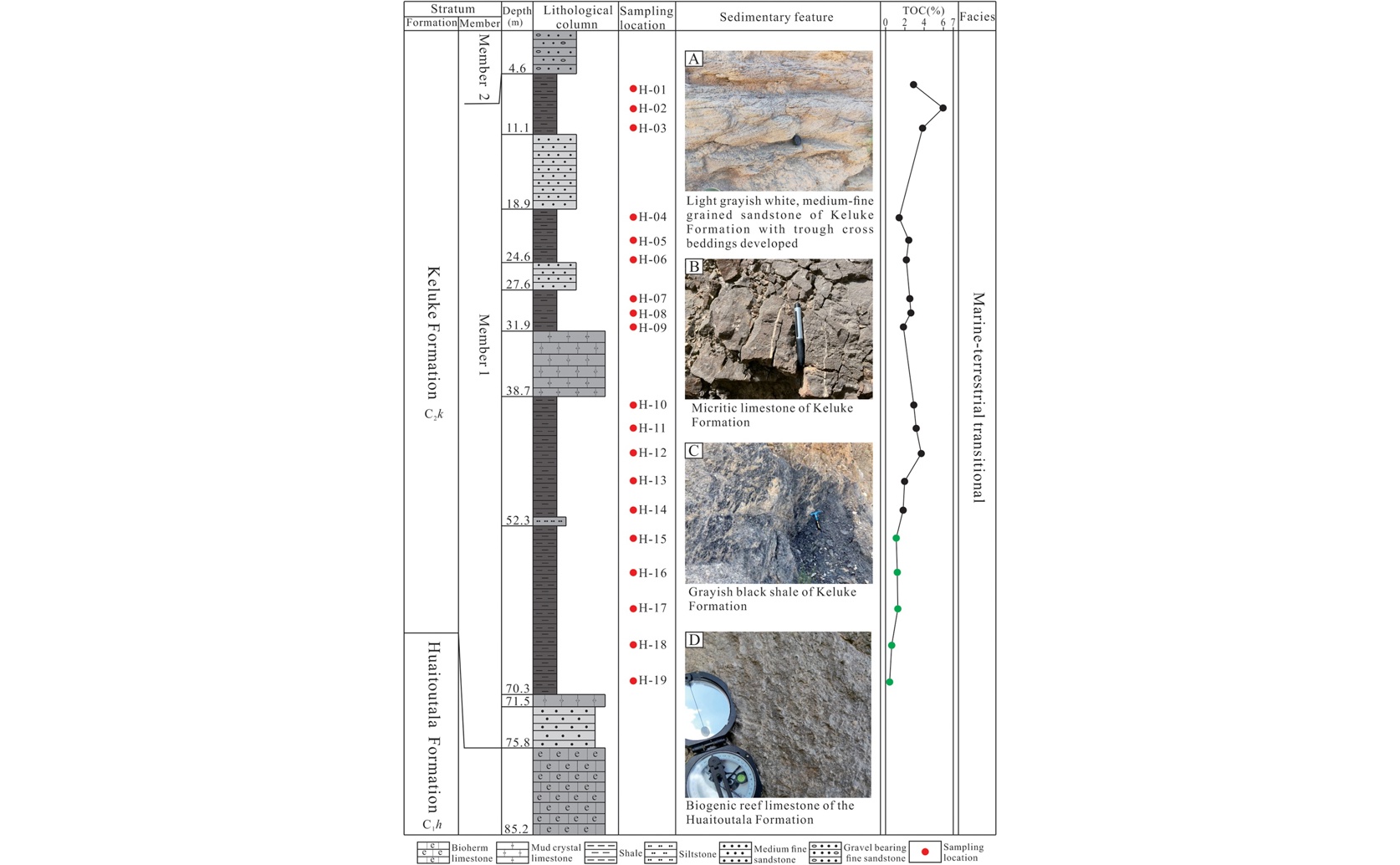
The lithological column and associated outcrop photos (a–d) illustrate a distinct vertical trend where total organic carbon (TOC) content is significantly enriched in the upper Sub-section II compared to the lower Sub-section I, serving as the basis for the study's two-section organic matter enrichment model.

Image adapted from: Lai et al. / CC BY (Source)

Key Findings

  • In China's Keluke Formation, organic matter accumulated due to high biological activity, warm/humid climate, and moderately oxygen-poor, salty water conditions
  • Crucially, clay minerals from land-derived sediments played a significant role by adsorbing and protecting organic matter, aiding its preservation
  • The study developed a two-part model, showing that warmer, wetter periods with more biological activity and clay input led to much higher organic matter in the rocks
Understanding how ancient rocks become rich in organic matter is crucial for locating and extracting fossil fuels like oil and natural gas. These "source rocks" are essentially the geological kitchens where hydrocarbons are cooked over millions of years. However, the precise conditions that lead to the accumulation and preservation of large amounts of organic material in these rocks are often complex and not fully understood. A recent study conducted by the National Key Laboratory of Uranium Resources investigated the organic-rich shale of Member 1 within the Keluke Formation, a newly identified source rock in the western Delingha Depression[1]. The primary goal was to uncover the factors controlling the enrichment of organic matter in this shale, which had previously been unclear. The researchers analyzed various aspects of the shale, including its total organic carbon (TOC) content, elemental geochemistry, and mineral composition. Total organic carbon (TOC) refers to the amount of carbon derived from once-living organisms preserved within the rock. By studying these characteristics, they aimed to reconstruct the paleoenvironment – the ancient environmental conditions – including the climate, oxygen levels in the water (redox conditions), water salinity, any influence from hot spring activity (hydrothermal activity), and the amount of biological life (primary productivity) in the ancient water body. The study divided the Member 1 shale section into two sub-sections based on TOC content. Sub-section II showed significantly higher TOC (averaging 2.79%) compared to Sub-section I (averaging 0.92%). The chemical index of alteration (CIA) values, which indicate the intensity of chemical weathering and thus reflect paleoclimate, were higher in Sub-section II, suggesting a warm and humid ancient climate, while Sub-section I indicated a more rapidly cooling period. Indicators like the ratios of strontium to barium (Sr/Ba) and rubidium to potassium oxide (Rb/K2O) suggested that the ancient water body was moderately to highly saline. Examining element enrichment factors (EFU, EFMo) and ratios like thorium to uranium (Th/U) and vanadium to chromium (V/Cr) revealed that the shale formed in an oxic-to-dysoxic environment. This means the water contained some oxygen (oxic) but could also have periods of low oxygen (dysoxic), rather than being completely oxygen-free (anoxic). This finding aligns with observations from other studies, such as research on the Dalong Formation, which noted that significant organic matter accumulation can occur even in oxygenated or dysoxic water environments, challenging the idea that anoxic conditions are always necessary for high TOC content[2]. Evidence from ratios like aluminum to the sum of aluminum, iron, and manganese (Al/(Al+Fe+Mn)), subtle negative europium anomalies (Eu anomaly), and specific ternary diagrams (Cu+Co+Ni-Fe-Mn and Zn-Ni-Co) indicated that the shale was influenced by weak hydrothermal activity and received a relatively high input of terrestrial sediments (terrigenous clastic input). Terrigenous clastic input refers to rock fragments and minerals, often clays, washed into the basin from land. Furthermore, ratios of phosphorus to aluminum (P/Al), copper to aluminum (Cu/Al), and zinc to aluminum (Zn/Al) showed that the primary productivity – the rate at which organic matter is created by living organisms, like algae – in the surface water was relatively high and increased over time. The study found strong correlations between TOC content and indicators of paleoclimate, paleo-salinity, terrigenous clastic input, and primary productivity. This suggests that the main drivers for organic matter enrichment in the Member 1 shale were high primary productivity, a brackish to salt-water environment, and dysoxic preservation conditions within a warm and humid climate. Crucially, the research also highlighted the significant role of terrigenous clastic input, specifically the adsorption of organic matter onto clay minerals, in the accumulation process. This finding strongly supports earlier research on black shale deposits in the late Cretaceous Western Interior Seaway, which demonstrated that the adsorption of carbon compounds onto clay mineral surfaces played a fundamental role in the burial and preservation of organic carbon[3]. That study found that mineral surface area could explain a large portion of the variation in total organic carbon, suggesting that how organic matter sticks to and is protected by clay minerals from continental weathering is a key factor in its preservation[3]. The current study, therefore, reinforces and expands upon this understanding, demonstrating its applicability to different geological settings. Based on these comprehensive results, the researchers established a two-section model for organic matter enrichment in the Member 1 shale. This model integrates the interplay of high biological productivity, specific water chemistry (salinity and dysoxic conditions), a favorable climate, and the protective role of clay minerals from land-derived sediments. This integrated view, which emphasizes the combined effect of productivity and preservation even in less-than-anoxic conditions, echoes the "integrated model" proposed by earlier research on the Dalong Formation, which also stressed the importance of biotic productivity and sedimentary rate in allowing organic matter accumulation in more oxygenated water environments[2]. The Keluke Formation study thus provides further evidence for these complex, multi-factor mechanisms of organic matter preservation in important source rocks.

EnvironmentOceanography

References

Main Study

1) Analysis on factors controlling organic matter enrichment in marine-terrestrial transitional shale of Member 1, Upper Carboniferous Keluke Formation, Huaitoutala area, east of northern margin of Qaidam Basin, China

Published 16th July, 2025

https://doi.org/10.1371/journal.pone.0328397


Related Studies

2) Controlling Factors and Formation Models of Organic Matter Accumulation for the Upper Permian Dalong Formation Black Shale in the Lower Yangtze Region, South China: Constraints from Geochemical Evidence.

https://doi.org/10.1021/acsomega.0c04979


3) Mineral surface control of organic carbon in black shale.

Journal: Science (New York, N.Y.), Issue: Vol 295, Issue 5555, Jan 2002


Related Articles

An unhandled error has occurred. Reload 🗙