Melting Sea Ice Changes Light for Water Plants

Greg Howard
3rd May, 2025

Melting Sea Ice Changes Light for Water Plants

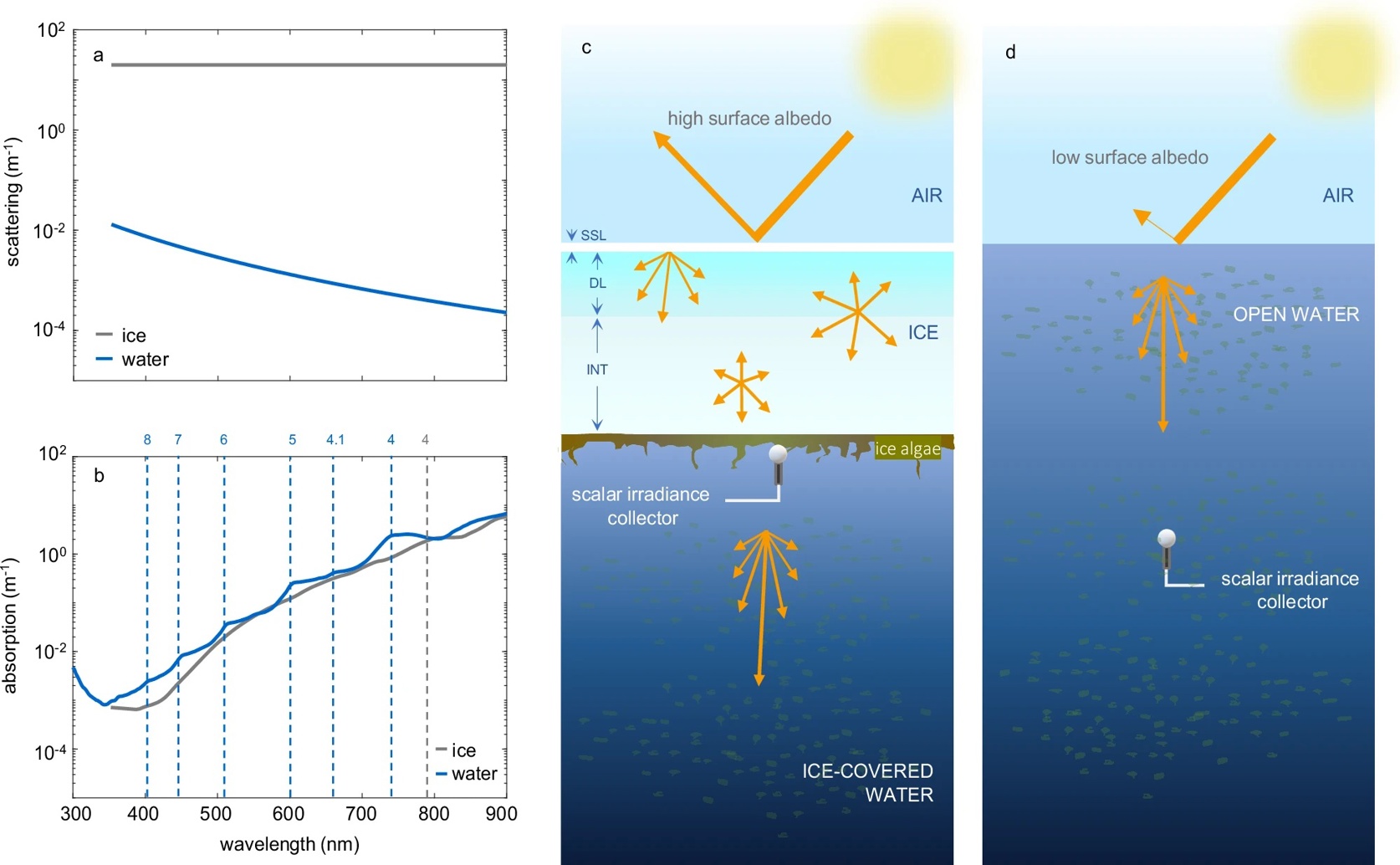
Sea ice differs fundamentally from liquid water by scattering light more strongly and uniformly (a) and having a much smoother absorption spectrum that lacks the distinct vibrational peaks of H2O (b), which are the key optical properties explaining how its loss alters the spectral light environment for photosynthesis (c, d).

Image adapted from: Soja-Woźniak et al. / CC BY (Source)

Key Findings

  • Researchers at the University of Amsterdam found that Arctic sea ice loss changes ocean light to more blue wavelengths
  • This blue shift affects which phytoplankton can thrive, potentially reducing marine biodiversity
  • Consequently, current satellite estimates of Arctic marine life production may be significantly underestimated
The Arctic is experiencing a significant reduction in sea ice due to global warming, which has profound implications for marine ecosystems. One of the critical aspects affected by the loss of sea ice is the light conditions in the ocean, essential for the growth of phytoplankton—the foundation of the marine food web. Understanding how changing ice cover alters light availability is crucial for predicting the future of Arctic marine life. A recent study conducted by researchers at the University of Amsterdam[1] explores how the dramatic loss of sea ice influences the light environment in polar waters. Sea ice acts as a barrier that affects how light penetrates the water, influencing the types of phytoplankton that can thrive. Previously, it was believed that phytoplankton blooms in the Arctic were limited to areas free of sea ice[2]. However, this study challenges that notion by demonstrating that under-ice blooms can occur in regions with consolidated ice, especially where ice thinning and melt ponds increase light transmission[2]. The researchers used a radiative transfer model, a mathematical tool that simulates how light moves through different mediums, to analyze the impact of sea ice loss on the light spectrum in the ocean's euphotic zone—the layer where sunlight supports photosynthesis. Their findings indicate that the reduction of sea ice leads to a pronounced blue shift in the light spectrum. This means that the available light becomes dominated by shorter wavelengths, primarily in the blue region. Additionally, open water conditions create distinct spectral niches, allowing different phytoplankton species to specialize based on their photosynthetic pigments. In contrast, ice-covered waters produce a smooth continuum of light, reducing these niches and potentially limiting phytoplankton diversity. These changes in the light spectrum have significant implications for phytoplankton communities. Phytoplankton rely on pigments to capture light for photosynthesis, and different pigments absorb specific wavelengths. For instance, diatoms, a type of phytoplankton mentioned in previous studies, thrive under certain light conditions[2]. The blue shift caused by sea ice loss may favor species with pigments adapted to shorter wavelengths, altering the composition of primary producers in the Arctic. This aligns with findings from study[3], which showed that variations in light absorption can lead to niche differentiation among phytoplankton species, promoting coexistence through efficient light utilization. Moreover, the study’s results suggest that satellite-based estimates of primary production in Arctic waters might be significantly underestimated—by up to tenfold[2]. As sea ice continues to decline, the increased light availability could enhance primary production, but the shift in light quality may also favor different phytoplankton communities than those currently dominant. This shift could have cascading effects throughout the marine food web, affecting everything from small zooplankton to large marine mammals. The research builds on the comprehensive review of light controls in Arctic ecosystems presented in study[4], which examined how factors like clouds, snow, and suspended matter influence the underwater light field. By incorporating these abiotic factors into their radiative transfer model, the University of Amsterdam team was able to provide a more nuanced understanding of how changing ice conditions alter the light environment. Their work highlights the sensitivity of Arctic ecosystems to changes in light availability, emphasizing the need for further research to predict ecological outcomes accurately. Additionally, the study’s findings resonate with earlier research on under-ice phytoplankton blooms[2]. The presence of melt ponds and thinner ice allows more light to penetrate, supporting biomass accumulation even beneath consolidated ice. The current study extends this understanding by showing how the quality of light changes, not just the quantity, influencing which phytoplankton species can thrive. This dual impact on both biomass and species composition underscores the complexity of Arctic ecosystem responses to climate change. Incorporating insights from study[3], which demonstrated how pigment diversity among phytoplankton allows for species coexistence through efficient light use, the University of Amsterdam’s findings suggest that the narrowing of the light spectrum could reduce this diversity. As certain wavelengths become more dominant, species with pigments optimized for these wavelengths may outcompete others, potentially leading to less diverse phytoplankton communities. This change could affect the resilience of the marine ecosystem, making it more vulnerable to environmental fluctuations and disruptions. Overall, the study by the University of Amsterdam provides valuable insights into the consequences of sea ice loss on Arctic marine ecosystems. By revealing how reduced ice cover leads to a blue shift in the light spectrum and alters phytoplankton community structure, it highlights the intricate link between physical changes in the environment and biological responses. These findings not only advance our understanding of primary production in polar regions but also emphasize the broader ecological implications of ongoing climate change. As the Arctic continues to warm and sea ice diminishes, the ability to accurately model and predict changes in light conditions will be essential for forecasting the future of marine life in these regions. The integration of radiative transfer models with ecological data, as demonstrated in this study, represents a crucial step toward a more comprehensive understanding of how polar ecosystems will adapt to a rapidly changing environment. Continued research in this area will be vital for developing strategies to preserve the biodiversity and functionality of one of the planet’s most sensitive and important marine habitats.

EnvironmentOceanographyMarine Biology

References

Main Study

1) Loss of sea ice alters light spectra for aquatic photosynthesis

Published 30th April, 2025

https://doi.org/10.1038/s41467-025-59386-x


Related Studies

2) Massive phytoplankton blooms under Arctic sea ice.

https://doi.org/10.1126/science.1215065


3) Adaptive divergence in pigment composition promotes phytoplankton biodiversity.

Journal: Nature, Issue: Vol 432, Issue 7013, Nov 2004


4) Shine a light: Under-ice light and its ecological implications in a changing Arctic Ocean.

https://doi.org/10.1007/s13280-021-01662-3


Related Articles

An unhandled error has occurred. Reload 🗙