Five-Year Study Shows Sudden Fungi Bursts In Coastal Water

Jenn Hoskins
15th July, 2025

Five-Year Study Shows Sudden Fungi Bursts In Coastal Water

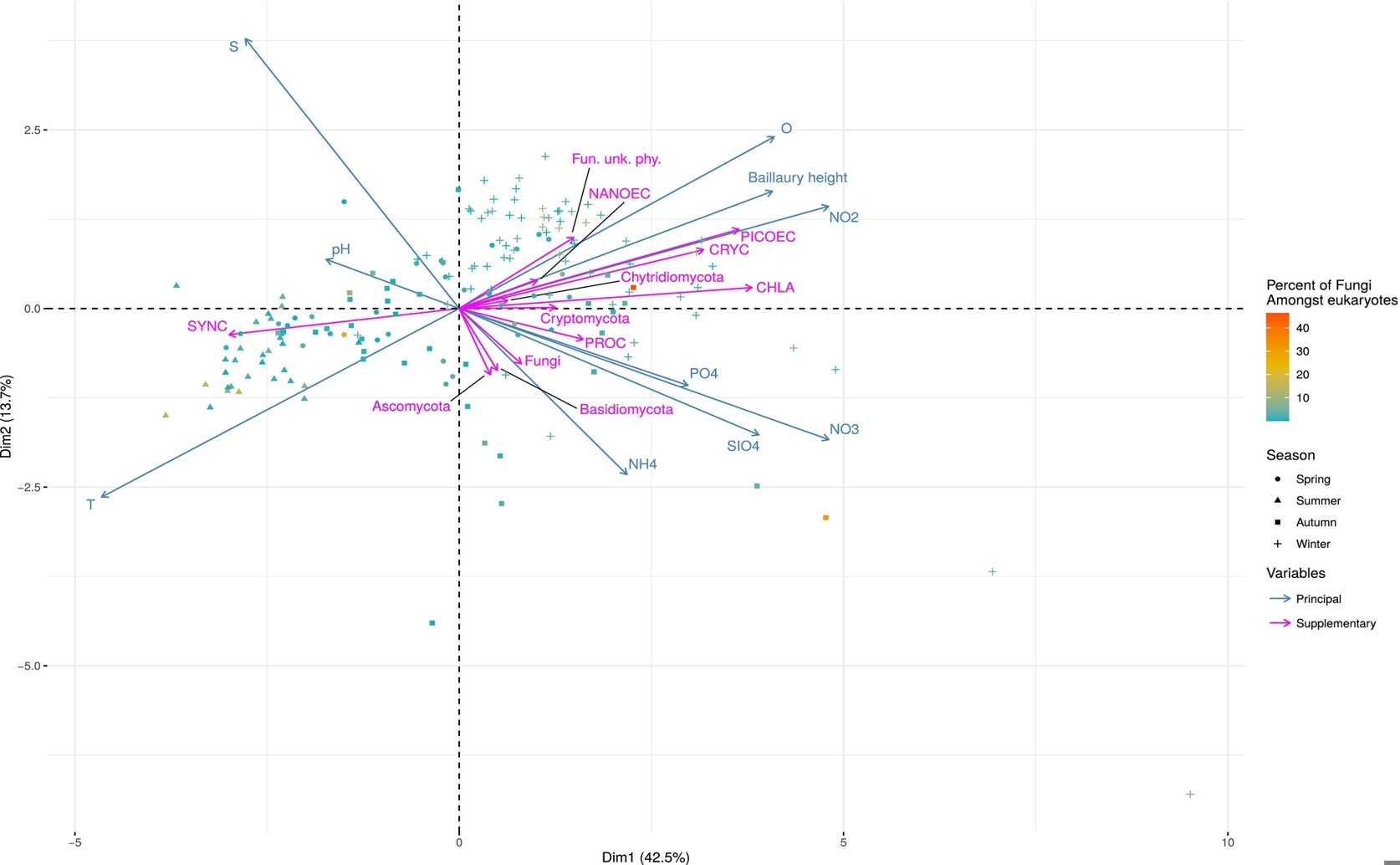
Principal Component Analysis demonstrates that the relative abundance of fungi does not correlate strongly with key environmental drivers or seasonal patterns, reinforcing the study's finding that fungal blooms are chaotic events unrelated to a unique set of abiotic conditions.

Image adapted from: Laymand et al. / CC BY (Source)

Key Findings

  • At a coastal site in the North West Mediterranean Sea, marine fungal populations show unpredictable, short-term bursts, unlike other ocean microbes
  • These rapid fungal blooms are mostly caused by a few common fungal types, primarily Ascomycota, and aren't strongly tied to environmental changes
Marine fungi, though often overlooked, are now recognized as vital components of the ocean's intricate food webs. For decades, the focus in marine microbial ecology largely centered on bacteria and protists. However, it has become clear that fungi also play significant roles in processing organic matter and interacting with other planktonic organisms. Despite this growing awareness, fundamental questions have remained about how the proportion of fungi in marine ecosystems changes over time, what triggers sudden increases in their numbers (known as blooms), and which specific types of fungi are involved in these events. Understanding these dynamics is crucial for a comprehensive picture of marine ecosystem function. Addressing these open questions, recent research from CNRS and Sorbonne Université[1] utilized an extensive five-year time series from a coastal site in the North West Mediterranean Sea. This study stands out for its exceptionally high temporal resolution, with samples collected up to twice a week. This detailed approach allowed researchers to closely observe the dynamics of marine fungi, specifically their relative abundance, which refers to the proportion of fungi compared to other organisms in the water. The study employed a technique called 18S V4 metabarcoding. This method involves extracting DNA from environmental samples and then sequencing a specific region of the ribosomal RNA gene (18S V4) that acts like a unique genetic barcode for different eukaryotic organisms, including fungi. By analyzing these barcodes, the researchers could identify and quantify the various fungal types present in the water over time. The high-frequency sampling was critical because, as the study points out, less frequent sampling can lead to "aliasing," where rapid changes are missed or misinterpreted, resulting in misleading conclusions about true microbial dynamics. The findings revealed that the dynamics of fungal relative abundance at this coastal site were primarily chaotic. This means that instead of following predictable seasonal patterns, their numbers fluctuated irregularly, characterized by short-term blooms. These blooms were largely dominated by 41 specific Amplicon Sequence Variants (ASVs), which are essentially highly precise genetic fingerprints representing distinct fungal groups. Most of these bloom-forming ASVs were identified as belonging to Ascomycota, a large and diverse group of fungi. Interestingly, many of these dominant ASVs are not exclusive to the Mediterranean Sea or even strictly to marine environments, suggesting a broader distribution. This observation of chaotic dynamics in relative abundance offers a more nuanced understanding compared to earlier studies that focused on fungal diversity and community structure. For instance, previous long-term time-series studies have demonstrated clear seasonal patterns in marine fungal diversity[2][3]. One study in the English Channel, using a 17-year time series, showed that fungal community structure progressed at seasonal and monthly scales, with communities restructuring annually[2]. Similarly, research in the coastal waters of North Carolina over three years found prominent seasonality in fungal 18S rRNA gene abundance and diversity, with diversity peaking in winter and abundance in summer/fall[3]. While these studies highlight seasonality in composition and overall abundance, the new research suggests that the short-term fluctuations and bloom events in relative abundance can be highly unpredictable, adding a layer of complexity not fully captured by less frequent sampling. Furthermore, the CNRS and Sorbonne Université study found only weak links between the relative abundance of fungi and various biotic (living organisms) or abiotic (non-living environmental) parameters. This contrasts somewhat with other research that identified stronger correlations between fungal communities and environmental factors. For example, the North Carolina study linked fungal diversity to temperature, pH, chlorophyll a, insolation (sunlight exposure), salinity, and dissolved inorganic carbon (DIC)[3]. It also noted positive correlations between fungal abundance and chlorophyll a, silicate, and oxygen saturation. These differences might suggest that while environmental factors influence the overall composition and seasonal presence of fungal communities, the specific triggers for intense, short-lived blooms in relative abundance might be more complex, transient, or driven by factors not easily captured by standard environmental monitoring. The role of biotic interactions is also a complex area. While the new study found weak links between biotic parameters and overall fungal relative abundance, earlier work specifically investigated these interactions. Research in the German Bight, for instance, suggested that marine fungi are deeply embedded in marine food webs through complex relationships like parasitism, predation, grazing, or allelopathy (chemical inhibition)[4]. That study found that a significant portion of fungal operational taxonomic units (OTUs – similar to ASVs, representing distinct groups) had negative relationships with zooplankton and other fungi, and to a lesser extent with phytoplankton, suggesting top-down control by fungi on other plankton or fungi serving as a food source for zooplankton[4]. The North Carolina study also noted that exclusion dominated fungus-and-phytoplankton networks[3]. The new study's focus on overall relative abundance might not fully resolve these intricate, species-specific interactions, or it might imply that while these interactions occur, they don't necessarily drive the large-scale, chaotic fluctuations in total fungal biomass in the same way. The dominance of Ascomycota in the blooms identified by the CNRS and Sorbonne Université team aligns with previous findings, as Ascomycota were also found to dominate coastal fungal communities throughout the year in the North Carolina study[3]. The observation that many bloom-forming ASVs are not restricted to the marine environment also resonates with the idea of land-sea exchange. Earlier research suggested that low relative abundance taxa, likely non-marine, show seasonal input to coastal marine ecosystems, indicating regular land-sea exchange[2]. In essence, the high-frequency sampling employed by the CNRS and Sorbonne Université researchers has unveiled a more dynamic and less predictable picture of marine fungal relative abundance than previously understood. While earlier studies established the seasonal patterns of fungal diversity and community structure[2][3] and highlighted their complex biotic interactions[4], this new research emphasizes that the sheer quantity of fungi can fluctuate chaotically, driven by factors not yet fully understood. This highlights the unique ecological roles of mycoplankton and their potentially broad niche complementarities to other microbial groups in the coastal ocean[3], pushing the boundaries of our understanding of these crucial, yet often cryptic, marine inhabitants.

EcologyMarine BiologyMycology

References

Main Study

1) Five‐Year Time Series Reveals Short‐Term Blooms of Planktonic Fungi in a Coastal Mediterranean Site

Published 12th July, 2025

https://doi.org/10.1111/1758-2229.70154


Related Studies

2) A 17-year time-series of fungal environmental DNA from a coastal marine ecosystem reveals long-term seasonal-scale and inter-annual diversity patterns.

https://doi.org/10.1098/rspb.2022.2129


3) A High-Resolution Time Series Reveals Distinct Seasonal Patterns of Planktonic Fungi at a Temperate Coastal Ocean Site (Beaufort, North Carolina, USA).

https://doi.org/10.1128/AEM.00967-18


4) Seasonal Dynamics of Pelagic Mycoplanktonic Communities: Interplay of Taxon Abundance, Temporal Occurrence, and Biotic Interactions.

https://doi.org/10.3389/fmicb.2020.01305


Related Articles

An unhandled error has occurred. Reload 🗙