Detecting Issues In Rice Fields

Jim Crocker
26th June, 2025

Detecting Issues In Rice Fields

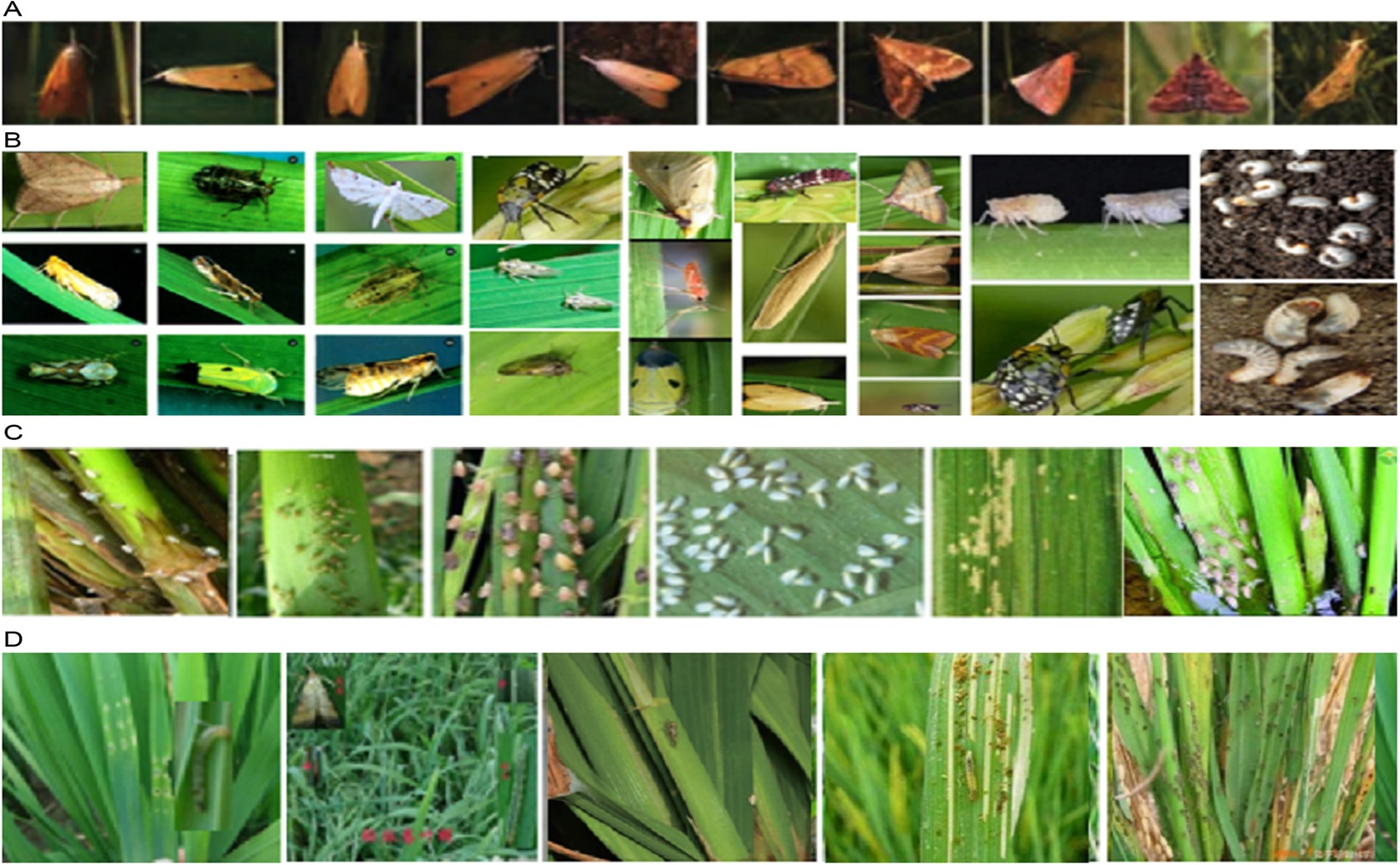
The distinct variations in pest shape and size within the IP102 dataset (A, B) and the inconspicuous nature of tiny pests in the AgriPest dataset (C, D) highlight the complex field background challenges that the proposed CATransU-Net model overcomes to achieve superior detection precision.

Image adapted from: Lu et al. / CC BY (Source)

Key Findings

  • Researchers from Chinese universities developed a new AI model, CATransU-Net, to accurately detect diverse rice pests in complex field environments, addressing limitations of traditional methods
  • This innovative model combines advanced image analysis techniques, like multiscale feature extraction and cross-attention, to precisely identify pests even when they are small or hidden
  • CATransU-Net achieved over 93% precision on large datasets, significantly outperforming other methods and proving its effectiveness for practical rice pest management
The health of agricultural crops is crucial for global food security, but they are constantly threatened by harmful insects and pests. Early and accurate detection of these pests is a critical step in preventing widespread damage and ensuring sustainable yields. Traditionally, this has relied on manual inspection, which is time-consuming, labor-intensive, and often less effective in large fields. The advent of artificial intelligence, particularly neural networks, has opened new avenues for automating and improving this process, allowing machines to learn and recognize patterns associated with pests[2]. This technological shift is transforming modern agriculture, moving towards more precise and efficient pest management. In a recent study, researchers from SIAS University, Chengdu University of Technology, and Shihezi University have developed a novel approach to address the challenge of accurate rice pest detection in the field[1]. Their work introduces a new model called Cross-Attention TransU-Net, or CATransU-Net, which aims to improve upon existing methods by combining the strengths of two powerful deep learning architectures: U-Net and the Transformer. The study's core innovation lies in how CATransU-Net processes images to identify pests. At its heart, the model builds upon concepts seen in advanced image analysis. U-Net, a type of convolutional neural network, excels at extracting detailed local features from images, making it very good at tasks like image segmentation, where specific objects need to be outlined. However, U-Net can sometimes struggle with understanding the broader context or "long-distance dependencies" within an image. This is where the Transformer architecture comes in. Originally designed for language processing, Transformers are highly effective at capturing relationships between distant parts of a sequence, and their application has expanded to image analysis. For instance, TransUNet, a model first introduced in 2021, demonstrated how integrating Transformer components into a U-Net framework could significantly enhance medical image segmentation by allowing the model to extract global context and refine regions through cross-attention[3]. CATransU-Net adapts and extends this hybrid approach for agricultural use. It consists of several key components: an encoder, a decoder, a dual Transformer-attention module (DTA), and a cross-attention skip-connection (CASC). The encoder part of the model incorporates what's called Dilated Residual Inception (DRI). This feature allows the model to extract "multiscale features," meaning it can analyze the image at different levels of detail simultaneously. This is similar in principle to how other advanced image recognition systems, such as the multiscale convolutional neural network used for plant species recognition, leverage multiscale analysis to capture both fine details and broader patterns in complex images like leaves[4]. A significant enhancement in CATransU-Net is the inclusion of the dual Transformer-attention module (DTA) within the bottleneck of the model. This module is specifically designed to efficiently learn "nonlocal interactions" between the features extracted by the encoder. Essentially, it helps the model understand how different parts of the image relate to each other, even if they are far apart. This attention mechanism, which allows the model to focus on the most relevant parts of an image, is a powerful tool also employed in other high-performing pest detection systems, such as the Convolutional Slice-Attention based Gated Recurrent Unit (CS-AGRU) model, which has achieved very high accuracy in segmenting and detecting crop pests by fetching relevant feature information[5]. Furthermore, CATransU-Net replaces the standard "skip-connections" found in traditional U-Net models with a "cross-attention skip-connection" (CASC). In U-Net, skip-connections help preserve fine-grained details by directly passing information from the encoder to the decoder. By using cross-attention in these connections, CATransU-Net can more effectively model "multi-resolution feature representation" and enhance the overall feature representation, leading to the generation of higher-resolution images of the insects. This allows for more precise identification. The experimental results of the CATransU-Net model, tested on large-scale datasets like IP102 and AgriPest, demonstrate its effectiveness in extracting rice pests. The model achieved a precision of 93.51%, which is approximately 2% higher than other comparable methods. Notably, it showed a significant improvement of 9.36% over a standard U-Net model. This highlights the benefit of combining the local feature extraction capabilities of U-Net with the global context understanding provided by Transformer components. While other hybrid deep learning mechanisms have shown even higher accuracy in specific pest detection scenarios, such as the 99.52% accuracy achieved by a model combining DenseNet-77 UNet and CS-AGRU[5], the CATransU-Net study contributes to the continuous advancement of these technologies, particularly for field applications. The ongoing research and development of neural network-based pest detection systems, as emphasized by earlier reviews[2], are crucial for maintaining sustainable and efficient agricultural production. The proposed CATransU-Net method offers a robust solution that can be practically applied in field rice pest detection systems, contributing to more proactive and targeted pest control strategies.

AgriculturePlant ScienceAnimal Science

References

Main Study

1) CATransU-Net: Cross-attention TransU-Net for field rice pest detection

Published 25th June, 2025

https://doi.org/10.1371/journal.pone.0326893


Related Studies

2) New trends in detection of harmful insects and pests in modern agriculture using artificial neural networks. a review.

https://doi.org/10.3389/fpls.2023.1268167


3) TransUNet: Rethinking the U-Net architecture design for medical image segmentation through the lens of transformers.

https://doi.org/10.1016/j.media.2024.103280


4) Multiscale Convolutional Neural Networks with Attention for Plant Species Recognition.

https://doi.org/10.1155/2021/5529905


5) Segmentation and detection of crop pests using novel U-Net with hybrid deep learning mechanism.

https://doi.org/10.1002/ps.8083


Related Articles

An unhandled error has occurred. Reload 🗙