How Accurate Are Finger Clips for Oxygen in Very Low Oxygen Environments?

Greg Howard
24th June, 2025

How Accurate Are Finger Clips for Oxygen in Very Low Oxygen Environments?

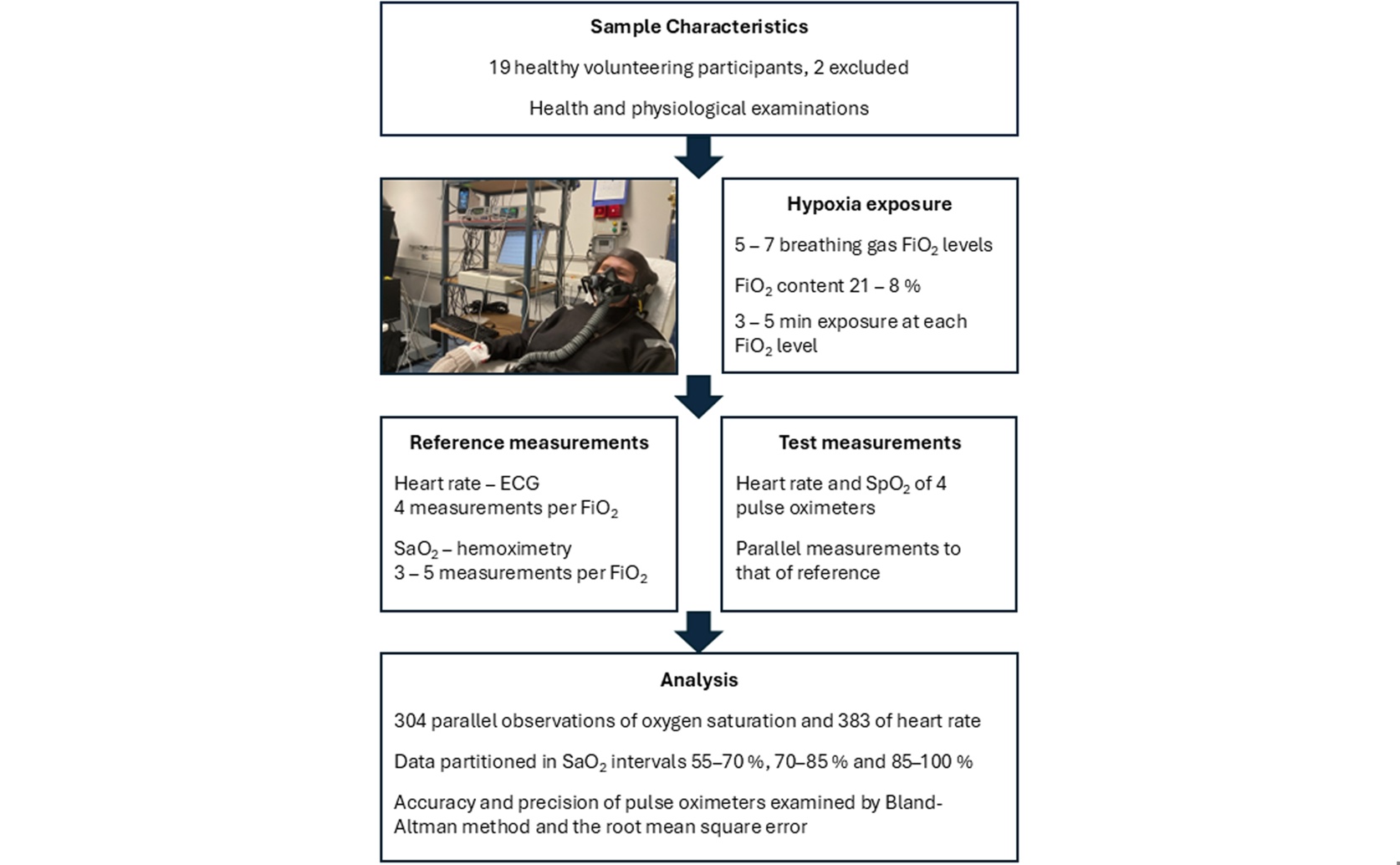
This study's experimental design involved exposing 17 healthy participants to controlled, stepwise desaturation to assess the validity of four commercial pulse oximeters by comparing their readings to reference instruments across three distinct oxygen saturation intervals.

Image adapted from: Vikne et al. / CC BY (Source)

Key Findings

  • A study by Norwegian & Italian Universities/Institutes found that common pulse oximeters are generally accurate for oxygen levels between 85-100%
  • However, their accuracy significantly drops below 85% oxygen saturation, becoming completely unreliable at very low levels (55-70%), posing a safety risk in extreme environments
The human body relies critically on a steady supply of oxygen. When oxygen levels in the blood drop, a condition known as hypoxia, it can have severe consequences, particularly for the brain. Cellular hypoxia is a common pathway for brain injury, occurring not only from conditions like asphyxia but also from impaired blood flow or exposure to high altitudes[2]. In environments like high-altitude aviation or mountaineering, individuals can experience significant drops in oxygen, making accurate monitoring of their oxygen levels vital for safety and performance. Pulse oximeters are widely used devices that non-invasively estimate blood oxygen saturation (SpO2) and heart rate. However, a key question remains: how accurate are these devices when oxygen levels fall to dangerously low levels? Addressing this critical question, a study conducted by Norwegian & Italian Universities/Institutes investigated the accuracy of four different commercial pulse oximeters at various arterial blood oxygen saturation (SaO2) levels, particularly focusing on severe desaturation[1]. The researchers noted that commercial pulse oximeters might not be well calibrated for oxygen saturations below 70%, conditions that can be met in high-altitude scenarios. This is important because even moderate hypoxia, where arterial partial pressure of oxygen (PaO2) is low (e.g., 35-60mmHg), can significantly impair cognitive performance, affecting tasks related to central executive function, perception, attention, and short-term memory[3]. Such cognitive impairment poses a direct risk in environments where clear thinking is paramount. The study involved seventeen healthy participants whose oxygen levels were carefully reduced in a controlled manner, mimicking conditions found at high altitudes. This approach aligns with the understanding that exposure to altitude provides a reproducible model for studying cerebral cellular hypoxia in healthy individuals[2]. Throughout the exposure, measurements from the four pulse oximeters were continuously compared against highly accurate reference instruments: hemoximetry for oxygen saturation and electrocardiography (ECG) for heart rate. Hemoximetry is a precise method that directly measures oxygen content in arterial blood samples, considered the gold standard for accuracy. While arterial punctures (APs) for blood gas analysis, which hemoximetry relies on, are generally safe procedures with a low major complication rate (0.14%)[4], their invasive nature makes continuous, non-invasive monitoring with devices like pulse oximeters highly desirable, provided they are accurate. The findings revealed significant limitations of the pulse oximeters at low oxygen levels. At oxygen saturation levels between 85% and 100%, most of the pulse oximeters showed good agreement with the reference measurements. However, as oxygen levels dropped further, their accuracy declined sharply. In the 70-85% SaO2 range, only one of the four tested pulse oximeters remained accurate. Crucially, when oxygen saturation fell to very low levels, specifically between 55% and 70% SaO2, none of the tested pulse oximeters were in agreement with the reference measurements for oxygen saturation. This means their readings were unreliable in conditions of severe hypoxia. Similarly, heart rate measurements from the pulse oximeters also showed inconsistencies when compared to ECG, particularly at the lowest and highest oxygen saturation ranges. The study clearly demonstrated that the bias (systematic error) and variability (random error) of the pulse oximeters significantly increased as oxygen saturation decreased. These findings have profound implications for safety in extreme environments. For instance, in military operations like High-Altitude High Opening (HAHO) parachute jumps, personnel rely on supplemental oxygen. A simulated HAHO scenario without supplemental oxygen demonstrated that individuals can experience extreme hypoxemia, with arterial oxygen tensions dropping to remarkably low levels (e.g., 24.8 mmHg), potentially leading to loss of consciousness[5]. In such critical situations, inaccurate pulse oximeter readings could provide a false sense of security or fail to alert personnel to dangerous oxygen deprivation. The study by Norwegian & Italian Universities/Institutes underscores that while pulse oximeters are convenient tools, their readings must be interpreted with extreme caution, especially when individuals are experiencing severe reductions in blood oxygen saturation. This highlights a critical gap in current monitoring technology for situations where precise oxygen level information is most needed.

MedicineHealth

References

Main Study

1) Validity of pulse oximetry measures for heart rate and oxygen saturation during profound hypoxia in normobaric simulated extreme altitudes

Published 23rd June, 2025

https://doi.org/10.1371/journal.pone.0326674


Related Studies

2) The cerebral effects of ascent to high altitudes.

https://doi.org/10.1016/S1474-4422(09)70014-6


3) Effect of acute hypoxia on cognition: A systematic review and meta-regression analysis.

https://doi.org/10.1016/j.neubiorev.2017.01.019


4) Arterial blood gas analysis: as safe as we think? A multicentre historical cohort study.

https://doi.org/10.1183/23120541.00535-2021


5) Acute hypoxia in a simulated high-altitude airdrop scenario due to oxygen system failure.

https://doi.org/10.1152/japplphysiol.00169.2017


Related Articles

An unhandled error has occurred. Reload 🗙