Special Algae Grow In Oily Water For Fuel

Jenn Hoskins
18th June, 2025

Special Algae Grow In Oily Water For Fuel

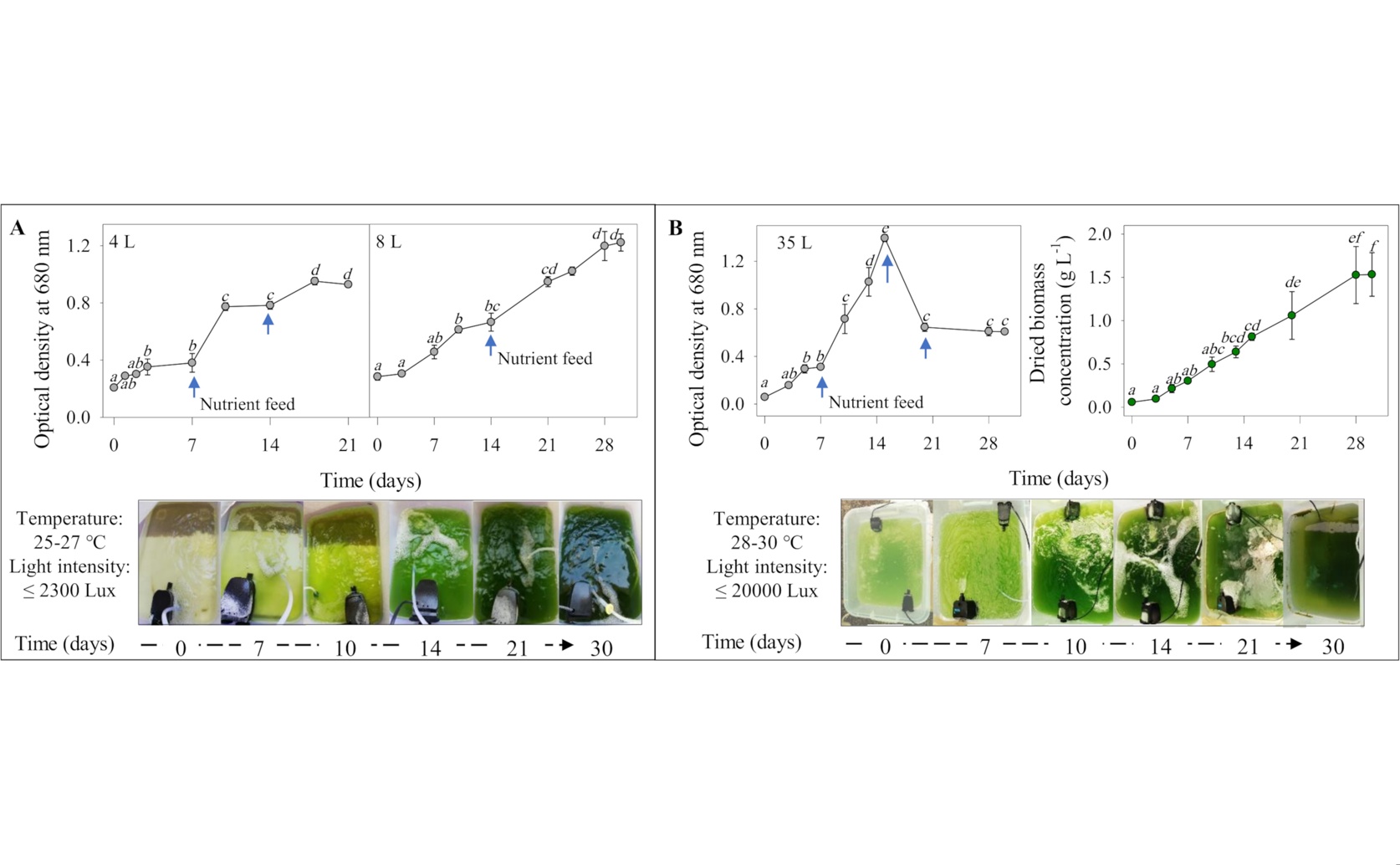
The successful scale-up of Asterarcys sp. RA100 cultivation in nutrient-amended produced water to an 8 L greenhouse setting (a) and a 35 L outdoor aquarium (b) demonstrates its feasibility for large-scale biomass generation, achieving an areal productivity of 10.3 ± 0.5 g m–2 day–1.

Image adapted from: Abed et al. / CC BY (Source)

Key Findings

  • Scientists in Oman found a microalga, Asterarcys sp. RA100, that can thrive in salty oil industry wastewater, offering a way to manage this waste
  • This alga efficiently converts the wastewater into biomass rich in lipids, which can then be processed into biodiesel that meets international fuel quality standards
  • Its successful growth in large-scale greenhouse settings suggests it could be a viable, eco-friendly solution for both treating industrial wastewater and producing renewable energy
Oil and gas extraction produces vast quantities of a byproduct known as produced water (PW). This wastewater is often saline, contains various dissolved solids, and can be rich in certain elements like boron, posing a significant environmental challenge for disposal. Finding sustainable ways to manage and repurpose this water is crucial for reducing the industry's environmental footprint. Recent research conducted by scientists at Sultan Qaboos University and Khalifa University[1] has explored a promising solution: using this produced water as a growth medium for microalgae, which can then be converted into valuable bioproducts like biodiesel. This study focused on a newly isolated microalga, Asterarcys sp. RA100, demonstrating its remarkable ability to thrive in produced water and accumulate lipids suitable for biodiesel production. The concept of using microalgae for industrial wastewater treatment and resource recovery is not entirely new. Earlier studies have shown that various microalgae strains, including cyanobacteria and green algae, can effectively grow in challenging wastewaters such as flowback water, a byproduct of hydraulic fracturing[2]. Flowback water shares similarities with produced water, being a high-volume wastewater from oil and gas operations. Research[2] successfully demonstrated that microalgae could significantly reduce total dissolved solids (over 65%), nitrates (100%), and boron (over 95%) in flowback water, while simultaneously generating biomass that could be converted into useful bioproducts. The current study on Asterarcys sp. RA100 builds upon this foundation, specifically targeting produced water and the high-value product of biodiesel. The produced water used in the study was slightly alkaline, deficient in key nutrients, and contained high levels of boron. Despite these challenging conditions, Asterarcys sp. RA100 exhibited robust growth. Researchers optimized its growth conditions, finding that the alga grew best with added phosphate and nitrate, at 1% salinity, 25°C, 150 revolutions per minute (rpm) for mixing, and under LED light intensity ranging from 4000 to 8000 Lux. Lux is a measure of light intensity, indicating how much light falls on a surface. To assess its potential for large-scale application, the alga was tested in a greenhouse setting, achieving an impressive areal productivity of 10.3 grams per square meter per day. This indicates its efficiency in converting light and nutrients into biomass over a given area. A key finding was the alga's ability to accumulate lipids, which are fats and oils, within its cells. When grown in produced water, Asterarcys sp. RA100 accumulated lipids reaching 27.0% of its dry weight. These lipids are the raw material for biodiesel. Biodiesel is a renewable fuel derived from biological sources, typically made by chemically modifying vegetable oils or animal fats. The lipids extracted from the microalgae are converted into Fatty Acid Methyl Esters (FAME), which is the chemical form of biodiesel. The FAME produced from Asterarcys sp. RA100 in this study displayed properties that met international biodiesel standards. Specifically, the FAME profiles showed elevated levels of certain fatty acids like palmitic acid (C16:0), elaidic acid (C18:1n9t), stearic acid (C18:0), and palmitoleic acid (C16:1n7C), which are desirable components for biodiesel. The successful growth of Asterarcys sp. RA100 under specific light conditions in the current study is further supported by previous research on the same genus. An earlier study on Asteracys sp.[3] explored its photosynthetic responses under different light intensities, especially during mixotrophic growth. Mixotrophic growth means the organism can use both light (like plants, through photosynthesis, which is phototrophic growth) and organic carbon sources (like animals, through consuming nutrients) for energy. This prior work highlighted the genus's enhanced ability to manage stress and maintain biomass accumulation under high light conditions, partly by regulating non-photochemical quenching (NPQ), a mechanism cells use to dissipate excess light energy as heat to prevent damage. This inherent robustness of Asteracys sp. to light, as demonstrated in[3], contributes to its suitability for cultivation under controlled light conditions in the current application. While the current study successfully demonstrated lipid accumulation, the efficiency of extracting these lipids from the algal biomass is also critical for commercial viability. Previous research has focused on optimizing lipid extraction methods. For instance, one study developed a novel method involving a water treatment step between solvent extractions, which significantly enhanced overall lipid extraction yield and, importantly, increased the proportion of triacylglycerols (TAGs)[4]. TAGs are a type of lipid particularly desirable for biodiesel production. Although not directly applied in the study, such advanced extraction techniques, as detailed in[4], could potentially be integrated to further maximize the biodiesel yield from Asterarcys sp. RA100 biomass, thereby improving the overall economic and environmental benefits of this approach. In conclusion, the research by Sultan Qaboos University and Khalifa University presents Asterarcys sp. RA100 as a promising candidate for a dual-benefit system: treating produced water from oil extraction and simultaneously generating a sustainable biofuel feedstock. This approach not only offers an eco-friendly method for managing a significant industrial waste stream but also contributes to meeting future energy demands through renewable resources.

SustainabilityBiotechPlant Science

References

Main Study

1) Growth of a newly isolated oleaginous microalgal strain (Asterarcys sp. RA100) in oil produced water and its potential for biodiesel production

Published 17th June, 2025

https://doi.org/10.1371/journal.pone.0325759


Related Studies

2) Algal treatment of wastewater generated during oil and gas production using hydraulic fracturing technology.

https://doi.org/10.1080/09593330.2017.1415983


3) Modulation in light utilization by a microalga Asteracys sp. under mixotrophic growth regimes.

https://doi.org/10.1007/s11120-018-0526-8


4) Current lipid extraction methods are significantly enhanced adding a water treatment step in Chlorella protothecoides.

https://doi.org/10.1186/s12934-017-0633-9


Related Articles

An unhandled error has occurred. Reload 🗙