Creating Natural Microfibers from Oil Palm and Pineapple Leaves for Various Uses

Greg Howard
24th September, 2024

Creating Natural Microfibers from Oil Palm and Pineapple Leaves for Various Uses

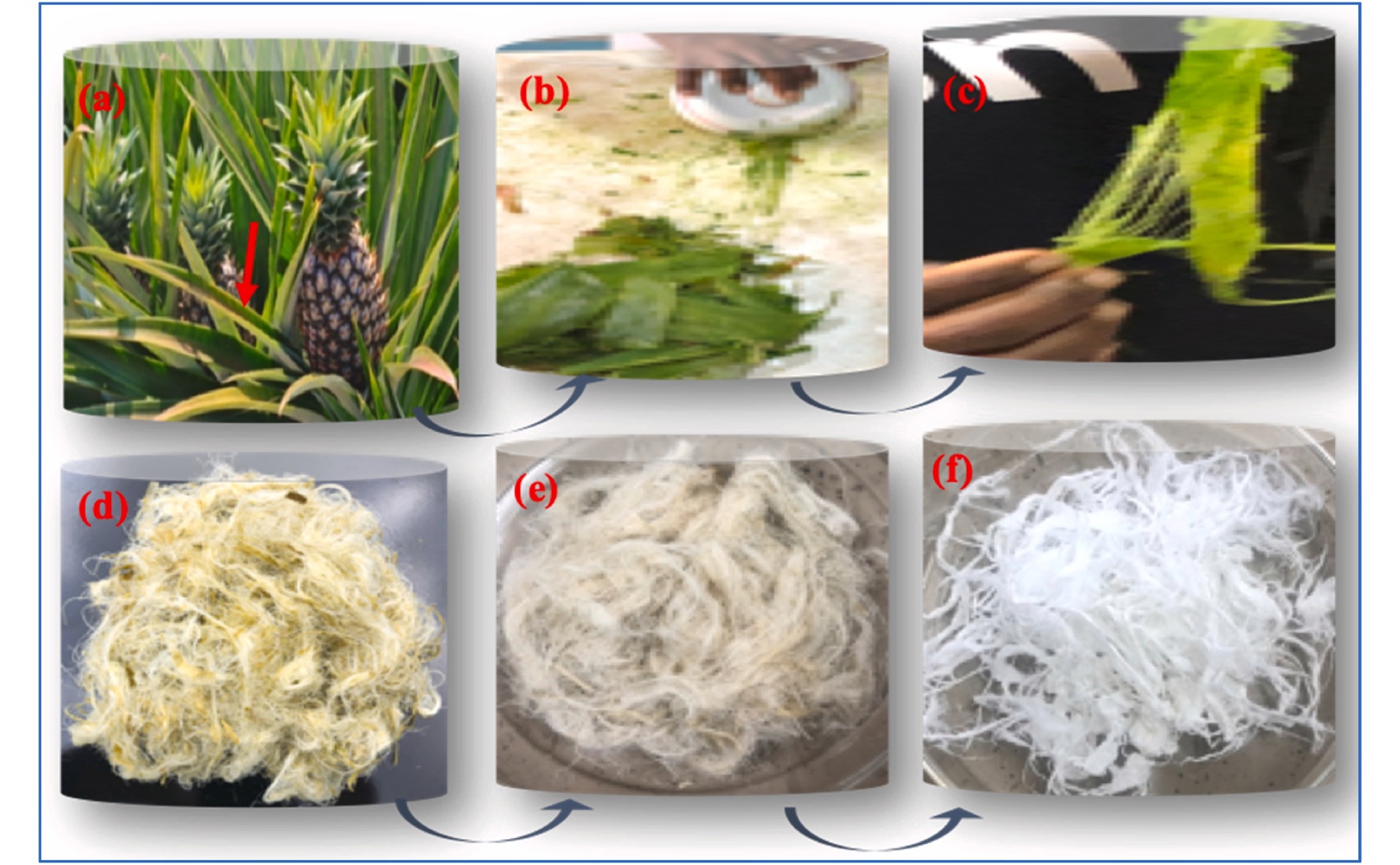
The visual progression from raw Pineapple (Ananas comosus) leaves (a–c) through the extraction and purification process (d–f) demonstrates the effective conversion of agricultural waste into clean, white cellulose microfibres.

Image adapted from: Anukwah et al. / CC BY (Source)

Key Findings

  • The University of Cape Coast developed biodegradable microfibers from oil palm mesocarp fibers and pineapple leaves
  • The extraction process used is economical and environmentally friendly, making it suitable for large-scale applications
  • The resulting microfibers are cleaner, smoother, and more porous, confirmed to be pure cellulose through various characterization techniques
The University of Cape Coast recently conducted a study to create environmentally sustainable and biodegradable microfibers from agricultural waste, specifically oil palm mesocarp fibers (OPMF) and pineapple leaves (PL)[1]. This research addresses the urgent need for eco-friendly waste management solutions and the development of sustainable materials. The extraction process used in this study is called alkaline-peroxide purification. This method is both economical and environmentally friendly, making it an attractive option for large-scale applications. The goal was to produce porous, biodegradable, biocompatible, and non-toxic solid supports that could be used in various future applications. The study involved several characterization techniques to confirm the cellulosic nature of the extracted microfibers. Scanning electron microscopy (SEM) images revealed that the bleached microfibers (B-OPMF and B-PLF) were cleaner, smoother, and more porous compared to the unrefined fibers (Ur-OPMF and Ur-PLF). Energy-dispersive X-ray spectroscopy (EDS) analysis showed peaks of carbon (C) and oxygen (O), indicating the presence of pure cellulose. Fourier-transform infrared (FTIR) spectral analysis further confirmed that the extracted cellulose-based fibers (B-OPMF and B-PLF) had similar compositions to the reference cellulose (P-GB). Thermogravimetric analysis (TGA) was used to study the thermal stability of the fibers. The maximum weight degradation occurred at 363.11°C for the reference cellulose (P-GB), 334.55°C for the bleached palm fibers (B-OPMF), and 375.68°C for the bleached pineapple leaf fibers (B-PLF). These temperatures correspond to the decomposition of cellulose, confirming the cellulosic nature of the fibers. Differential scanning calorimetry (DSC) tests verified the thermally induced transitions of the microfibers. This study builds upon earlier findings related to the use of agricultural waste for sustainable material production. For example, previous research demonstrated the potential of oil palm mesocarp fiber waste in creating thermoplastic starch (TPS) composites with improved tensile strength, thermal stability, and water resistance[2]. These composites were used to produce biodegradable seeding pots that could support plant growth and degrade slowly in soil without releasing pollutants. The current study from the University of Cape Coast expands on this by focusing on the extraction of pure cellulose microfibers, offering a new avenue for utilizing agricultural waste. Additionally, the research aligns with the global need for efficient agri-waste management technologies. Improper management of agricultural waste leads to environmental pollution, economic losses, and health problems[3]. By converting agricultural residues into valuable materials like cellulose microfibers, this study contributes to the development of eco-friendly and cost-effective waste management solutions. The potential applications of these cellulose-based microfibers are vast. They could be used as functionalized microfibre supports in various industries, including biocompatible materials for medical applications, biodegradable packaging, and more. This aligns with the broader goal of reducing reliance on fossil-based fuels and chemicals, which are known to cause significant environmental issues[4]. In conclusion, the University of Cape Coast's study offers a promising solution for the sustainable management of agricultural waste. By converting oil palm mesocarp fibers and pineapple leaves into pure cellulose microfibers, this research not only addresses environmental concerns but also opens up new possibilities for the development of biodegradable and biocompatible materials.

SustainabilityBiotechPlant Science

References

Main Study

1) Production of natural cellulose-based microfibres, from oil palm mesocarp fibres and pineapple leaf wastes, as porous supports for further applications.

Published 30th September, 2024 (future Journal edition)

https://doi.org/10.1016/j.heliyon.2024.e37701


Related Studies

2) Thermoplastic starch composite with oil palm mesocarp fiber waste and its application as biodegradable seeding pot.

https://doi.org/10.1016/j.carbpol.2022.120221


3) Exploring agricultural waste biomass for energy, food and feed production and pollution mitigation: A review.

https://doi.org/10.1016/j.biortech.2022.127566


4) Sustainable utilization of pineapple wastes for production of bioenergy, biochemicals and value-added products: A review.

https://doi.org/10.1016/j.biortech.2022.127085


Related Articles

An unhandled error has occurred. Reload 🗙