Finding Common Trends and Ecosystem States to Guide Alaska Fisheries Management

Greg Howard
9th June, 2025

Finding Common Trends and Ecosystem States to Guide Alaska Fisheries Management

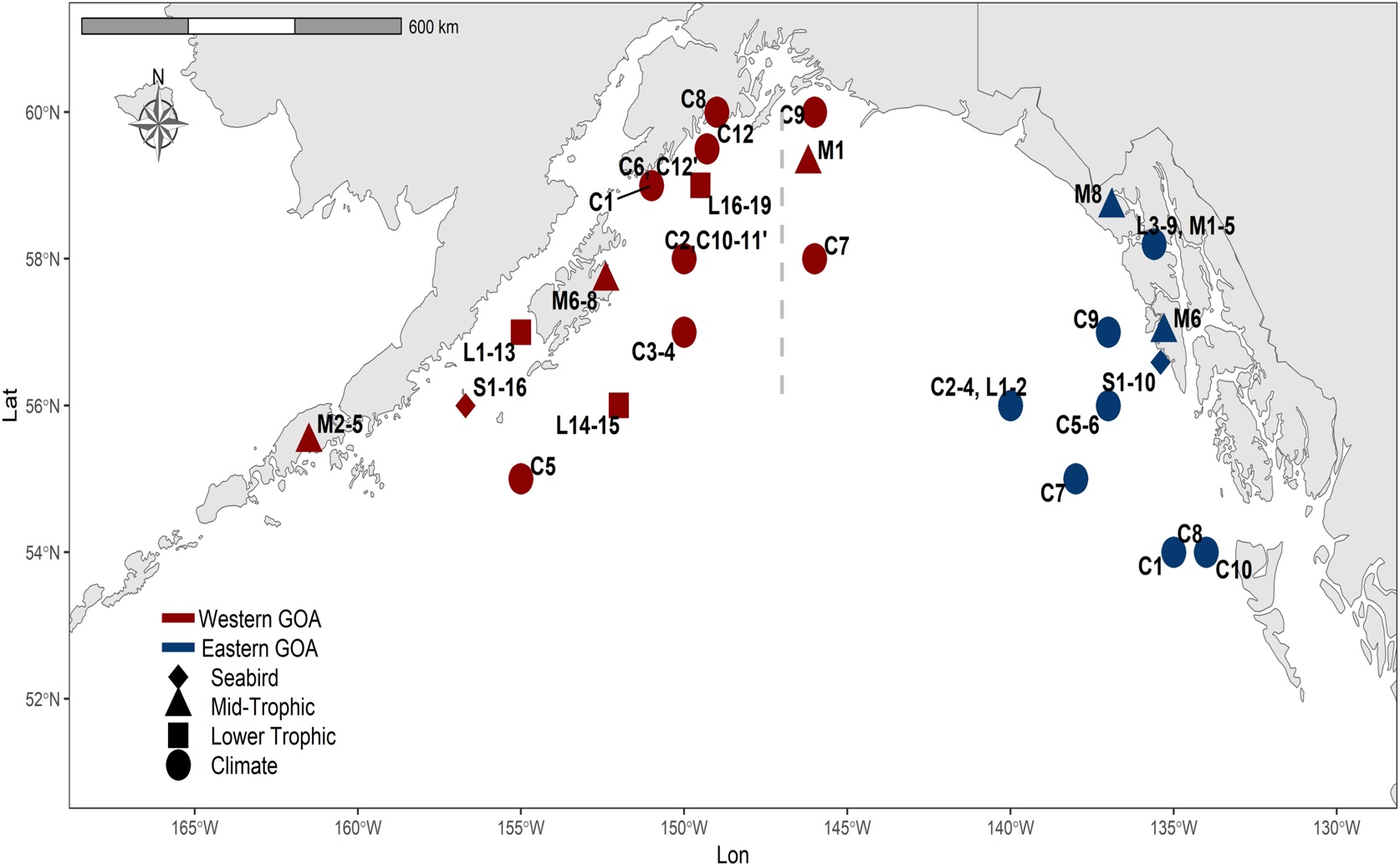
This study analyzed a diverse set of ecological indicators from locations across the Gulf of Alaska, which were separated into western (red) and eastern (blue) regions to identify distinct ecosystem trends and states.

Image adapted from: Ferriss et al. / CC BY (Source)

Key Findings

  • In the Gulf of Alaska, scientists reviewed decades of ocean and species data to track how climate and marine life change together
  • They used advanced statistics to pinpoint common trends and distinct ecosystem states, helping fisheries managers adjust fish harvests wisely
[1] A recent study from the National Oceanic and Atmospheric Administration focuses on integrating ecosystem information into fisheries management for the Gulf of Alaska. The aim is to provide resource managers with clear, science-based insights that will support decisions about groundfish harvests. This study uses advanced statistical techniques to identify common trends and different ecosystem states across decades of data, helping to translate complex natural processes into manageable indicators. The researchers analyzed 92 different indicators that span various components of the marine ecosystem. These indicators cover climate data as well as biological measurements from the lower trophic level (such as plankton), mid-trophic level (forage fish), and top predators like seabirds. Some of the time series extend from 25 to 52 years, with all data current through 2022. A central element of the study was the application of Dynamic Factor Analysis (DFA). DFA is a tool that helps find shared patterns among many datasets. In this case, it was used to reveal common trends among the wide range of indicators—such as coordinated shifts in zooplankton biomass observed across the region. By reducing the complexity of the multiple datasets into a few trends, the researchers can more easily communicate these findings to decision-makers responsible for managing fisheries. In addition to DFA, the researchers applied hidden Markov models (HMM). HMMs are statistical methods designed to detect underlying states in systems that can change over time, even when these states are not directly observable. In ecological research, HMMs are valuable because ecosystem processes are often hidden behind indirect observations, as noted in earlier work[2]. In this study, HMMs revealed that the Gulf of Alaska ecosystem typically exists in two or three distinct states. These states largely corresponded with known shifts in ecosystem dynamics that had previously been documented to occur in the mid-1970s, late 1980s, and around 2014. Such shifts include significant changes in species composition and productivity levels that affect the entire food web. Finding these ecosystem states is crucial. They provide a simplified but robust way to understand how the ecosystem is functioning at any given time. With this information, fisheries managers can adjust harvest specifications based on the current state of the ecosystem rather than relying on historical averages or isolated indicators. The ability to update these analyses annually provides an early warning system; if the correlations among indicators start to change, it may indicate that the ecosystem is shifting to a different state. This dynamic approach to monitoring ecosystem health aligns with earlier research that highlighted the usefulness of recognizing stochastic shifts in ecological states[2]. Interestingly, this study ties in with other ecosystem monitoring efforts in the region. For instance, previous research on mass mortality events in seabirds[3] and long-term monitoring following events like the Exxon Valdez oil spill[4] have shown that abrupt changes in ecosystem information often have far-reaching impacts. The current study builds on these findings by providing a more systematic and statistically robust framework to identify such changes. Additionally, research on larval fish dynamics in the Northeast Pacific[5] underscores how sensitive early life stages of marine species are to environmental shifts, further emphasizing the importance of integrating ecosystem indicators into management decisions. The methods used in this study are both timely and practical. Dynamic Factor Analysis pulls out underlying trends among the various indicators, allowing complex data to be communicated effectively to fisheries managers. Meanwhile, Hidden Markov Models offer a means to detect sudden shifts or transitions between ecosystem states that may require rapid management responses. One of the appealing aspects of these approaches is their ability to highlight non-stationarity—situations where relationships between different parts of the ecosystem change over time. Recognizing and quantifying non-stationarity is important because it can serve as an early warning signal that prevention or mitigation measures might be needed soon. In practice, the annual updating of DFA and HMM analyses as part of existing ecosystem reporting systems provides fisheries managers with near-real-time information. This ongoing monitoring system helps to ensure that management decisions keep pace with the changing conditions in the Gulf of Alaska. By streamlining the process of collecting and interpreting ecosystem-wide data, concerned agencies can better support sustainable fisheries and balance them with other conservation goals. Overall, this study represents a significant step forward in ecosystem-based fisheries management. By incorporating robust statistical techniques and over 25 years of ecosystem data, the researchers have provided a template that can support more informed management decisions. This approach not only complements earlier studies that revealed hidden changes in ecological systems[2] but also addresses recent, high-profile ecosystem shifts observed in marine species[3][4][5]. The integration of these tools into annual management updates promises an improved ability to predict, respond, and adapt to the continually changing marine environment.

EcologyMarine Biology

References

Main Study

1) Identifying common trends and ecosystem states to inform Gulf of Alaska ecosystem-based fisheries management

Published 6th June, 2025

https://doi.org/10.1371/journal.pone.0324154


Related Studies

2) Uncovering ecological state dynamics with hidden Markov models.

https://doi.org/10.1111/ele.13610


3) Extreme mortality and reproductive failure of common murres resulting from the northeast Pacific marine heatwave of 2014-2016.

https://doi.org/10.1371/journal.pone.0226087


4) Ecosystem response persists after a prolonged marine heatwave.

https://doi.org/10.1038/s41598-021-83818-5


5) Responses of ichthyoplankton assemblages to the recent marine heatwave and previous climate fluctuations in several Northeast Pacific marine ecosystems.

https://doi.org/10.1111/gcb.15415


Related Articles

An unhandled error has occurred. Reload đź—™