Upstream Regions Stabilize Protein Production in Evolution and Development

Jenn Hoskins
9th June, 2025

Upstream Regions Stabilize Protein Production in Evolution and Development

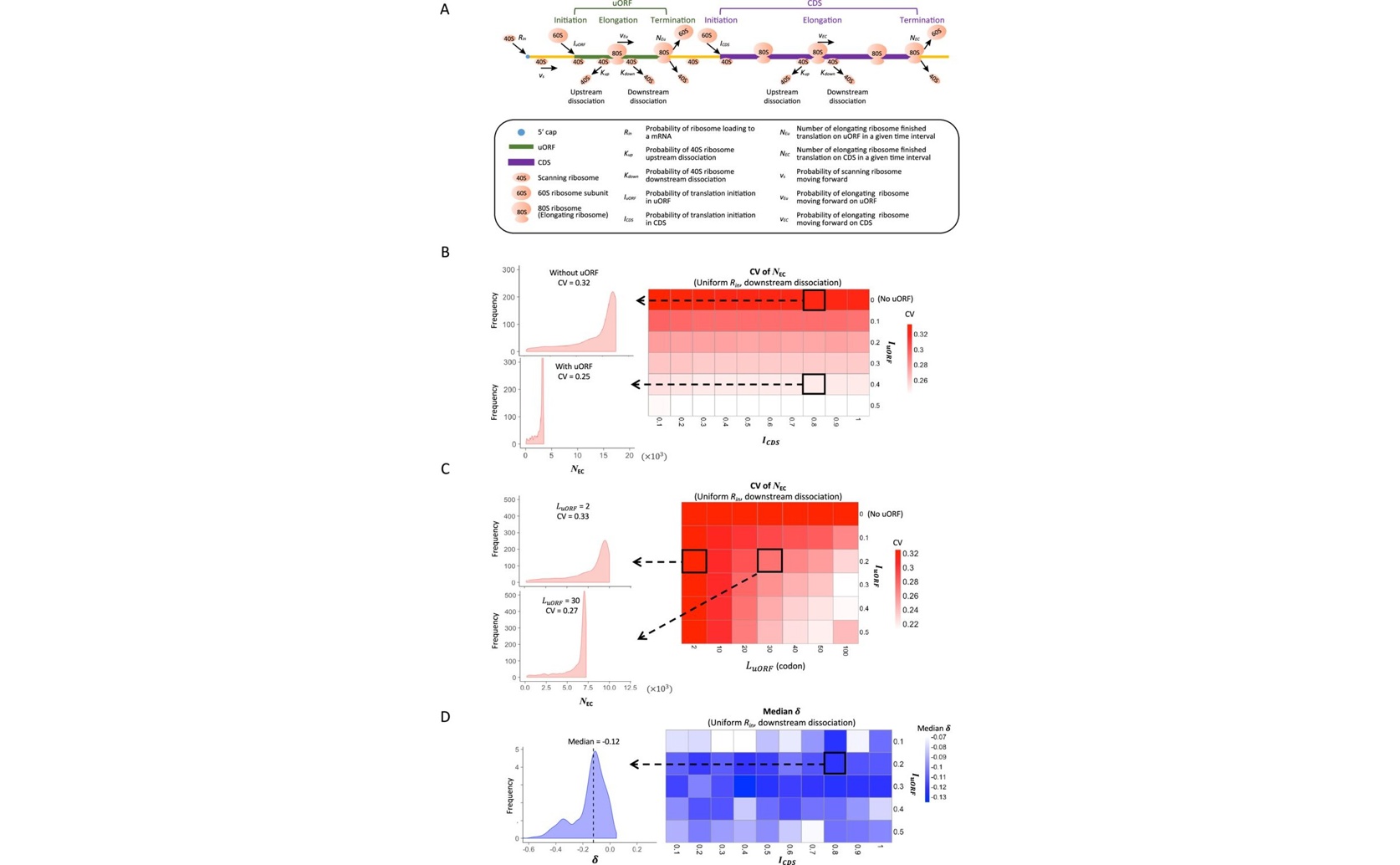
Mathematical simulations (a) demonstrate that the presence of upstream open reading frames (uORFs) functions as a buffer to significantly reduce the variability of downstream coding sequence translation (b–d).

Image adapted from: Sun et al. / CC BY (Source)

Key Findings

  • In fruit flies studied at Peking University, uORFs in mRNA act like “molecular dams” that help keep protein production steady despite mRNA fluctuations
  • Computer simulations and translation profiling show that more efficient, longer, or additional uORFs reduce variability in downstream protein synthesis
  • Removing a uORF from the bicoid gene disrupted gene expression and development, confirming uORFs’ key role in stabilizing protein levels
[1] A recent study from Peking University has provided new insights into how cells maintain stable protein levels during development and evolution by using upstream open reading frames (uORFs). Proteins are essential molecules that perform a wide range of functions inside cells, and their production is controlled at many levels. One key regulatory layer is the process of translation—the step during which the messenger RNA (mRNA) is converted into protein. Although mRNA levels can vary significantly, protein abundance is much more conserved across species. This longstanding puzzle may be explained by the presence of uORFs, small sequences located upstream of the main coding region (coding sequence, or CDS) that can influence how much protein is made. The study focused on assessing the role of uORFs in buffering the variability of translation. In simple terms, buffering here means reducing the fluctuations in protein synthesis so that despite changes in mRNA levels, the final amount of protein remains relatively steady. To address this, the researchers used computer simulations of ribosome translation—a method where the movement and activity of ribosomes (the cellular machines that convert mRNA into protein) are modeled on mRNA molecules. Their simulations showed that when uORFs are actively translated, they dampen the variability in translation of the downstream CDS. Moreover, the study found that the buffering capacity closely correlates with how efficiently and how often these uORFs are translated. Longer uORFs or a greater number of uORFs resulted in stronger buffering effects. In addition to computational simulations, the study analyzed the translatome—the complete set of mRNAs being actively translated—across different developmental stages in two species of the fruit fly Drosophila. This comparison highlighted that uORFs played a similar buffering role during development, acting to stabilize protein production even when mRNA translation levels fluctuated between species. By broadening the study to include different species and stages of development, the authors provided strong evidence that uORFs contribute to the evolutionary conservation of protein levels. To support their simulation data, the researchers went a step further and carried out experimental genetic manipulations. In one set of experiments, they specifically deleted a uORF from the bicoid (bcd) gene in Drosophila melanogaster. The bicoid gene is a well-known example involved in early developmental processes. Deleting its uORF led to extensive changes in gene expression and observable differences in phenotype (the physical traits of the organism). The experimental results confirmed that the absence of the uORF disrupted the normal buffering mechanism, resulting in more variable protein production from the bicoid gene. This direct intervention further solidifies the idea that uORFs are a critical regulatory element ensuring consistency in translation. These new findings build upon earlier research that identified uORFs as important regulators of protein synthesis. For instance, previous studies demonstrated that under stressful conditions, cells can limit overall protein production by targeting translation initiation factors; however, certain mRNAs that include functional uORFs can escape this broad repression[2]. Additional computational models from other researchers have predicted that uORFs, depending on their features like translation efficiency and length, are able to control the flux of ribosomes along the mRNA, effectively positioning them as gatekeepers that modulate translation initiation on the main CDS[3]. By showing that uORFs reduce fluctuations in translation not only under stress but throughout development and across species, the current study expands on these earlier findings, providing a broader biological context for uORF-mediated regulation. Furthermore, the study’s results align with existing evidence about the evolutionary stability of protein levels. Earlier evolutionary analyses pointed out that despite rapid changes in mRNA levels, protein abundances tend to remain conserved between species, suggesting that there must be regulation beyond transcription—a point underscored by the buffering role of uORFs. The present work from Peking University supplies a mechanistic explanation for this phenomenon, indicating that uORFs help maintain steady protein synthesis even when other regulatory processes vary. Such insights could have implications for understanding genetic diseases and developmental disorders, where misregulation of protein synthesis is often a contributing factor. In summary, the study offers a clear demonstration that uORFs act as stabilizers in the translation process. The combination of ribosome translation simulations, developmental comparisons, and targeted genetic experiments firmly establishes that uORFs are not just passive sequences but are essential regulatory elements that attenuate variations in mRNA translation. The research shows that these elements contribute to both the immediate control of protein synthesis during stress and development as well as to the long-term evolutionary conservation of protein levels. This work represents an important step in understanding how cells buffer fluctuations in gene expression and ensure that crucial proteins are produced consistently, despite variability in upstream processes.

GeneticsEvolution

References

Main Study

1) Upstream open reading frames buffer translational variability during Drosophila evolution and development

Published 6th June, 2025

https://doi.org/10.7554/eLife.104074


Related Studies

2) Translation of 5' leaders is pervasive in genes resistant to eIF2 repression.

https://doi.org/10.7554/eLife.03971


3) TASEP modelling provides a parsimonious explanation for the ability of a single uORF to derepress translation during the integrated stress response.

https://doi.org/10.7554/eLife.32563


Related Articles

An unhandled error has occurred. Reload 🗙