Exploring Virus Gene Swaps with Bunyamwera and Batai

Greg Howard
2nd June, 2025

Exploring Virus Gene Swaps with Bunyamwera and Batai

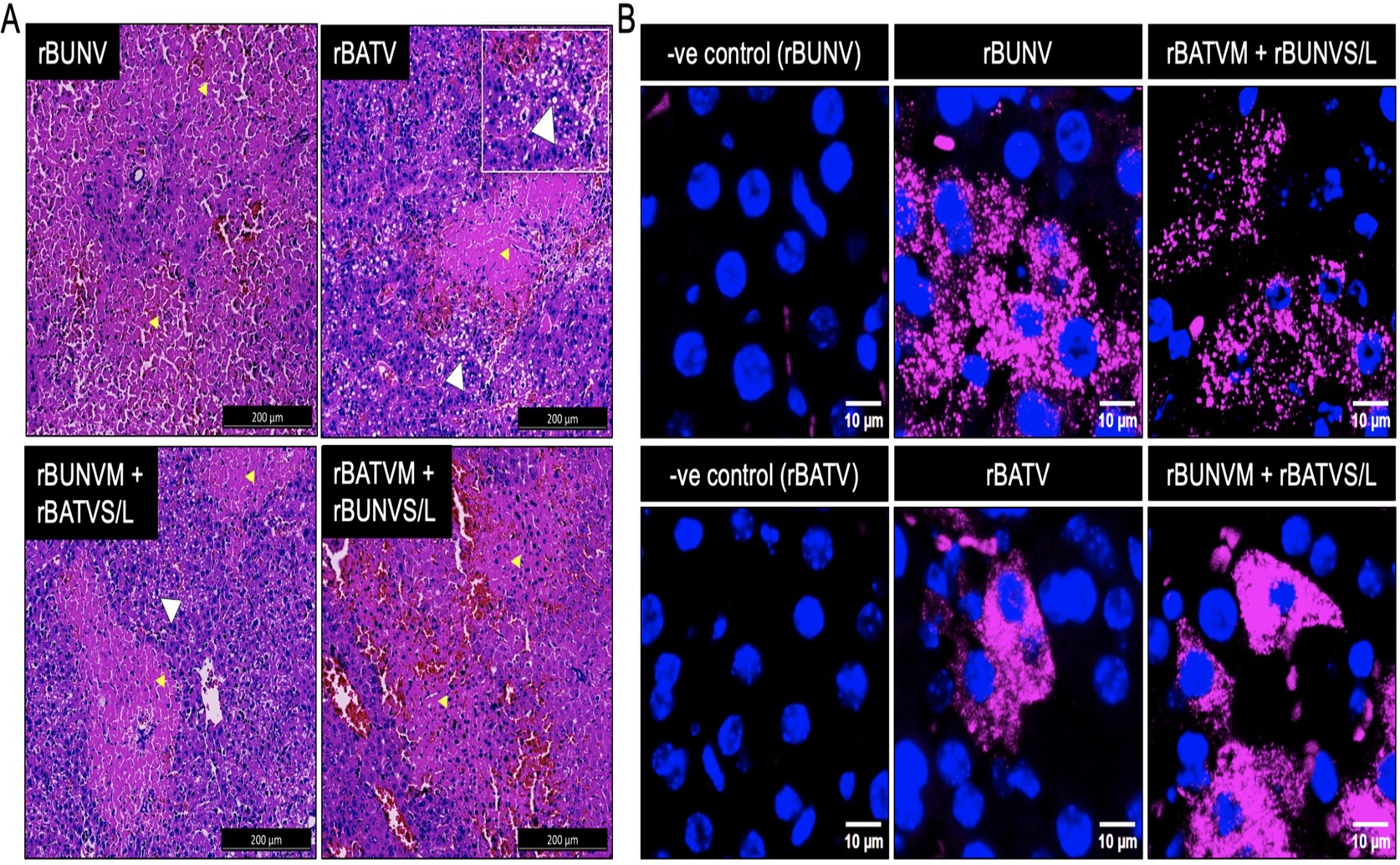
Histological examination revealed that Bunyamwera virus and Batai virus parental and reassortant strains induced severe hepatic necrosis in interferon-deficient mice (a), with Batai virus notably associated with fatty acid accumulation, while fluorescence in situ hybridization confirmed active viral RNA replication within the liver (b).

Image adapted from: Bowen et al. / CC BY (Source)

Key Findings

  • In labs at Indiana University, University of Pittsburgh, and Texas A&M, scientists mixed gene segments from two related viruses to study how swapping parts affects virus behavior
  • The engineered virus hybrids grew well in cells and showed different disease patterns in mice, showing that small genetic swaps can change a virus’s infectious power
[1] Researchers from Indiana University School of Medicine, University of Pittsburgh School of Medicine, and Texas A&M University have taken a significant step forward in understanding how viruses evolve by swapping sections of their genetic material. Viruses with segmented genomes, such as those in the orthobunyavirus group, can exchange whole pieces of RNA during co-infection—a process known as reassortment. This mechanism can alter a virus’s ability to infect, replicate, and cause disease. Past studies have shown that many bunyaviruses have three distinct RNA segments. In earlier work, scientists proposed that much of the genetic diversity seen among these viruses could be explained by frequent reassortment events[2]. Similarly, research on influenza A viruses has established that mixing of gene segments is central to the emergence of new strains with pandemic potential[3]. These findings underscore the importance of reassortment as a driving force behind viral evolution and disease emergence. In the current study, the research team focused on two representative orthobunyaviruses—Bunyamwera virus (BUNV) and Batai virus (BATV)—to explore how reassortment influences virus behavior and potentially increases pathogenicity. Key to their approach was the use of reverse genetics, a method that allows scientists to engineer viruses from scratch using defined genetic components. Prior to this work, only BUNV had a well-established reverse genetics system; establishing one for BATV marked a noteworthy achievement. The researchers generated reassortant viruses by deliberately mixing gene segments from BUNV and BATV. They then used a combination of minigenome assays and a novel hybridization chain reaction assay to study these engineered viruses. A minigenome assay is a controlled laboratory approach that helps determine how well the virus's replication machinery functions when confronted with genetic segments from different origins. By confirming that the replication process was compatible across the mixed segments, the team could be confident that the reassortant viruses were viable. The hybridization chain reaction assay provided high-resolution visualization of individual viral RNA segments inside infected cells, giving insights into how the genetic material is organized and behaves during infection. All six reassortants generated in this study were found to be viable, meaning that they could successfully infect cells and replicate. Interestingly, when these viruses were tested in interferon receptor-deficient mice (IFNAR-/- mice), each reassortant exhibited distinct differences in how aggressively it caused disease. The use of IFNAR-/- mice, which have a compromised ability to mount an antiviral interferon response, provided a sensitive model to uncover differences in viral behavior that might be masked in a normal immune setting. These results not only confirm the role of reassortment in generating genetic diversity among orthobunyaviruses but also demonstrate that even small changes in a virus’s genome can have a significant impact on its pathogenicity. By showing that viruses created with mixed gene segments can differ notably in their behavior in animal models, the study offers a concrete example of how reassortment can alter virus properties such as transmissibility and virulence. This finding builds on earlier research[2] by not only reinforcing that segment interchange is common but by also highlighting that these changes can have clear biological consequences. It also complements the work on influenza A viruses[3] and observations from natural reassortants related to disease outbreaks in Africa[4][5]. The methods developed in this study provide important tools for future research. The established reverse genetics system for BATV now makes it easier for researchers to study this virus in detail and to examine how reassortment events might lead to the emergence of novel pathogens. The ability to create and study reassortant viruses in a controlled environment is vital, as it can help predict and perhaps prevent the rise of new strains that could affect both human and animal populations. This work has clear implications in the context of One Health—a perspective that recognizes the interconnectedness of human, animal, and environmental health. Viruses like BUNV and BATV are not confined to a single host species, and their ability to reassort means that viruses can potentially jump from animals to humans with new properties that might pose significant health risks. Previous observations of natural reassortant viruses causing outbreaks[4][5] highlight the need for ongoing surveillance and research into these mechanisms. Overall, the study provides a practical demonstration of the complex interplay of viral genetics that shapes pathogen evolution. By integrating improved experimental approaches with insights from earlier research, the team has enhanced our understanding of how genetic shifts in segmented viruses contribute to disease emergence. This knowledge is crucial for informing public health strategies and for the development of interventions to mitigate future outbreaks.

GeneticsEvolution

References

Main Study

1) Probing orthobunyavirus reassortment using Bunyamwera and Batai viruses as models

Published 30th May, 2025

https://doi.org/10.1371/journal.pntd.0013120


Related Studies

2) Viruses of the family Bunyaviridae: are all available isolates reassortants?

https://doi.org/10.1016/j.virol.2013.07.030


3) Constraints, Drivers, and Implications of Influenza A Virus Reassortment.

https://doi.org/10.1146/annurev-virology-101416-041726


4) Ngari virus is a Bunyamwera virus reassortant that can be associated with large outbreaks of hemorrhagic fever in Africa.

Journal: Journal of virology, Issue: Vol 78, Issue 16, Aug 2004


5) A Review of Bunyamwera, Batai, and Ngari Viruses: Understudied Orthobunyaviruses With Potential One Health Implications.

https://doi.org/10.3389/fvets.2018.00069


Related Articles

An unhandled error has occurred. Reload 🗙