New AI Tool for Identifying and Tracking Cells

Jim Crocker
26th May, 2025

New AI Tool for Identifying and Tracking Cells

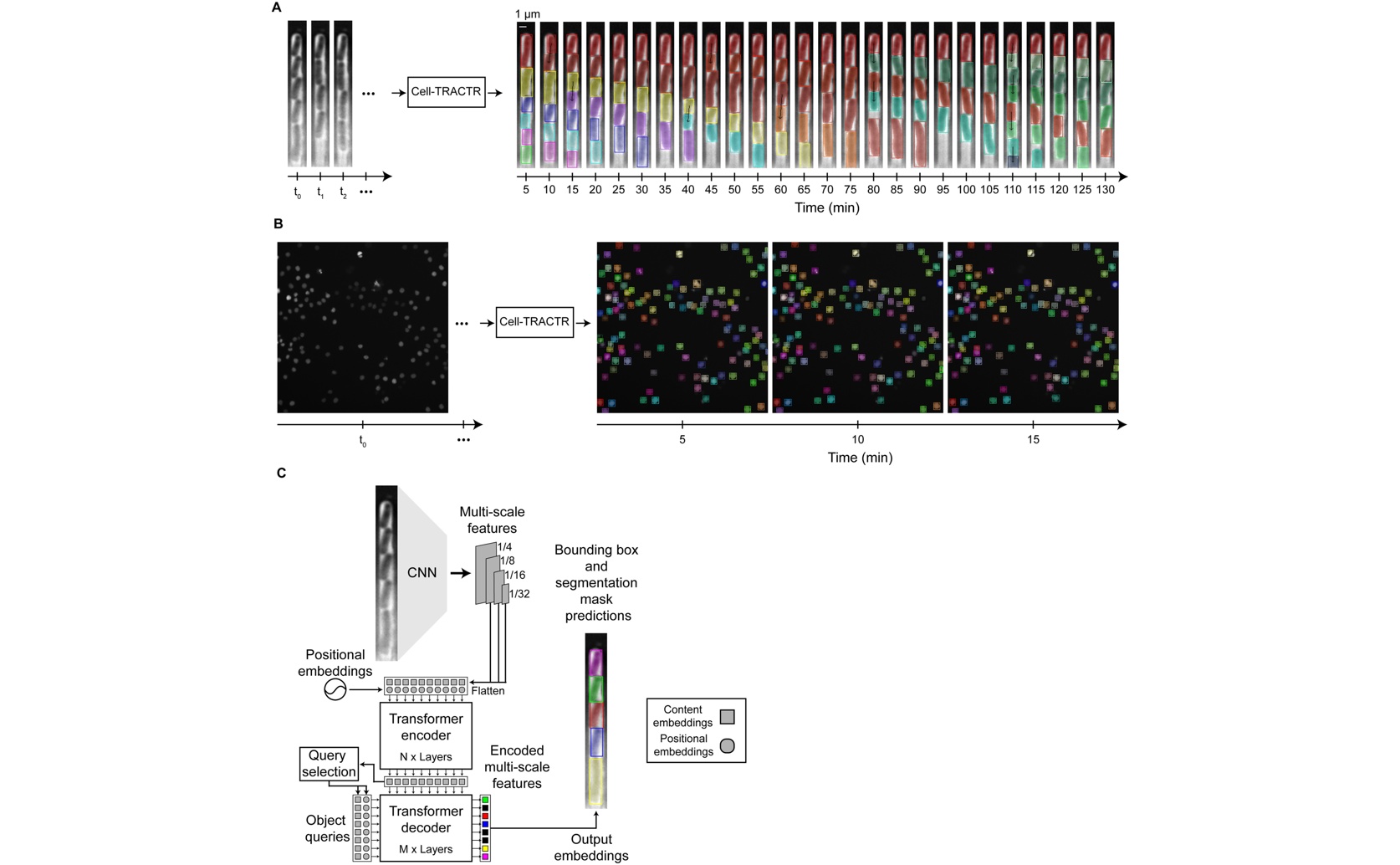
The Cell-TRACTR model utilizes a transformer-based encoder-decoder framework (c) to simultaneously segment and track cells without post-processing, as demonstrated by the accurate reconstruction of Escherichia coli lineages (a) and mammalian nuclei trajectories (b).

Image adapted from: O'Connor et al. / CC BY SA (Source)

Key Findings

  • Researchers at Boston University developed Cell-TRACTR, a new AI tool for tracking and segmenting cells in microscope images
  • Cell-TRACTR outperforms existing methods by accurately following cells during divisions and complex movements
  • The study introduced Cell-HOTA, a novel metric that better evaluates the accuracy of cell tracking
Advancements in microscopy have significantly enhanced our ability to observe and analyze cells at a high resolution. However, despite these technological improvements, analyzing the vast amounts of data generated remains a challenge. Accurately segmenting and tracking cells, especially during dynamic processes like cell division, is crucial for understanding various biological phenomena. Traditional methods often require substantial human input and struggle with accuracy when dealing with complex cell behaviors. To address these challenges, researchers at Boston University have developed a novel deep learning model named Cell-TRACTR[1]. This model leverages a transformer-based architecture, which is a type of neural network designed to handle sequential data and capture long-range dependencies. Unlike previous models that rely on convolutional neural networks (CNNs), Cell-TRACTR effectively manages the spatial and global contextual dependencies necessary for precise cell tracking. This capability is particularly important when cells undergo frequent divisions or when tracking numerous cells with similar appearances, scenarios where existing CNN-based methods often falter. Cell-TRACTR operates in an end-to-end manner, meaning it can simultaneously segment and track cells without requiring additional post-processing steps. This streamlined approach not only simplifies the workflow but also enhances the accuracy and efficiency of cell analysis. To evaluate the performance of Cell-TRACTR, the researchers introduced a new metric called Cell-HOTA. This metric is an extension of the Higher Order Tracking Accuracy (HOTA) metric, specifically adapted to assess cell division. Cell-HOTA provides a balanced and easily interpretable evaluation of detection, association, and division accuracy, offering a more comprehensive assessment compared to standard tracking metrics. The effectiveness of Cell-TRACTR was tested on datasets involving bacteria growing within a defined microfluidic geometry and mammalian cells growing freely in two dimensions. The results demonstrated that Cell-TRACTR outperformed state-of-the-art algorithms in both tracking and division accuracy while maintaining high detection accuracy. This performance indicates that transformer-based models like Cell-TRACTR can set a new standard for cell segmentation and tracking in biological research. The development of Cell-TRACTR builds on previous advancements in the field. For instance, Omnipose[2], a deep neural network for image segmentation, has shown that accurate cell segmentation is achievable even in mixed bacterial cultures and varied imaging modalities. Omnipose’s success in segmenting diverse and arbitrarily shaped cells highlights the potential of deep learning models in enhancing microscopy analysis. Similarly, DeLTA 2.0[3], a Python-based workflow, has improved the speed and accuracy of analyzing single-cell data in two-dimensional environments, which are common in experimental settings. These tools have laid the groundwork for more sophisticated models like Cell-TRACTR by demonstrating the importance of accurate segmentation and tracking in cell research. Additionally, advancements in multiple-level-set methods[4] have improved cell segmentation and tracking by enhancing robustness and applicability across different biological imaging studies. These methods have shown that incorporating topological changes and handling multiple cells concurrently can significantly boost tracking performance and reduce computation time. The innovations introduced by Cell-TRACTR align with these improvements by efficiently managing cell divisions and maintaining high tracking accuracy in complex scenarios. The introduction of transformer-based architectures in Cell-TRACTR represents a significant shift from traditional CNN-based approaches. Transformers excel at understanding the broader context within data, which is essential for tracking cells that may move, divide, or change shape over time. By capturing these global dependencies, Cell-TRACTR can maintain consistent tracking of cells across different frames of microscopy images, even when cells undergo complex behaviors. Moreover, the Cell-HOTA metric enhances the evaluation process by specifically addressing the accuracy of cell divisions. Traditional metrics often overlook the intricacies of cell division, which can lead to incomplete assessments of tracking performance. By incorporating division accuracy, Cell-HOTA provides a more nuanced understanding of a model's effectiveness, ensuring that both the detection and the dynamic behaviors of cells are accurately captured. The implementation of Cell-TRACTR also emphasizes accessibility and usability. The model was tested on datasets from diverse environments, including controlled microfluidic setups and more natural two-dimensional growth conditions. This versatility demonstrates Cell-TRACTR's potential applicability across a wide range of biological studies, from microbiology to mammalian cell research. By requiring no human input after training, Cell-TRACTR simplifies the workflow, allowing researchers to focus more on data interpretation rather than the technical challenges of data analysis. In conclusion, Cell-TRACTR represents a significant advancement in the field of cell segmentation and tracking. By utilizing transformer-based architectures and introducing the Cell-HOTA metric, this model addresses the limitations of previous CNN-based methods and provides a more accurate and efficient tool for analyzing complex cell behaviors. Building on the foundation laid by earlier studies[2][3][4], Cell-TRACTR sets a new benchmark for automated cell analysis, promising to accelerate research in various biological and medical fields.

BiotechBiochem

References

Main Study

1) Cell-TRACTR: A transformer-based model for end-to-end segmentation and tracking of cells

Published 23rd May, 2025

https://doi.org/10.1371/journal.pcbi.1013071


Related Studies

2) Omnipose: a high-precision morphology-independent solution for bacterial cell segmentation.

https://doi.org/10.1038/s41592-022-01639-4


3) DeLTA 2.0: A deep learning pipeline for quantifying single-cell spatial and temporal dynamics.

https://doi.org/10.1371/journal.pcbi.1009797


4) Advanced level-set-based cell tracking in time-lapse fluorescence microscopy.

https://doi.org/10.1109/TMI.2009.2038693


Related Articles

An unhandled error has occurred. Reload 🗙