How Horses Show Emotions When Expecting Good or Bad Things

Greg Howard
17th May, 2025

How Horses Show Emotions When Expecting Good or Bad Things

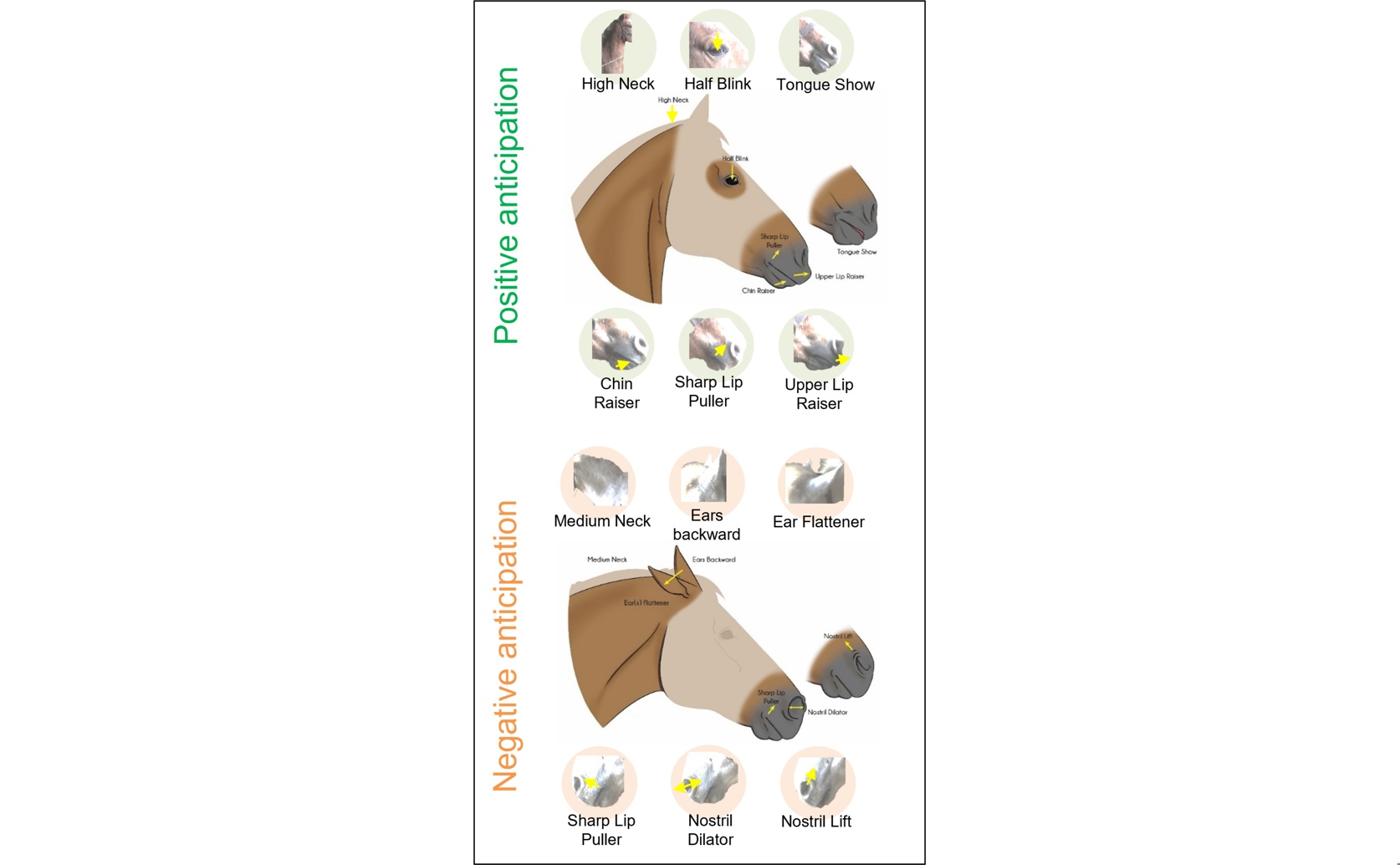
Distinct facial expression profiles identified in horses (Equus caballus) demonstrate that positive anticipation is characterized by a high neck, half-blinks, and mouth movements, whereas negative anticipation is defined by a medium neck, flattened ears, and increased nostril activity.

Image adapted from: Phelipon et al. / CC BY (Source)

Key Findings

  • Researchers in France discovered that horses exhibit different behaviors and facial expressions when expecting positive events like going to pasture or negative ones like social isolation
  • When anticipating a positive experience, horses approached pasture quickly and showed eager behaviors such as head shaking and half-blinks, indicating relaxation and happiness
  • Conversely, before a negative event, horses had higher heart rates and displayed signs of stress through flattened ears and increased nostril movements
Understanding Animal Emotions: Insights from Recent Horse Behavior Research The emotional well-being of animals is a crucial aspect of their overall welfare, impacting how they interact with their environment and respond to various situations. Accurately assessing these emotions, however, poses significant challenges since animals cannot communicate their feelings directly. Researchers have long sought reliable indicators of animal emotions through observable behaviors and physiological responses[2]. A recent study conducted by INRAE, CNRS, Université de Tours in France[1] advances this field by identifying specific behaviors and facial expressions in horses that correlate with positive and negative emotional states. Traditionally, studies on animal emotions have utilized both discrete and dimensional approaches. The discrete emotion approach categorizes emotions into distinct states such as fear or joy, focusing on specific responses[2]. In contrast, the dimensional approach considers emotions along continuous scales like valence (positivity versus negativity) and arousal. Integrating these approaches provides a comprehensive framework for understanding the wide range of animal emotional experiences[2]. The main study from INRAE aimed to bridge the gap between these approaches by examining how horses respond emotionally to different anticipatory conditions. Specifically, the research focused on how horses behave and express themselves facially when anticipating a positive outcome, such as going to pasture, versus a negative outcome, like being taken alone to a new environment. To achieve this, twenty horses were trained daily to wait in a starting box before being exposed to one of the two conditions over the course of a week. The researchers measured various indicators, including the time it took for horses to approach the positive or negative condition, changes in heart rate, cortisol levels (a stress hormone), and facial movements using the Equine Facial Action Coding System (EquiFACS). Additionally, network analysis (NetFACS) was employed to identify patterns in facial expressions that corresponded to each emotional state. Results confirmed that the two conditions indeed induced distinct emotional responses. Horses anticipating a positive experience approached their destination more quickly and exhibited a wider range of behaviors such as head shaking, stepping back, sniffing, and pawing at the ground. These behaviors suggest a state of eagerness and positive anticipation. In contrast, horses anticipating a negative outcome showed higher heart rates and greater cortisol variation, indicating stress and anxiety. Facial expressions further differentiated the emotional states. In positive anticipation, horses displayed a higher neck position, accompanied by more frequent half-blinks and mouth movements. These expressions are indicative of a relaxed and content state. Conversely, during negative anticipation, horses had a medium neck position with ears flattened backward and increased nostril movements, signs of discomfort and alertness. This study builds on previous research that highlights the complexity of animal emotions and the need for reliable indicators. For example, research on dogs has shown that specific facial expressions can distinguish between positive anticipation and frustration, offering valuable insights into their emotional states[3]. Similarly, studies in other species, such as horses and cats, have demonstrated that different animals exhibit unique behavioral patterns in anticipation of rewards or stressors[4][5]. By incorporating these earlier findings, the current study not only reinforces the idea that facial expressions are crucial indicators of emotion but also expands our understanding of how these expressions vary across different emotional contexts. One notable aspect of the study was the use of EquiFACS, a systematic method for coding equine facial movements. This approach allowed researchers to quantify subtle changes in facial expressions that might otherwise go unnoticed. The application of network analysis (NetFACS) further enabled the identification of distinct facial expression profiles associated with each emotional state, providing a more nuanced perspective on horse emotions. Interestingly, the study also found that basal oxytocin levels were lower in horses subjected to positive grooming, aligning with previous research suggesting that lower basal oxytocin can be a marker of better well-being[2]. This unexpected finding underscores the complexity of physiological indicators and the importance of interpreting them within a broader behavioral and emotional context. The implications of this research are significant for animal welfare science. By identifying specific behaviors and facial expressions linked to positive and negative emotions, caregivers and practitioners can better assess and improve the welfare of horses. For example, understanding that certain grooming techniques elicit positive emotions can inform best practices in horse handling and care, enhancing the animals' overall well-being. Moreover, this study contributes to the ongoing effort to develop more sophisticated tools for evaluating animal emotions across different species. The integration of behavioral observations with facial expression analysis offers a comprehensive approach that can be adapted to other animals, providing a standardized method for assessing emotional states[2][3]. In conclusion, the research conducted by INRAE and its collaborators provides valuable insights into the emotional lives of horses. By identifying specific behaviors and facial expressions associated with positive and negative anticipation, the study advances our ability to assess and enhance animal welfare. This work not only builds on prior studies but also sets the stage for future research aimed at unraveling the complex emotional experiences of animals, ultimately contributing to more humane and informed animal care practices.

Animal Science

References

Main Study

1) Characterisation of facial expressions and behaviours of horses in response to positive and negative emotional anticipation using network analysis

Published 14th May, 2025

https://doi.org/10.1371/journal.pone.0319315


Related Studies

2) An integrative and functional framework for the study of animal emotion and mood.

https://doi.org/10.1098/rspb.2010.0303


3) Differences in facial expressions during positive anticipation and frustration in dogs awaiting a reward.

https://doi.org/10.1038/s41598-019-55714-6


4) Facial expression and oxytocin as possible markers of positive emotions in horses.

https://doi.org/10.1038/s41598-018-32993-z


5) Anticipation is differently expressed in rats (Rattus norvegicus) and domestic cats (Felis silvestris catus) in the same Pavlovian conditioning paradigm.

Journal: Behavioural brain research, Issue: Vol 141, Issue 1, Apr 2003


Related Articles

An unhandled error has occurred. Reload 🗙