Potential Spread and Circulation of the Coronavirus in the Wild

Jenn Hoskins
14th May, 2025

Potential Spread and Circulation of the Coronavirus in the Wild

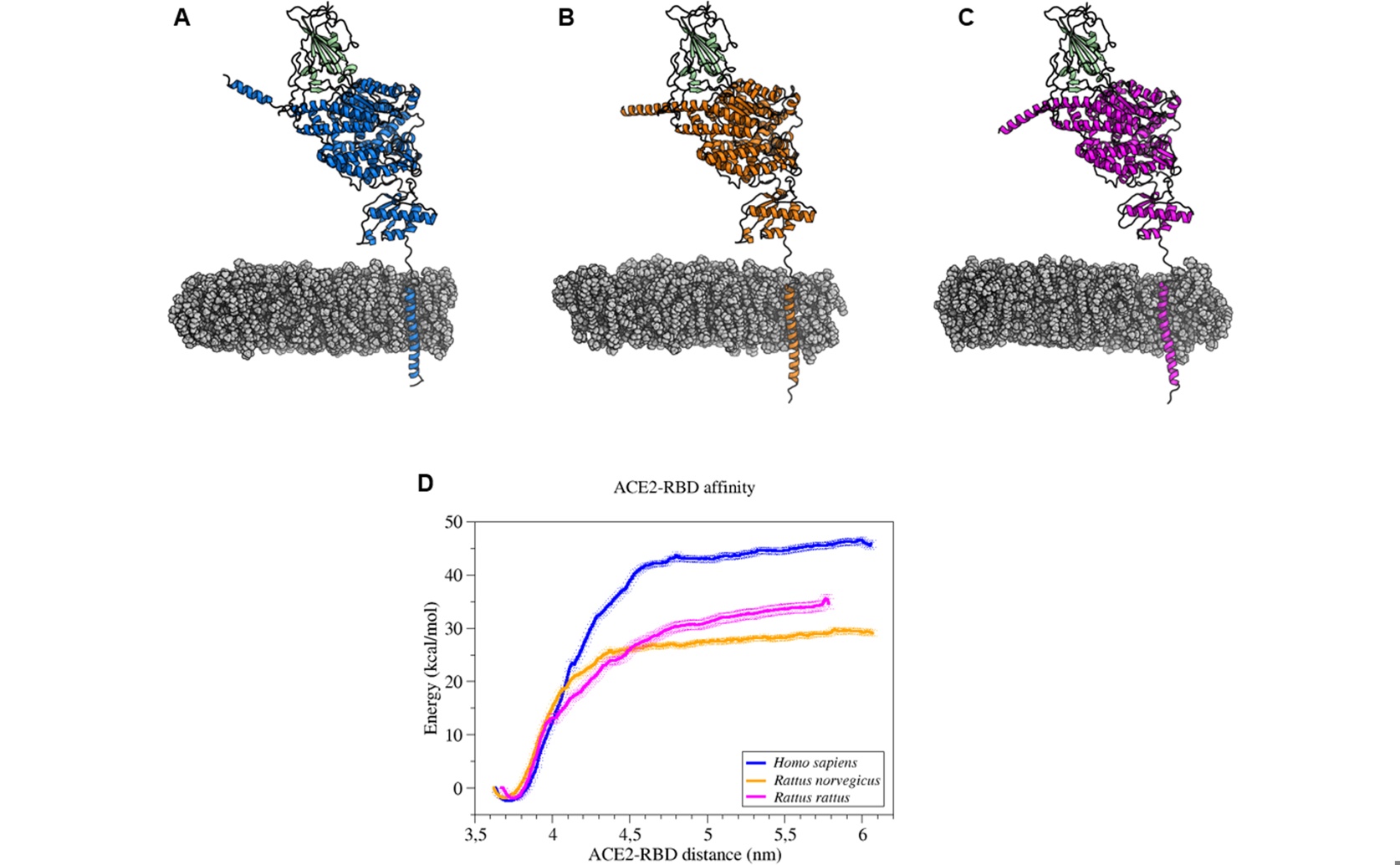
Molecular modelling reveals that the SARS-CoV-2 Omicron BA.5 receptor binding domain exhibits significantly lower binding affinity for the ACE2 receptors of the brown rat (Rattus norvegicus) (B) and black rat (Rattus rattus) (C) compared to humans (Homo sapiens) (A), providing a mechanistic explanation for the resistance to infection observed in these rodent species (D).

Image adapted from: Beissat et al. / CC BY (Source)

Key Findings

  • *In France, researchers tested over 400 city rats and found no active COVID-19 infections.*
  • *Experiments showed rats could produce antibodies but the virus couldn’t effectively infect them.*
  • *Scientific analysis revealed the virus doesn’t easily attach to rat cells, preventing its spread.*
Since the outbreak of COVID-19, caused by the SARS-CoV-2 virus, understanding how the virus interacts with various animal species has been crucial for controlling the pandemic and preventing future outbreaks. While humans are the primary hosts, several animal species have been shown to contract the virus, raising concerns about potential new reservoirs that could sustain and spread the virus[2]. A key concern has been whether urban rat populations could serve as such reservoirs. Rats are widespread in cities worldwide and interact closely with human environments, making them potential candidates for hosting the virus. Previous studies have demonstrated that SARS-CoV-2 can jump from humans to animals. For instance, tigers and lions in the Bronx Zoo were among the first nondomestic species in the United States to contract the virus, likely through human handlers[3]. Additionally, certain SARS-CoV-2 variants, such as B.1.1.7, have shown the ability to infect wildtype mice and rats, suggesting that mutations in the virus could expand its host range[4]. However, another study conducted in Antwerp, Belgium, found no evidence of SARS-CoV-2 infection in urban Norway rats, although it recommended ongoing monitoring due to the emergence of new variants[5]. Addressing these concerns, researchers from ANSES, VetAgroSup, INRAE, Lyon University, IFREMER in France, and the National Veterinary Research Institute in Nigeria conducted a comprehensive study to evaluate the role of urban rats in the transmission of SARS-CoV-2[1]. The study combined surveillance of wild rat populations in various French cities, experimental infections of rats with the Omicron BA.5 variant, and computational analyses of how the virus interacts with rat receptors. The surveillance component involved capturing 401 wild brown rats (Rattus norvegicus) from urban areas and sewage systems across several French cities. The researchers tested these rats for SARS-CoV-2 using RT-qPCR to detect viral RNA and microsphere immunoassays to identify antibodies against the virus. Out of 353 serum samples tested, only three were initially inconclusive, and further testing confirmed that none had neutralizing antibodies. Additionally, no viral RNA was detected in the lung tissues of any of the 401 rats, indicating an absence of active infection. To complement the field studies, the research team conducted experimental infections using four groups of rats, including both wild-type Rattus norvegicus and Rattus rattus, as well as two laboratory strains, Sprague-Dawley and Wistar. These rats were inoculated with the Omicron BA.5 variant of SARS-CoV-2. Four days after inoculation, the researchers found no infectious virus particles in the lungs or upper respiratory tracts of the rats. Only low levels of viral RNA were present in the upper respiratory tract. However, by fourteen days post-inoculation, all groups of rats had developed antibodies against SARS-CoV-2, demonstrating that while the virus could trigger an immune response, it did not establish a productive infection. Further insights were gained through molecular modeling, which examined how the virus's spike protein interacts with the ACE2 receptor in rats compared to humans. The results showed that the receptor binding domain (RBD) of the Omicron BA.5 variant had significantly lower affinity for rat ACE2 receptors than for human ACE2 receptors. This lower affinity likely explains the limited ability of the virus to infect rats effectively. These findings build on previous research by reinforcing the notion that while SARS-CoV-2 can jump between species, not all animals are equally susceptible. The study supports the findings from the Antwerp study[5], which also found no evidence of SARS-CoV-2 in urban rats, and contrasts with earlier research[4] showing that certain variants can infect rodents. By demonstrating that the Omicron BA.5 variant does not efficiently infect laboratory or wild-type rats, this study provides reassuring evidence that urban rat populations are unlikely to become significant reservoirs for SARS-CoV-2 under current conditions. Moreover, this research emphasizes the importance of continuous monitoring and evaluation of different SARS-CoV-2 variants. As the virus evolves, its ability to infect new hosts may change, necessitating ongoing vigilance to prevent the establishment of animal reservoirs that could complicate efforts to control the pandemic. In summary, the comprehensive study conducted by French research institutions indicates that urban rats in France are not currently a significant reservoir for SARS-CoV-2, including the Omicron BA.5 variant. These findings contribute to the broader understanding of cross-species transmission of SARS-CoV-2 and help inform public health strategies aimed at controlling the spread of the virus across different populations.

WildlifeHealthAnimal Science

References

Main Study

1) Infectious potential and circulation of SARS-CoV-2 in wild rats

Published 12th May, 2025

https://doi.org/10.1371/journal.pone.0316882


Related Studies

2) SARS-CoV-2 and natural infection in animals.

https://doi.org/10.1002/jmv.28147


3) From People to Panthera: Natural SARS-CoV-2 Infection in Tigers and Lions at the Bronx Zoo.

https://doi.org/10.1128/mBio.02220-20


4) Emerging SARS-CoV-2 variants expand species tropism to murines.

https://doi.org/10.1016/j.ebiom.2021.103643


5) SARS-CoV-2 surveillance in Norway rats (Rattus norvegicus) from Antwerp sewer system, Belgium.

https://doi.org/10.1111/tbed.14219


Related Articles

An unhandled error has occurred. Reload 🗙