Dehydration’s Effects on Health and Voice

Jenn Hoskins
24th April, 2025

Dehydration’s Effects on Health and Voice

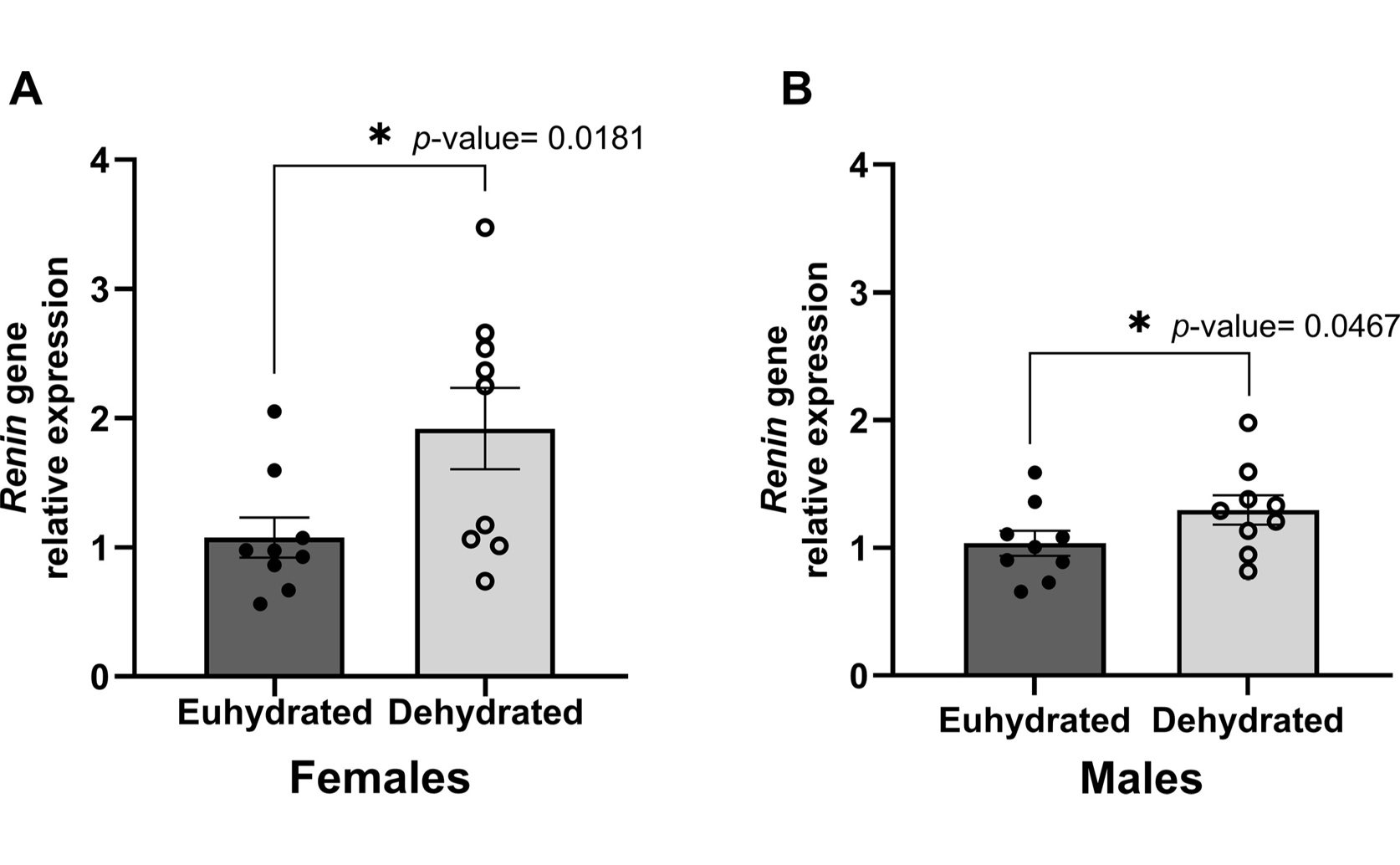
Confirming the effectiveness of the experimental model, the water-restriction protocol led to significantly increased expression of the kidney gene renin (Ren) in both female (a) and male (b) rats, a key physiological marker of systemic dehydration.

Image adapted from: Rodgers et al. / CC BY (Source)

Key Findings

  • Researchers from Purdue and Friedrich-Alexander-University studied how dehydration affects rat vocal cords
  • They found that dehydration changes the genes related to vocal fold tissue structure and function
  • Despite these changes, the rats' vocal sounds remained the same, indicating internal effects on vocal health
Hydration plays a crucial role in maintaining the health and functionality of various bodily systems, including the vocal folds, which are essential for voice production. Understanding how systemic dehydration affects the vocal folds can help in developing strategies to preserve vocal health, especially for individuals who rely heavily on their voice for professional reasons. A recent study conducted by researchers at Purdue University and Friedrich-Alexander-University Erlangen-Nürnberg[1] explores this relationship by examining the biological and functional changes in vocal folds due to dehydration. The study utilized an in vivo rat model to investigate how systemic dehydration influences vocal fold gene expression, tissue structure, and vocalization patterns. A total of 36 Long-Evans rats, both male and female, aged between three to four months, were divided into two groups. One group underwent a water-restriction protocol for five days to induce dehydration, while the other group had unrestricted access to water, maintaining normal hydration levels. Throughout the study period, the rats' ultrasonic vocalizations (USVs) were recorded daily to assess any changes in their vocal behavior. USVs are high-frequency sounds that rats emit, which serve as indicators of their communication and emotional states. By analyzing variables such as the total number of USVs, their complexity, duration, frequency range, and intensity, the researchers aimed to identify any acoustic differences between dehydrated and euhydrated rats. Additionally, after the dehydration period, the rats were euthanized to collect kidney and vocal fold tissues for further analysis of gene expression and tissue structure. The findings revealed that dehydrated rats exhibited a significant increase in the expression of the renin gene in their kidneys, a clear marker of physiological dehydration. This up-regulation confirmed that the rats were indeed experiencing dehydration. However, despite these physiological changes, there were no significant differences in the acoustic profiles of the USVs between the dehydrated and euhydrated groups. This suggests that mild systemic dehydration affects the underlying biology of the vocal folds without immediately altering vocal behavior. On a molecular level, the study identified differential expression of several genes in the vocal fold mucosa of dehydrated rats. These genes are involved in extracellular matrix remodeling, inflammatory responses, and water ion transport, indicating that dehydration initiates a cascade of biological processes aimed at maintaining vocal fold integrity and function. These changes align with previous research[2], which highlighted the relationship between hydration and vocal function, although the exact mechanisms remained unclear. The study also relates to findings from research on water balance physiology[3]. Proper hydration is essential for various bodily functions, including the lubrication and protection of vocal tissues. The precise regulation of water balance ensures that even minor changes in hydration status can trigger significant biological responses to maintain homeostasis. This study builds on that understanding by showing how systemic dehydration specifically impacts the vocal folds at a genetic level. Furthermore, the results complement earlier experimental work on vocal fold dehydration in canines[4]. That study supported the biphasic theory of vocal fold physiology, which posits that vocal fold tissue consists of both solid and liquid components. The current research extends these findings by demonstrating that dehydration alters the expression of genes responsible for managing the liquid component within the vocal folds, thereby supporting the biphasic model. Despite the molecular changes observed, the lack of significant alterations in vocalization suggests that the vocal system may have compensatory mechanisms to maintain function despite dehydration. This aligns with the literature review conducted in study[2], which indicated that while there is a recognized relationship between hydration and voice production, the treatment effects of systemic hydration on vocal health had yet to be fully demonstrated. The current study provides evidence that while dehydration does induce biological changes in the vocal folds, these changes do not immediately translate to altered vocal behavior, at least in the short term or under mild dehydration conditions. The implications of this research are significant for both clinical and occupational settings. For individuals who depend on their voice professionally, understanding that systemic hydration affects vocal fold biology can inform hydration strategies to maintain vocal health. Moreover, the study highlights the need for further research to explore the long-term effects of dehydration on vocal function and to determine whether more severe or prolonged dehydration would eventually impact vocal behavior. In conclusion, the study by Purdue University and Friedrich-Alexander-University Erlangen-Nürnberg advances our understanding of how systemic dehydration influences vocal fold biology. By demonstrating that dehydration leads to significant gene expression changes without immediate effects on vocalization, it bridges gaps identified in earlier research[2][3][4]. Future studies could build on these findings to develop comprehensive guidelines for hydration management aimed at preserving vocal health and preventing voice disorders.

HealthBiochemAnimal Science

References

Main Study

1) Molecular changes, histopathology, and ultrasonic vocalization acoustic profiles of systemically dehydrated rats

Published 22nd April, 2025

https://doi.org/10.1371/journal.pone.0322187


Related Studies

2) Systemic hydration: relating science to clinical practice in vocal health.

https://doi.org/10.1016/j.jvoice.2014.01.007


3) Water as an essential nutrient: the physiological basis of hydration.

https://doi.org/10.1038/ejcn.2009.111


4) Parameters quantifying dehydration in canine vocal fold lamina propria.

https://doi.org/10.1002/lary.20927


Related Articles

An unhandled error has occurred. Reload 🗙