
New Method to Prevent Overlaps in Tiny Organism Models
Greg Howard
22nd April, 2025


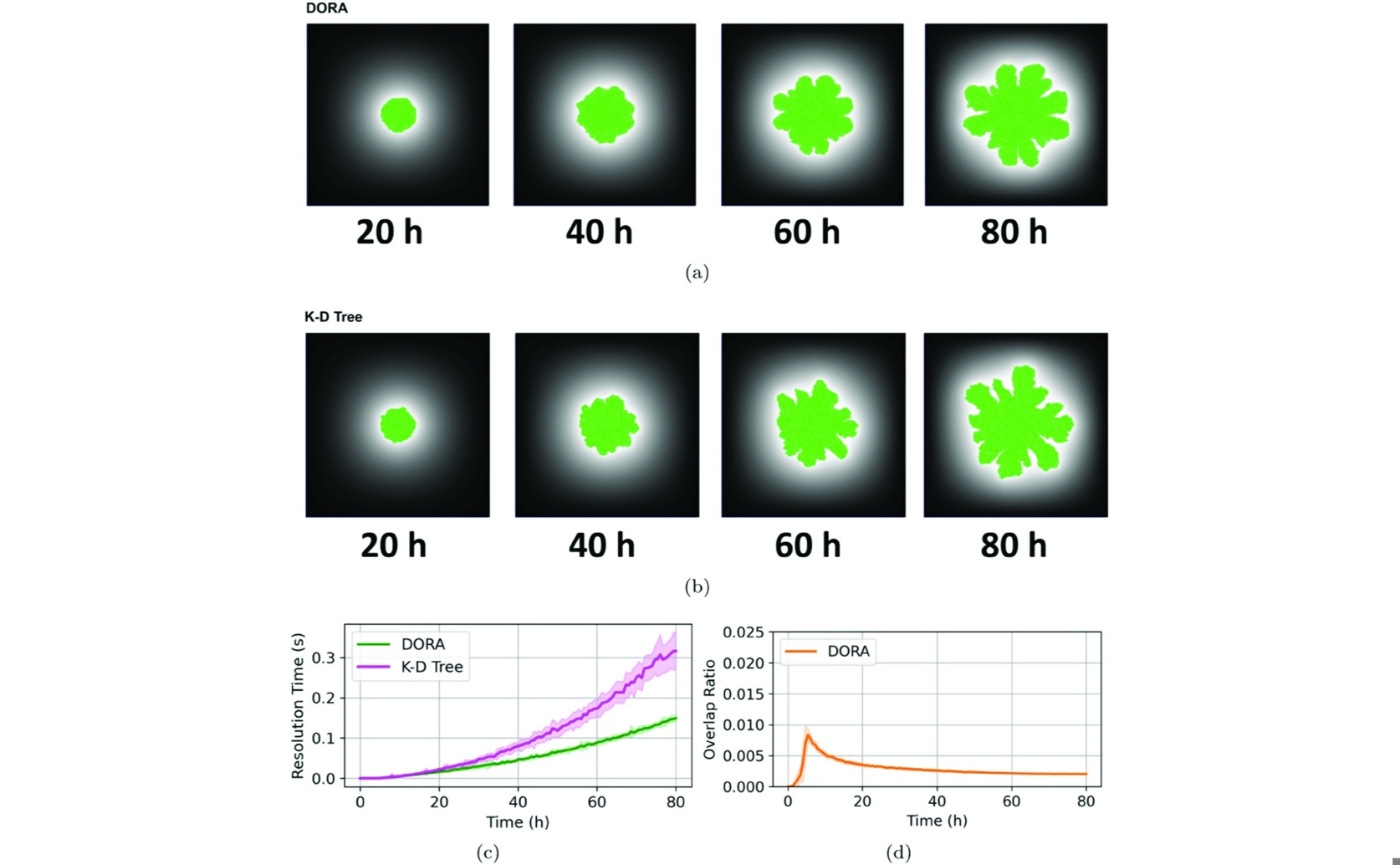
Under medium nutrient conditions that promote fractal growth, the DORA algorithm produces colony structures comparable to the traditional kd-tree method (a, b) while demonstrating superior computational efficiency (c) and maintaining a minimal spatial overlap ratio (d).
Key Findings
- Researchers at KU Leuven developed DORA, a new method that better simulates microbial growth by efficiently managing overlapping cells
- DORA is faster and can handle larger bacterial populations than traditional techniques, improving simulation speed and scalability
- The algorithm accurately models complex microbial behaviors, such as colony and biofilm growth under different nutrient levels
References
Main Study
1) A Discretized Overlap Resolution Algorithm (DORA) for resolving spatial overlaps in individual-based models of microbes
Published 21st April, 2025
https://doi.org/10.1371/journal.pcbi.1012974
Related Studies
2) Modeling microbial growth and dynamics.
3) Biofilms promote altruism.
4) Spatial structure, cooperation and competition in biofilms.
5) Social evolution in multispecies biofilms.
Related Articles
 13th March, 2024 | Jenn Hoskins