How the Environment Influences Antibiotic Resistance in the Baltic Sea

Jenn Hoskins
10th April, 2025

How the Environment Influences Antibiotic Resistance in the Baltic Sea

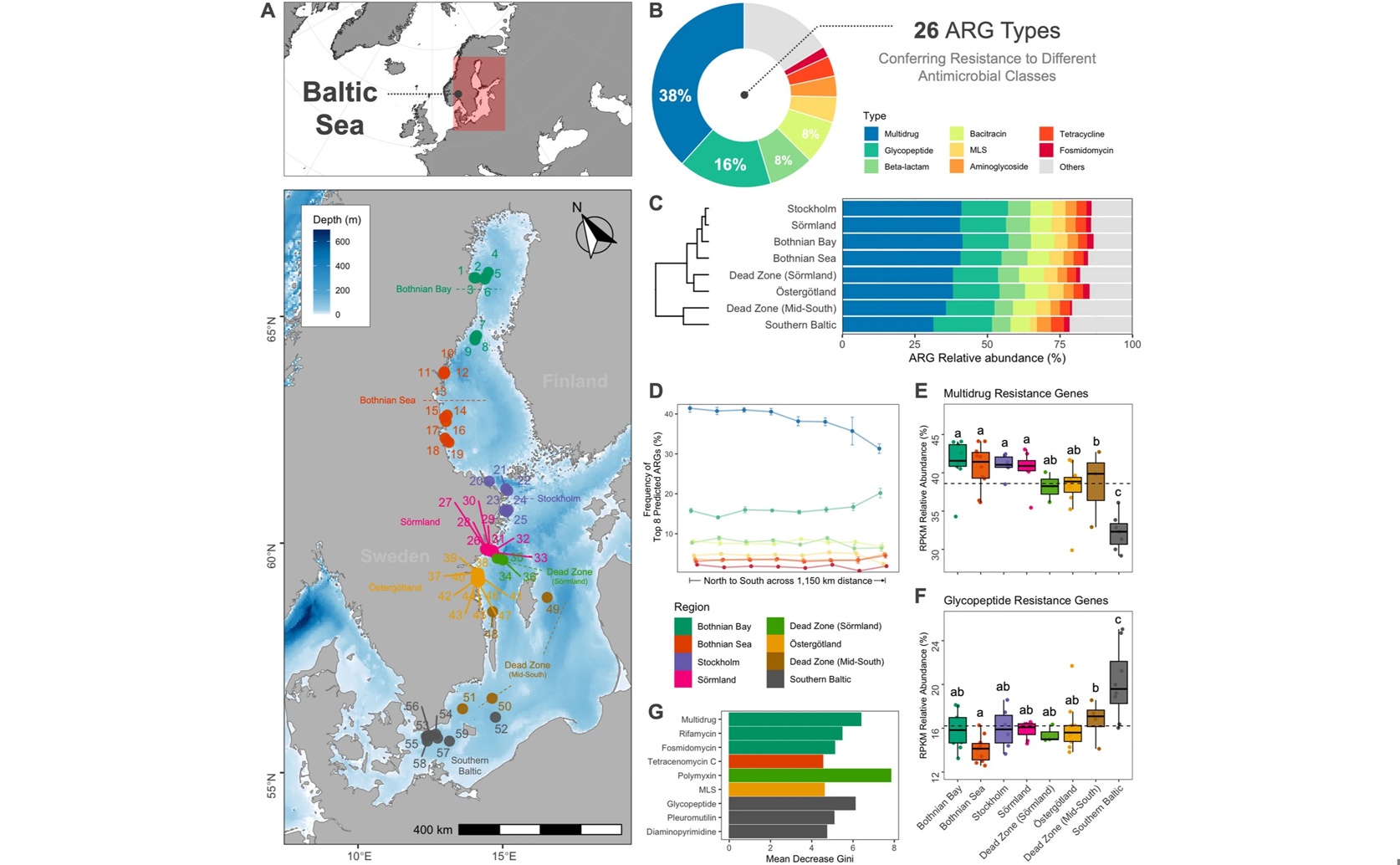
The environmental resistome of the Baltic Sea displays a distinct geographic pattern, with a higher abundance of multidrug resistance genes in the northern regions (e, g) compared to an increase in glycopeptide resistance genes in the south (f, g), demonstrating the key spatial variation this study attributes to environmental gradients.

Image adapted from: Serrana et al. / CC BY (Source)

Key Findings

  • Researchers from Stockholm University studied the Baltic Sea and found more diverse antibiotic resistance genes in its northern regions
  • The diversity and spread of these resistance genes are primarily driven by environmental factors like salinity and temperature
  • Microbial communities and genetic elements, such as plasmids, play key roles in spreading resistance, emphasizing the need for integrated health strategies
Antimicrobial resistance (AMR) poses a significant threat to global health, compromising the effectiveness of antibiotics that are crucial for treating bacterial infections. The environment plays a pivotal role in the emergence and dissemination of AMR, acting as both a reservoir and a conduit for resistance genes. Understanding the complex interactions between environmental factors, microbial communities, and resistance mechanisms is essential for addressing this pressing issue. A recent study conducted by researchers at Stockholm University, Sweden[1] delves into the environmental resistome of the Baltic Sea, providing valuable insights into how various environmental gradients and spatial variability influence the diversity and distribution of antimicrobial resistance genes (ARGs). The resistome refers to the collection of all ARGs in a particular environment, and characterizing it is crucial for understanding the potential pathways through which resistance can spread. The study analyzed metagenomes from benthic sediments collected from 59 monitoring stations along a 1,150-kilometer stretch of the Baltic Sea. This comprehensive analysis revealed a resistome comprising ARGs that confer resistance to 26 different classes of antibiotics. Notably, the researchers found significant spatial variation in the resistance profiles across different regions of the Baltic Sea. The northern regions exhibited higher resistome diversity, while the diversity declined in areas known as dead zones and further south. Environmental factors such as salinity, temperature, and nutrient availability were identified as key drivers shaping the resistome's diversity and distribution. Salinity, in particular, had a predominant influence on both the composition of microbial communities and the ARGs present. High-saline regions displayed distinct ARG profiles compared to areas with lower to mid-level salinity, suggesting that changes in salinity can directly impact the spread of resistance genes[2]. Temperature gradients and nutrient levels further contributed to the complexity of the environmental landscape, affecting how ARGs are distributed across different geographic regions. The study also highlighted the role of microbial community composition and mobile genetic elements in shaping ARG diversity. Mobile genetic elements, such as plasmids, are crucial for the horizontal gene transfer (HGT) of ARGs between bacteria[3]. This process allows for the rapid acquisition and dissemination of resistance traits, making it a significant factor in the spread of AMR. Previous research has shown that plasmids facilitate the transfer of ARGs across various bacterial species, enhancing the adaptability and resilience of microbial communities[4]. The Stockholm University study builds on these findings by demonstrating how environmental factors influence the prevalence and distribution of these mobile elements in natural ecosystems. Furthermore, the research underscores the importance of considering the One Health approach, which recognizes the interconnectedness of human, animal, and environmental health[2]. The Baltic Sea, being a large and diverse aquatic ecosystem, serves as an ideal model for studying these interactions. By analyzing sediments from different regions, the study provides a detailed map of ARG distribution, revealing how environmental conditions can either limit or promote the spread of resistance genes. The methodology employed in the study involved advanced metagenomic sequencing techniques, which allow for the comprehensive analysis of genetic material from environmental samples. This approach enabled the researchers to identify a wide range of ARGs and assess their abundance and diversity across different sampling sites. By correlating the presence of specific ARGs with environmental parameters, the study was able to pinpoint the factors most influential in shaping the resistome. One of the significant contributions of this research is its potential to inform future strategies for managing AMR in aquatic environments. By understanding how salinity, temperature, and nutrient levels impact ARG distribution, policymakers and environmental managers can develop targeted interventions to mitigate the spread of resistance. For example, regulating nutrient runoff into coastal areas could help control the proliferation of ARGs in regions where nutrient availability significantly influences microbial communities. Additionally, the study’s findings on the role of mobile genetic elements in ARG dissemination highlight the need for monitoring these vectors as part of AMR surveillance programs[5]. Effective monitoring can help identify hotspots of resistance gene transfer, allowing for timely and coordinated actions to prevent widespread dissemination. This research also complements previous studies that have explored the mechanisms of ARG spread and the factors contributing to AMR in different environments. For instance, earlier work has demonstrated how pollution from antibiotics and resistant organisms can alter bacterial population structures, facilitating the expansion of resistant strains[2]. The Stockholm University study adds a spatial dimension to this understanding, showing how geographic and environmental variability further influences these dynamics. In conclusion, the study by Stockholm University provides a comprehensive analysis of the environmental resistome in the Baltic Sea, highlighting the significant impact of salinity, temperature, and nutrient availability on ARG diversity and distribution. By elucidating the complex interplay between environmental factors and microbial communities, this research advances our understanding of AMR in natural ecosystems and offers valuable insights for developing effective strategies to combat the global resistance crisis[2][3][4][5]. As AMR continues to pose a threat to public health, such studies are crucial for informing policies and interventions aimed at preserving the efficacy of antibiotics and ensuring the health of both humans and the environment.

EnvironmentGeneticsMarine Biology

References

Main Study

1) Environmental drivers of the resistome across the Baltic Sea

Published 7th April, 2025

https://doi.org/10.1186/s40168-025-02086-x


Related Studies

2) Defining and combating antibiotic resistance from One Health and Global Health perspectives.

https://doi.org/10.1038/s41564-019-0503-9


3) Inter-plasmid transfer of antibiotic resistance genes accelerates antibiotic resistance in bacterial pathogens.

https://doi.org/10.1093/ismejo/wrad032


4) Lateral gene transfer, bacterial genome evolution, and the Anthropocene.

https://doi.org/10.1111/nyas.13213


5) Antibiotic resistance in the environment.

https://doi.org/10.1038/s41579-021-00649-x


Related Articles

An unhandled error has occurred. Reload 🗙