Shapes and Environments of Ancient Microbial Structures

Greg Howard
29th March, 2025

Shapes and Environments of Ancient Microbial Structures

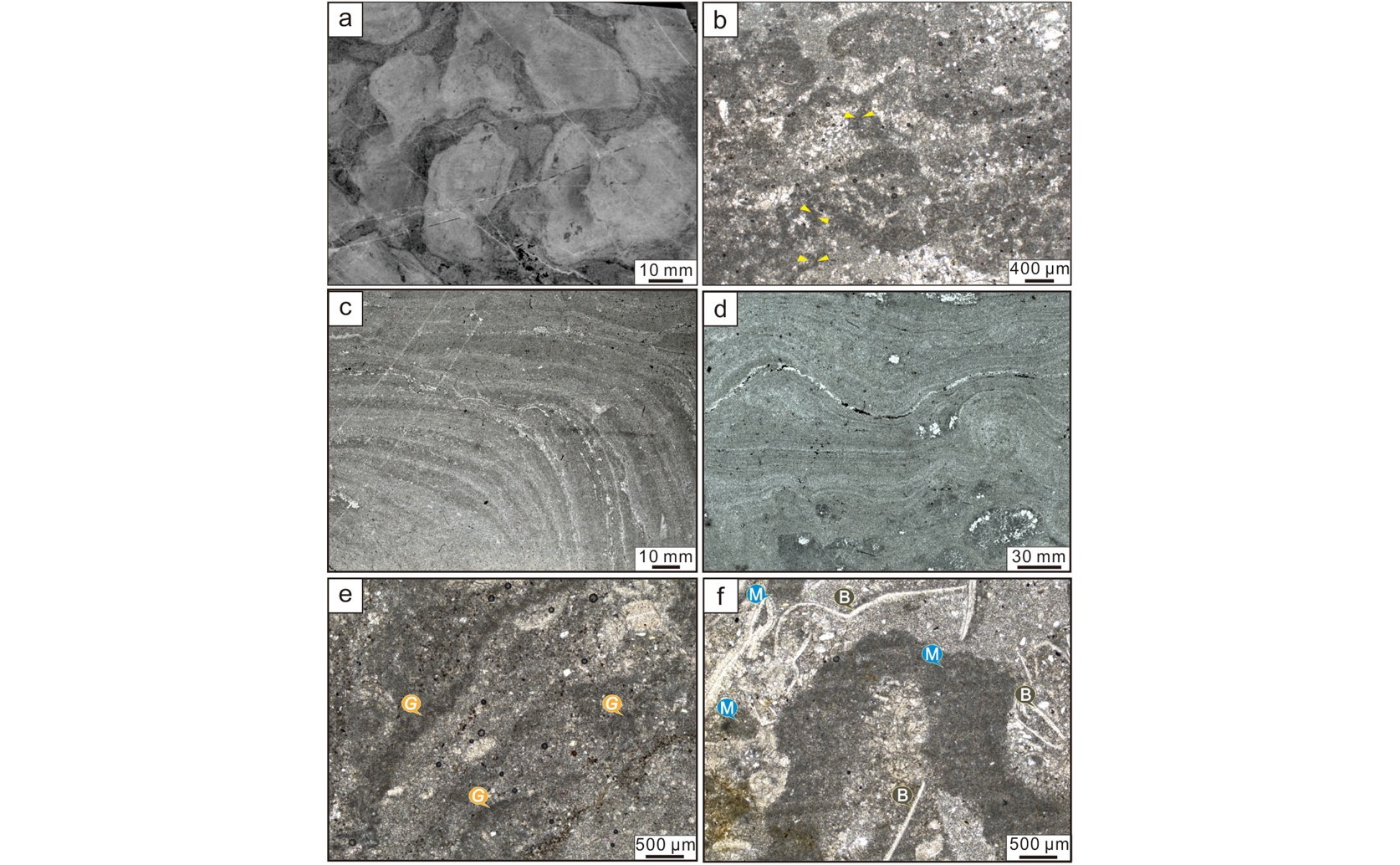
Microscopic analysis of the varied Cambrian stromatolite morphologies (a–f) reveals that their internal dark laminae are primarily constructed by filaments of the cyanobacterium Girvanella (e) and contain biodetritus (f), demonstrating the fundamental role of microbial activity and interaction with metazoans in the formation of these structures.

Image adapted from: Chang et al. / CC BY (Source)

Key Findings

  • In western Henan, China, scientists found different types of ancient stromatolites, showing how microbes lived in varied tidal areas
  • They discovered cyanobacteria fossils within these stromatolites, proving that microorganisms were essential in building these structures
  • The research revealed that water movement and sediments influenced stromatolite shapes, confirming they were created by living organisms
Stromatolites are layered structures formed by the activity of microorganisms, primarily cyanobacteria. These ancient formations provide valuable insights into early life on Earth and the environments in which these microorganisms thrived. Understanding the diversity and formation conditions of stromatolites helps scientists reconstruct past marine environments and the evolution of early life. A recent study conducted by researchers at Henan Polytechnic University[1] has shed new light on the variety of Cambrian stromatolites found in western Henan, located on the North China Craton. The Cambrian period, approximately 541 to 485 million years ago, was a crucial time in Earth's history when most major animal groups first appeared. By examining different types of stromatolites from this era, the study aims to unravel the complex interactions between microorganisms and their environment. The researchers identified several distinct morphotypes of stromatolites in the region, including small plexiform, hemispherical-smooth wavy, small columnar, irregular small columnar stromatolites, and a unique type surrounding flat-pebble conglomerate limestones. Each of these types exhibits specific macroscopic and microscopic characteristics that reflect the conditions under which they formed. For instance, small plexiform and small columnar stromatolites developed in the supratidal zone, an area that experiences regular exposure to air and water, indicating their adaptation to fluctuating environments. Hemispherical-smooth wavy and small columnar stromatolites, along with those surrounding flat-pebble conglomerate limestones, were found in the intertidal zone. This area is influenced by tides, resulting in weaker hydrodynamic conditions compared to the supratidal zone. The presence of these stromatolites suggests that they thrived in environments with moderate water movement, which likely influenced their growth patterns and structures. Irregular small columnar stromatolites were identified in the subtidal zone, which remains underwater more consistently. The stable conditions in this zone allowed these stromatolites to develop unique morphologies influenced by consistent water flow and sediment deposition. This variety in stromatolite types across different zones highlights the adaptability of microbial communities to diverse environmental conditions. A significant aspect of the study was the discovery of numerous Girvanella fossils within the stromatolite laminae. Girvanella is a genus of filamentous cyanobacteria known for forming intricate patterns. In the western Henan stromatolites, Girvanella fossils were found in prostrate or horizontal and winding or overlapping formations. The dark laminae within the stromatolites were formed by the combined effect of Girvanella activity and the precipitation of calcium carbonate, a common mineral in marine sediments. This finding underscores the role of microorganisms in shaping stromatolite structures and highlights the interplay between biological activity and mineral deposition. The study employed a multi-faceted approach to analyze the stromatolites, integrating macroscopic observations with microscopic examinations. By studying the size, shape, and distribution of stromatolite types, the researchers were able to infer the paleoenvironments in which they formed. Microscopic analysis revealed that the laminae of stromatolites were influenced by both microorganisms and metazoans, indicating a complex ecosystem even in these early periods. This research builds upon earlier studies, such as the work on the 3.43-billion-year-old Strelley Pool Chert (SPC) from Australia[2]. The SPC study identified various stromatolite morphotypes and argued for their biological origin, countering abiogenic hypotheses. Similarly, the Henan study supports the idea that the diversity and complexity of stromatolites are indicative of biological processes, reinforcing the conclusions drawn from the SPC findings[2]. By demonstrating that stromatolite morphologies are closely tied to specific environmental conditions, the current study provides further evidence that these structures were formed by living organisms rather than purely chemical processes. The Henan study also highlights the influence of external factors such as terrigenous materials, hydrodynamic conditions, and sedimentary substrates on stromatolite development. Terrigenous materials, which are derived from land sources, can affect the availability of nutrients and the stability of the substrate where stromatolites grow. Hydrodynamic conditions, including water flow and turbulence, shape the physical structure of stromatolites by influencing sediment deposition and microbial activity. Sedimentary substrates provide the necessary foundation for stromatolite growth, determining the spatial distribution and orientation of microbial communities. By integrating these factors, the researchers were able to create a comprehensive picture of the environments that supported diverse stromatolite formations during the Cambrian period. This holistic approach allows for a better understanding of how early microbial life interacted with its surroundings, offering clues about the conditions that favored the emergence and diversification of complex life forms. The findings from Henan Polytechnic University not only expand our knowledge of Cambrian stromatolites but also contribute to the broader understanding of early Earth's ecosystems. Comparing these ancient structures with those from different geological periods and locations, such as the SPC, helps scientists trace the evolution of microbial life and its impact on the planet's geological and biological history[2]. This comparative analysis is essential for constructing accurate models of early life and its environmental context. In conclusion, the study of Cambrian stromatolites in western Henan provides valuable insights into the interplay between microorganisms and their environment in early marine settings. By identifying and analyzing various stromatolite morphotypes and their associated fossils, the research emphasizes the biological origin of these structures and their dependence on specific environmental conditions. Building on previous studies like the SPC, this work reinforces the significance of stromatolites as indicators of early life and paleoenvironmental conditions, contributing to our understanding of Earth's ancient history.

EnvironmentEcologyEvolution

References

Main Study

1) Morphological and environmental varieties of the Cambrian stromatolites in Western Henan, North China Craton

Published 28th March, 2025

https://doi.org/10.1371/journal.pone.0319713


Related Studies

2) Stromatolite reef from the Early Archaean era of Australia.

Journal: Nature, Issue: Vol 441, Issue 7094, Jun 2006


Related Articles

An unhandled error has occurred. Reload 🗙