Using a DNA Test to Detect Parasite Growth: A Tool for Monitoring Disease Spread

Jenn Hoskins
19th March, 2025

Using a DNA Test to Detect Parasite Growth: A Tool for Monitoring Disease Spread

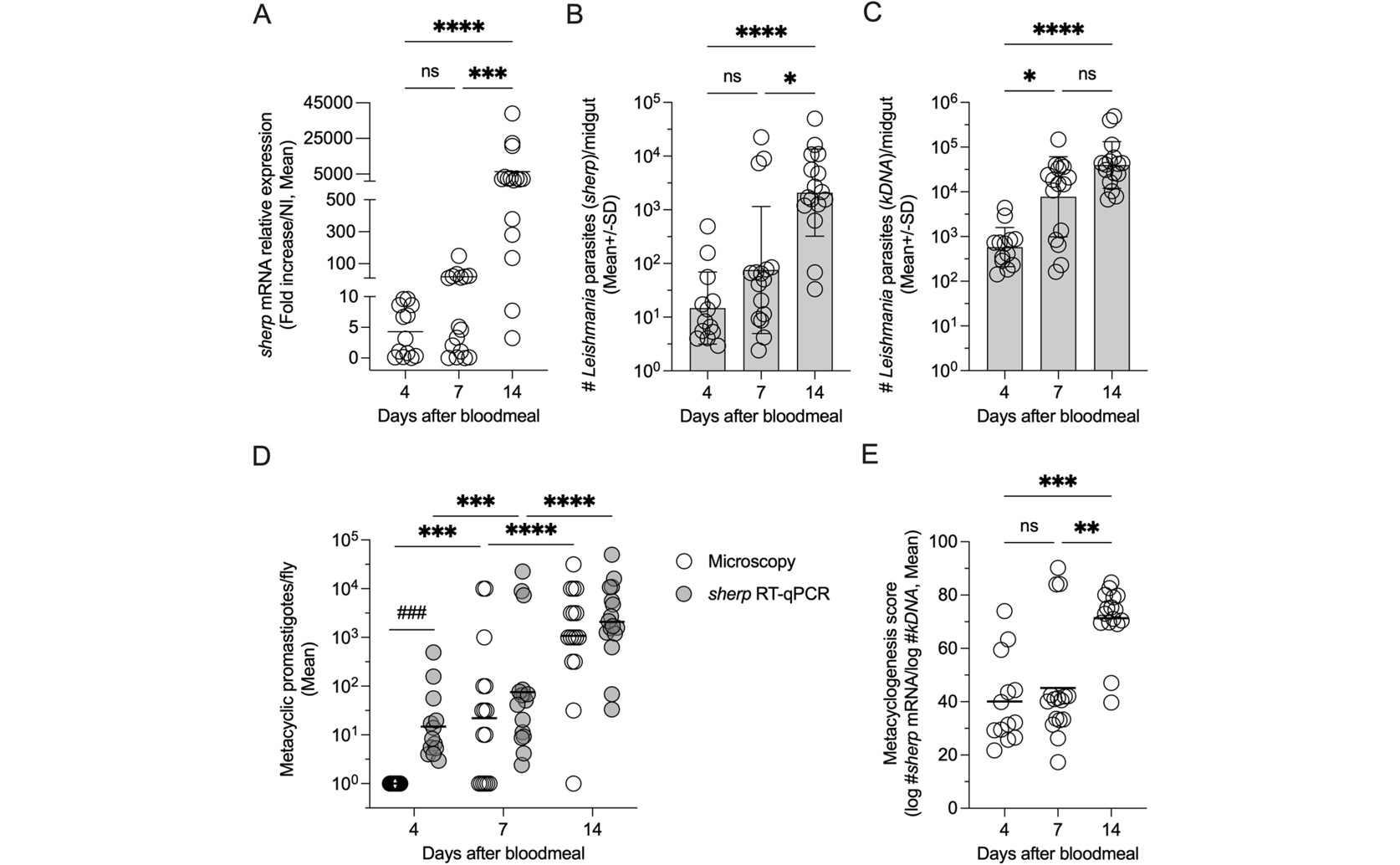
The sherp RT-qPCR assay detects a dramatic increase in metacyclic-associated gene expression between days 7 and 14 post-infection in Lutzomyia longipalpis sand fly midguts (a, b), with parasite quantification by sherp RT-qPCR closely matching microscopic metacyclic counts at later time points (d), enabling calculation of a metacyclogenesis score (e) that correlates with transmission potential.

Image adapted from: Nzelu et al. / CC BY (Source)

Key Findings

  • Scientists at the University of Calgary developed a new DNA test to quickly detect infectious Leishmania parasites in sandflies
  • This test can identify live, disease-causing parasites without dissecting the flies, making monitoring faster and easier
  • Enhanced detection helps pinpoint high-risk areas and effectively control the spread of leishmaniasis
Leishmaniasis is a significant tropical disease transmitted by sandfly vectors carrying the parasite Leishmania. Monitoring infected sandflies is crucial for understanding and controlling the spread of this disease. Traditional methods of studying these vectors relied on physically dissecting and examining each sandfly under a microscope, a time-consuming and labor-intensive process. However, advances in molecular biology have introduced rapid DNA detection techniques, enhancing our ability to monitor pathogen prevalence and transmission potential more efficiently. Despite these advancements, a major challenge remains: DNA-based detection methods cannot differentiate between live, infectious parasites and dead or non-infectious forms. This limitation affects the accuracy of assessing the true transmission potential of infected sandflies in both natural settings and experimental studies. Addressing this issue, researchers from the University of Calgary[1] have developed a novel assay that improves the precision of detecting infectious Leishmania parasites in sandflies. The new method, known as the sherp RT-qPCR assay, utilizes quantitative real-time PCR combined with reverse transcription to target a specific protein called sherp (small hydrophilic endoplasmic reticulum-associated protein). Sherp is significantly more expressed in the infectious metacyclic promastigote stage of Leishmania compared to other forms such as non-metacyclic promastigotes or amastigotes found in mammalian hosts. By focusing on sherp transcripts, this assay can accurately identify and quantify the infectious parasites within sandflies without the need for dissection. The development of this assay builds on previous research that has highlighted the complexity of Leishmania’s life cycle within the sandfly vector. For instance, a study from Shahid Chamran University of Ahvaz[2] revealed that Leishmania major undergoes a nonlinear developmental progression within the sandfly gut, leading to different morphotypes that contribute to transmission. Understanding these stages is essential for targeting the infectious forms more effectively. Moreover, research from Brigham Young University[3] demonstrated that levels of tetrahydrobiopterin (H4B), a biochemical factor, influence the differentiation of Leishmania into its highly infective metacyclic stage. This finding underscores the importance of identifying molecular markers that can distinguish between different parasite stages, further supporting the need for assays like the sherp RT-qPCR. The sherp RT-qPCR assay developed by the University of Calgary team offers several advantages. It can detect parasite levels ranging from one to one million, making it highly sensitive. Additionally, the assay works effectively on sandflies preserved in ethanol at room temperature, which is a practical and cost-effective method for sample storage, especially in resource-limited field settings. This feature is particularly valuable for large-scale surveillance efforts where maintaining cold chains can be challenging. Another significant advancement of this study is the ability to calculate a "metacyclogenesis score" by combining sherp RT-qPCR data with an established assay for Leishmania kinetoplast DNA minicircles. Metacyclogenesis refers to the process by which Leishmania transforms into its infectious metacyclic form within the sandfly. By quantifying this process, researchers can better predict the transmission potential of infected sandfly populations. This approach aligns with findings from previous studies, such as the one from the Wadsworth Center[4], which identified the percentage of metacyclic promastigotes as a key predictor of transmission competence. Furthermore, the ability to quantify infectious parasites without dissection simplifies and speeds up the monitoring process, enabling more extensive and rapid surveillance. This capability is crucial for identifying transmission hotspots, areas experiencing re-emergence of the disease, and assessing the competence of different sandfly populations as vectors. Understanding these dynamics is essential for implementing effective control measures and predicting how Leishmania populations might respond to interventions. The implications of this study extend to both laboratory research and field applications. In laboratory settings, the sherp RT-qPCR assay can streamline experiments by providing accurate measurements of parasite infectivity without the need for laborious dissection. In the field, it facilitates large-scale monitoring efforts, helping public health officials identify regions at high risk of transmission and allocate resources more effectively. Additionally, this assay contributes to a deeper understanding of the transmission strategies employed by Leishmania. Previous research from the Wadsworth Center[5] highlighted the role of mixed parasite stages in transmission and disease severity. By specifically targeting the infectious metacyclic stage, the sherp RT-qPCR assay allows for more precise studies on how different parasite forms influence disease outcomes and transmission dynamics. In summary, the development of the sherp RT-qPCR assay by the University of Calgary represents a significant advancement in the field of vector-borne disease monitoring. By accurately detecting and quantifying infectious Leishmania parasites in sandflies, this method enhances our ability to assess transmission potential, identify high-risk areas, and implement targeted control strategies. Integrating this new assay with existing knowledge from earlier studies provides a more comprehensive understanding of Leishmania’s life cycle and its implications for public health, ultimately contributing to more effective efforts to combat leishmaniasis.

HealthBiotechGenetics

References

Main Study

1) Detection of Leishmania metacyclogenesis within the sand fly vector employing a real-time PCR for sherp gene expression: A tool for Leishmania surveillance and transmission potential

Published 17th March, 2025

https://doi.org/10.1371/journal.pntd.0012915


Related Studies

2) Single-cell atlas of Leishmania development in sandflies reveals the heterogeneity of transmitted parasites and their role in infection.

https://doi.org/10.1073/pnas.2406776121


3) Regulation of differentiation to the infective stage of the protozoan parasite Leishmania major by tetrahydrobiopterin.

Journal: Science (New York, N.Y.), Issue: Vol 292, Issue 5515, Apr 2001


4) Infection parameters in the sand fly vector that predict transmission of Leishmania major.

https://doi.org/10.1371/journal.pntd.0001288


5) Quantifying Leishmania Metacyclic Promastigotes from Individual Sandfly Bites Reveals the Efficiency of Vector Transmission.

https://doi.org/10.1038/s42003-019-0323-8


Related Articles

An unhandled error has occurred. Reload 🗙