Food and Predators Shape How Neighboring Groups Use the Landscape

Jenn Hoskins
25th February, 2025

Food and Predators Shape How Neighboring Groups Use the Landscape

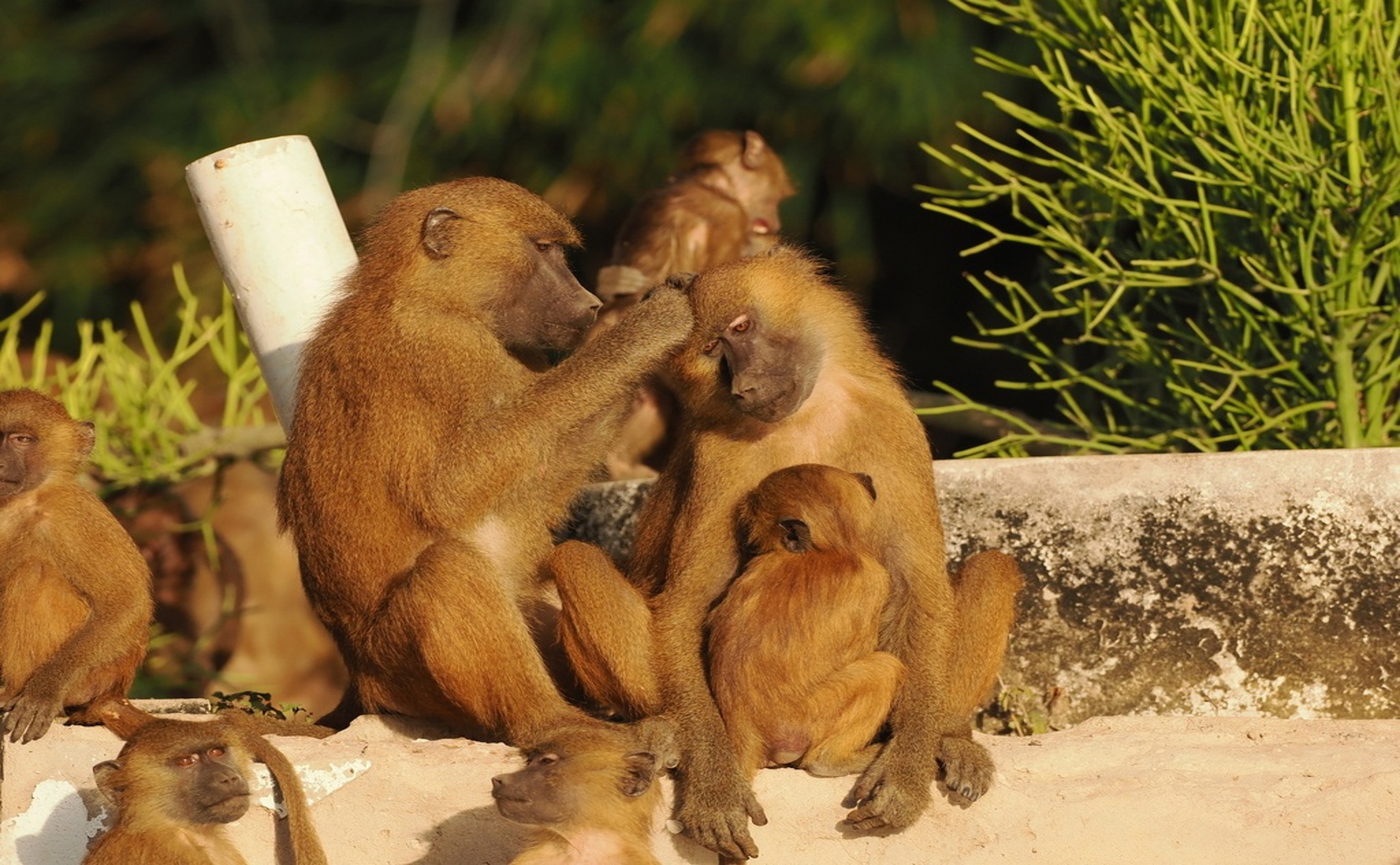
Guinea Baboon (Papio papio)

Photo adapted from: Peter Archdale / CC BY (Source)

Key Findings

  • In Senegal’s Niokolo-Koba National Park, Guinea baboons’ home areas largely overlap, with groups staying within 100 meters of each other
  • Regardless of changes in food availability or predator presence, baboons maintained close distances, showing low competition for resources
  • These findings suggest that social interactions are more important than dividing resources, challenging traditional views on primate social behavior
Access to essential resources such as food, water, and shelter plays a critical role in the survival and reproduction of animals. In environments where these resources are scarce, animals often adopt strategies to minimize competition. One such strategy is landscape partitioning, where animals divide their habitat to reduce direct encounters over limited resources. While territoriality is a well-known form of landscape partitioning, other methods exist, especially among social species with flexible group structures. A recent study conducted by researchers at Georg-August-Universität Göttingen[1] investigated how Guinea baboons (Papio papio) in the Niokolo-Koba National Park, Senegal, manage their home ranges and social groupings. Using four years of GPS tracking data from individuals equipped with collars, the study aimed to understand whether factors like food availability and predator presence influence the spatial relationships between neighboring baboon parties. The researchers found that Guinea baboon parties exhibit a high degree of overlap in their home ranges, with overlaps ranging from 33% to 100%. Additionally, the average minimum distance between parties was consistently below 100 meters, regardless of variations in food availability or predator presence. These findings suggest that, unlike what might be expected, there is a low level of feeding competition among the baboon parties in this particular area. This result is intriguing when considered in the context of previous research on animal movement and social organization. Study[2] highlights the importance of detailed movement data in understanding population dynamics, emphasizing how technologies like GPS can reveal the intricate links between behavior and individual fitness. The current study builds on this by utilizing extensive locational data to assess how baboons navigate their environment and interact with neighboring groups. Moreover, the findings challenge some of the assumptions outlined in socioecological theories of primate sociality. For instance, study[3] argued that factors beyond feeding competition, such as life-history traits and reproductive strategies, significantly influence group size and social structure. The low feeding competition observed among Guinea baboons at Niokolo-Koba supports the idea that other ecological and social factors may be more critical in shaping their social organization. Additionally, study[4] calls for a reevaluation of models that prioritize competition over cooperation in explaining primate social systems. The current study’s observation of minimal competition aligns with the perspective that cooperation and other social dynamics may play more substantial roles in maintaining group cohesion and flexibility. This is further supported by findings in study[5], which examined hamadryas baboons and found that their social groupings respond dynamically to changes in food availability and predation risk. Like the hamadryas baboons, the Guinea baboons in the main study exhibit flexible grouping patterns, although the mechanisms and ecological contexts may differ. The implications of these findings are significant for understanding the social dynamics and population ecology of Guinea baboons. The substantial overlap in home ranges and the lack of significant distance changes in response to environmental factors suggest that these baboons may prioritize social interactions and group benefits over strict resource partitioning. This behavior could facilitate better predator detection and defense, aligning with the flexibility described in multilevel societies[2]. However, the study also raises questions about whether the observed low feeding competition is a general characteristic of Guinea baboons or specific to the conditions in the Niokolo-Koba National Park. Further research in different habitats and with other baboon populations would be necessary to determine the broader applicability of these results. In summary, the research from Georg-August-Universität Göttingen provides valuable insights into the social and spatial behaviors of Guinea baboons. By demonstrating substantial home range overlap and minimal feeding competition, the study contributes to a more nuanced understanding of primate sociality, emphasizing the need to consider a variety of ecological and social factors. This work not only builds on previous studies but also encourages a reevaluation of existing theories, highlighting the complexity of animal behavior and the importance of flexible, data-driven approaches in ecological research.

WildlifeEcologyAnimal Science

References

Main Study

1) Impact of food availability and predator presence on patterns of landscape partitioning among neighbouring Guinea baboon (Papio papio) parties

Published 22nd February, 2025

https://doi.org/10.1186/s40462-025-00534-9


Related Studies

2) Building the bridge between animal movement and population dynamics.

https://doi.org/10.1098/rstb.2010.0082


3) Primate socioecology at the crossroads: past, present, and future.

https://doi.org/10.1002/evan.21316


4) Reply to Lawler: feeding competition, cooperation, and the causes of primate sociality.

https://doi.org/10.1002/ajp.20889


5) Ecology and sociality in a multilevel society: ecological determinants of spatial cohesion in hamadryas baboons.

https://doi.org/10.1002/ajpa.22076


Related Articles

An unhandled error has occurred. Reload 🗙