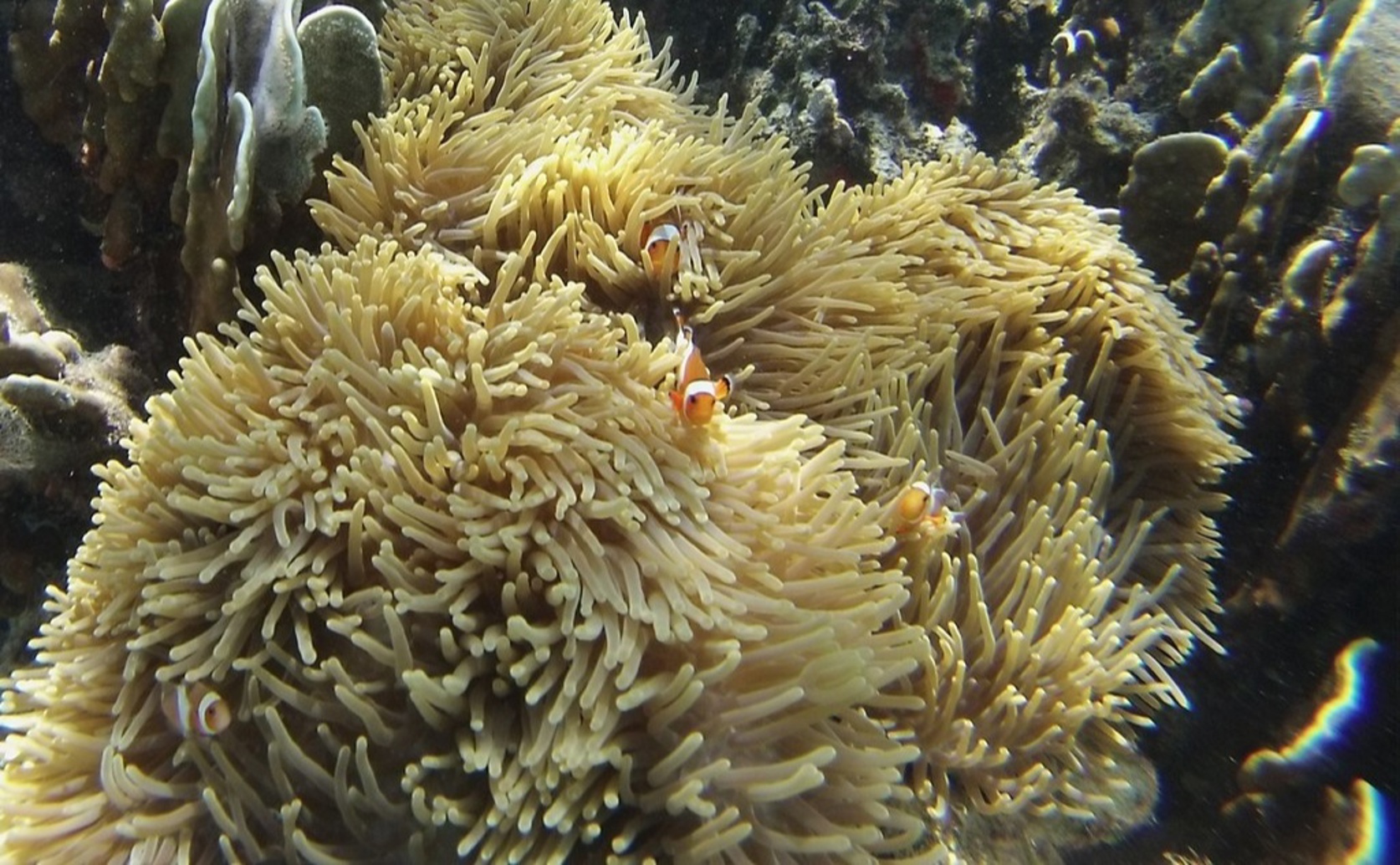
Clownfish Use Sugar Tricks to Outsmart Big Sea Anemones’ Stings

Greg Howard
16th February, 2025

Clownfish Use Sugar Tricks to Outsmart Big Sea Anemones’ Stings

Ocellaris Anemonefish (Amphiprion ocellaris)

Photo adapted from: Matt Berger / CC BY (Source)

Key Findings

  • Researchers in Okinawa found that clownfish have less sialic acid in their mucus, helping them safely live among stinging sea anemones
  • This special mucus prevents the anemones from releasing their toxic stings, providing protection for the clownfish
  • The study also identified specific genes that manage sialic acid levels, explaining how clownfish and anemones coexist peacefully
The mutualistic relationship between anemonefish and sea anemones is a remarkable example of nature's intricate collaborations. Anemonefish, also known as clownfish, find shelter among the stinging tentacles of sea anemones, gaining protection from predators. In return, they help defend the anemones from potential threats. However, the exact mechanism that allows anemonefish to avoid being harmed by the sea anemone’s toxic nematocysts—the specialized cells responsible for the anemone’s stinging—has remained unclear. A recent study conducted by researchers at the Okinawa Institute of Science and Technology[1] sheds light on this intriguing interaction by exploring the role of sialic acids in anemonefish mucus. Previous research has suggested that the mucus coating of anemonefish and other crustaceans serves as a protective barrier against nematocyst discharge[2]. While some fish species produce their own protective mucus, others, like crustaceans, may acquire mucus from the sea anemone during an acclimation period[2]. Additionally, studies have indicated that the microbiomes—the communities of microorganisms living on and within an organism—of clownfish and sea anemones share similarities after establishing symbiosis[3]. This microbial sharing raises questions about its role in the mutualistic relationship and the protection of clownfish from anemone stings. Furthermore, genomic analyses have identified specific genes in clownfish that may be involved in their mutualistic interactions with sea anemones[4]. Building on these foundations, the Okinawa Institute of Science and Technology's study focused on the biochemical aspect of this symbiosis, particularly the levels of sialic acids in the mucus of anemonefish. Sialic acids are a family of sugars commonly found on the surfaces of cells and proteins, playing various roles in cellular recognition and signaling. The researchers hypothesized that lower levels of sialic acids in anemonefish mucus might prevent the discharge of nematocysts, thereby allowing the fish to coexist safely with their sea anemone hosts. To test this hypothesis, the study made four key predictions. First, it was expected that anemonefish mucus would contain lower levels of sialic acids compared to non-symbiotic damselfish, which do not associate with sea anemones. Second, this reduction in sialic acid levels would be specific to the mucus rather than other tissues. Third, during the development of the fish, there would be an inverse correlation between sialic acid levels and the degree of protection from nematocyst discharge. Finally, the mucus of sea anemones themselves was predicted to have minimal sialic acids. The results confirmed all four predictions. Anemonefish were found to have significantly lower levels of sialic acids in their mucus compared to damselfish. This reduction was specific to the mucus, supporting the idea that the mucus serves a targeted protective function. During the developmental stages of the fish, lower sialic acid levels were indeed associated with increased protection from nematocysts. Additionally, sea anemone mucus exhibited minimal sialic acid content, aligning with the hypothesis that sialic acids play a critical role in the interaction between the two species. The study also identified several genes involved in the removal of sialic acids, suggesting a genetic basis for this protective mechanism. These findings build on previous genomic studies that highlighted genes potentially linked to the mutualistic relationship between clownfish and sea anemones[4]. By pinpointing specific genes responsible for regulating sialic acid levels, the research provides a deeper understanding of how anemonefish have adapted to live among the stinging tentacles of sea anemones. Interestingly, the mechanism identified in this study might not be unique to anemonefish. The researchers noted that juveniles of Dascyllus trimaculatus, another fish species, may employ a similar strategy to form mutualistic associations with sea anemones. This suggests that the regulation of sialic acids in mucus could be a convergent evolutionary strategy employed by different species to achieve symbiosis with sea anemones. Integrating these findings with earlier studies, it becomes evident that the protective mucus plays a multifaceted role in the mutualistic relationship. The dynamic changes in microbiomes observed in previous research[3] might interact with the biochemical properties of the mucus, such as sialic acid levels, to enhance protection and stability of the symbiosis. Moreover, the identification of specific genetic adaptations[4] provides a molecular basis for the observed biochemical and microbial interactions, offering a comprehensive picture of how anemonefish and sea anemones coexist harmoniously. Overall, the study from the Okinawa Institute of Science and Technology advances our understanding of the mutualistic relationship between anemonefish and sea anemones by elucidating the role of sialic acids in mucus. By confirming that lower sialic acid levels in anemonefish mucus prevent nematocyst discharge, the research not only solves a long-standing mystery but also integrates seamlessly with previous findings on mucus composition, microbiome dynamics, and genetic adaptations. This holistic approach offers valuable insights into the complex mechanisms that underpin one of the ocean’s most fascinating mutualistic relationships.

BiochemAnimal ScienceMarine Biology

References

Main Study

1) Anemonefish use sialic acid metabolism as Trojan horse to avoid giant sea anemone stinging.

Published 15th February, 2025

https://doi.org/10.1186/s12915-025-02144-8


Related Studies

2) Chemical biology of the mutualistic relationships of sea anemones with fish and crustaceans.

https://doi.org/10.1016/j.toxicon.2009.02.027


3) Sea anemone and clownfish microbiota diversity and variation during the initial steps of symbiosis.

https://doi.org/10.1038/s41598-019-55756-w


4) Insights into the Genomics of Clownfish Adaptive Radiation: Genetic Basis of the Mutualism with Sea Anemones.

https://doi.org/10.1093/gbe/evz042


Related Articles

An unhandled error has occurred. Reload 🗙