Genetic Differences in Silver Fir Growing in Warmer Mediterranean-Like Areas

Jim Crocker
4th February, 2025

Genetic Differences in Silver Fir Growing in Warmer Mediterranean-Like Areas

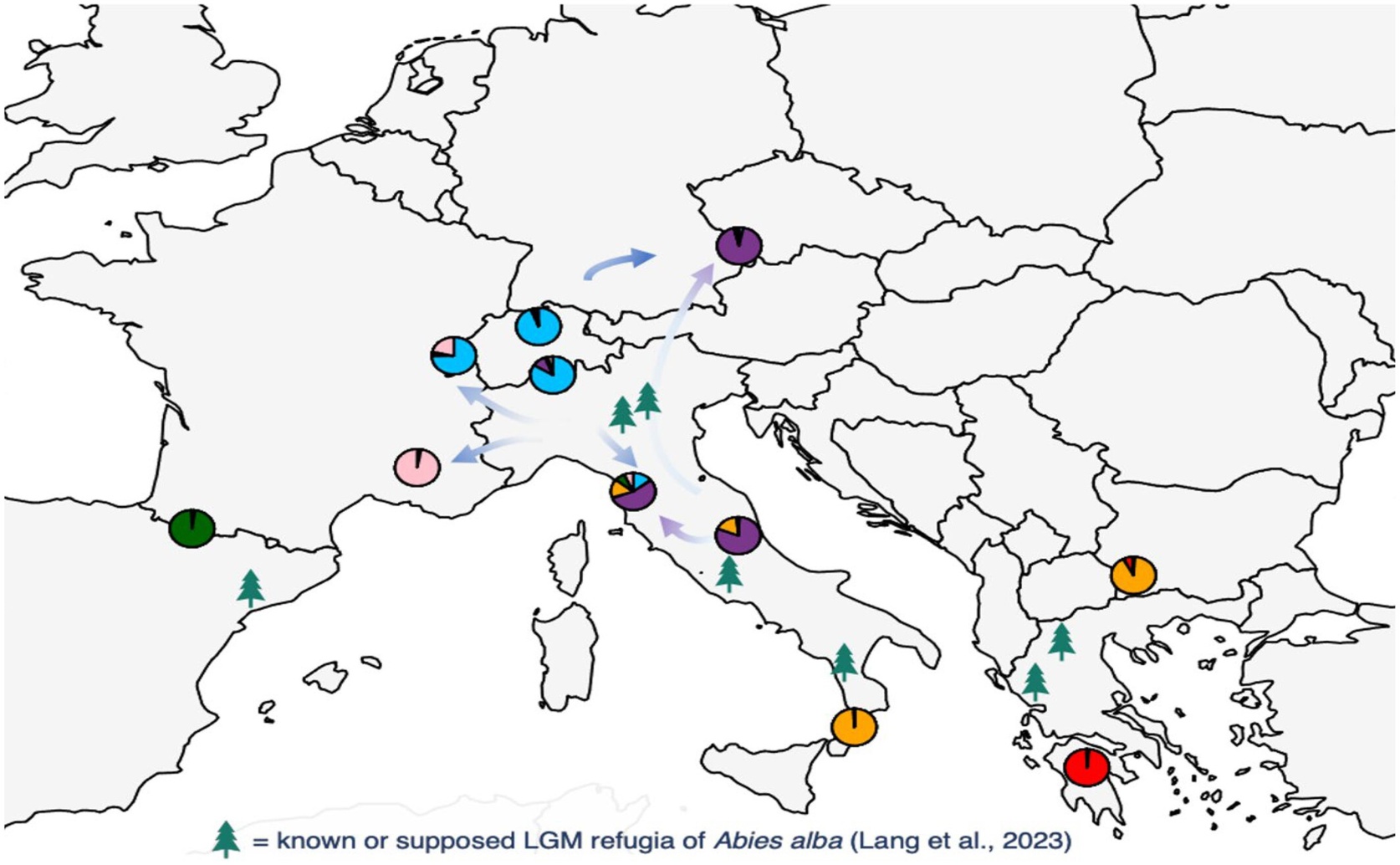
This map of postglacial expansion reveals that the genetic structure of modern Silver fir (Abies alba) populations, including those in unexpectedly warm climates, was shaped by migration from distinct southern refugia and subsequent gene flow, such as between the Balkan and Southern Italian peninsulas.

Image adapted from: Coşgun et al. / CC BY (Source)

Key Findings

  • A study analyzed the genetic structure of silver fir populations from Southern Italy to Switzerland to understand their adaptability to climate variability
  • Mediterranean silver fir populations are genetically similar to mountain populations, showing no evidence of distinct subspecies or ecotypes
  • Silver fir's adaptability to warmer, drier climates reflects local environmental pressures within its existing genetic framework, not large-scale genetic differentiation
Abies alba, commonly known as silver fir, is a key European tree species typically found in cool, humid mountain zones. However, historical evidence suggests that it also thrived in warmer and drier climates during the Eemian and mid-Holocene periods. Cryptic populations of silver fir in Mediterranean regions today indicate the species’ potential to grow under such conditions, raising questions about whether these populations possess unique genetic traits or represent distinct subspecies or ecotypes. A recent study by researchers at the University of Bern[1] sought to investigate this by analyzing the genetic structure of Mediterranean and mountain populations of A. alba to better understand its adaptability to climate variability and inform future conservation strategies. The study genotyped 478 A. alba samples across a latitudinal range from Southern Italy to Switzerland, focusing on single-nucleotide polymorphisms (SNPs), which are small genetic variations that can provide insights into population structure and evolutionary history. These new genetic data were integrated with previously published genotypes from other European populations. The findings revealed that warm-adapted Mediterranean populations are genetically consistent with their local mountain counterparts, rather than forming distinct genetic groups. This suggests that these cryptic populations are not subspecies or ecotypes but are part of the broader genetic structure of the species. The study also identified three main genetic clusters corresponding to the species’ glacial refugia in Northern, Central, and Southern Italy, which align with its post-glacial northward expansion and historical gene flow between Balkan and Southern Italian populations. These results align with earlier research on local adaptation in A. alba populations. For example, a hierarchical Bayesian model study[2] emphasized the importance of examining genetic divergence across replicated environmental contrasts, such as altitude or climate gradients. This approach revealed that adaptive divergence in silver fir populations often reflects local environmental pressures rather than large-scale genetic differentiation. The new study builds on this by demonstrating that Mediterranean populations of A. alba are not genetically distinct but instead exhibit local adaptations within the species’ existing genetic framework. The findings also resonate with studies on drought adaptation in silver fir populations. Research on seedlings and adult trees in the French Mediterranean Alps[3] highlighted how populations from drier regions evolved traits like slower growth and higher water-use efficiency to cope with drought stress. Similarly, another study[4] on Swiss silver fir populations identified divergent life-history strategies shaped by local climatic conditions, such as precipitation seasonality. These studies collectively underscore the species’ capacity for local adaptation to environmental heterogeneity, which is consistent with the genetic patterns observed in the Mediterranean populations analyzed in the current study. The implications of these findings are significant. By demonstrating that A. alba can thrive in warmer and drier conditions without requiring distinct genetic subspecies or ecotypes, the study challenges assumptions about the species’ climatic limits. This insight expands our understanding of the potential future distribution of silver fir under climate change. It also highlights the importance of conserving genetic diversity across the species’ range, as local populations may already harbor the adaptive potential needed to survive in changing environments. In summary, the study confirms that cryptic Mediterranean populations of A. alba are part of the species’ broader genetic structure, reflecting its historical adaptability to diverse climates. These findings, supported by earlier research[2][3][4], emphasize the species’ resilience and adaptability, providing valuable insights for forest management and conservation in the face of climate change.

GeneticsEcologyPlant Science

References

Main Study

1) Genetic Differentiation of Abies alba Outside Its Main Range Under Warm Meso- and Sub-Mediterranean Conditions in Italy and Switzerland.

Published 3rd February, 2025

https://doi.org/10.1002/ece3.70909


Related Studies

2) Local Adaptation in European Firs Assessed through Extensive Sampling across Altitudinal Gradients in Southern Europe.

https://doi.org/10.1371/journal.pone.0158216


3) Adaptation to drought is coupled with slow growth, but independent from phenology in marginal silver fir (Abies alba Mill.) populations.

https://doi.org/10.1111/eva.13029


4) Adaptation to local climate in multi-trait space: evidence from silver fir (Abies alba Mill.) populations across a heterogeneous environment.

https://doi.org/10.1038/s41437-019-0240-0


Related Articles

An unhandled error has occurred. Reload 🗙