Understanding How Helpful Fungi Can Fight Banana Diseases

Jim Crocker
26th January, 2025

Understanding How Helpful Fungi Can Fight Banana Diseases

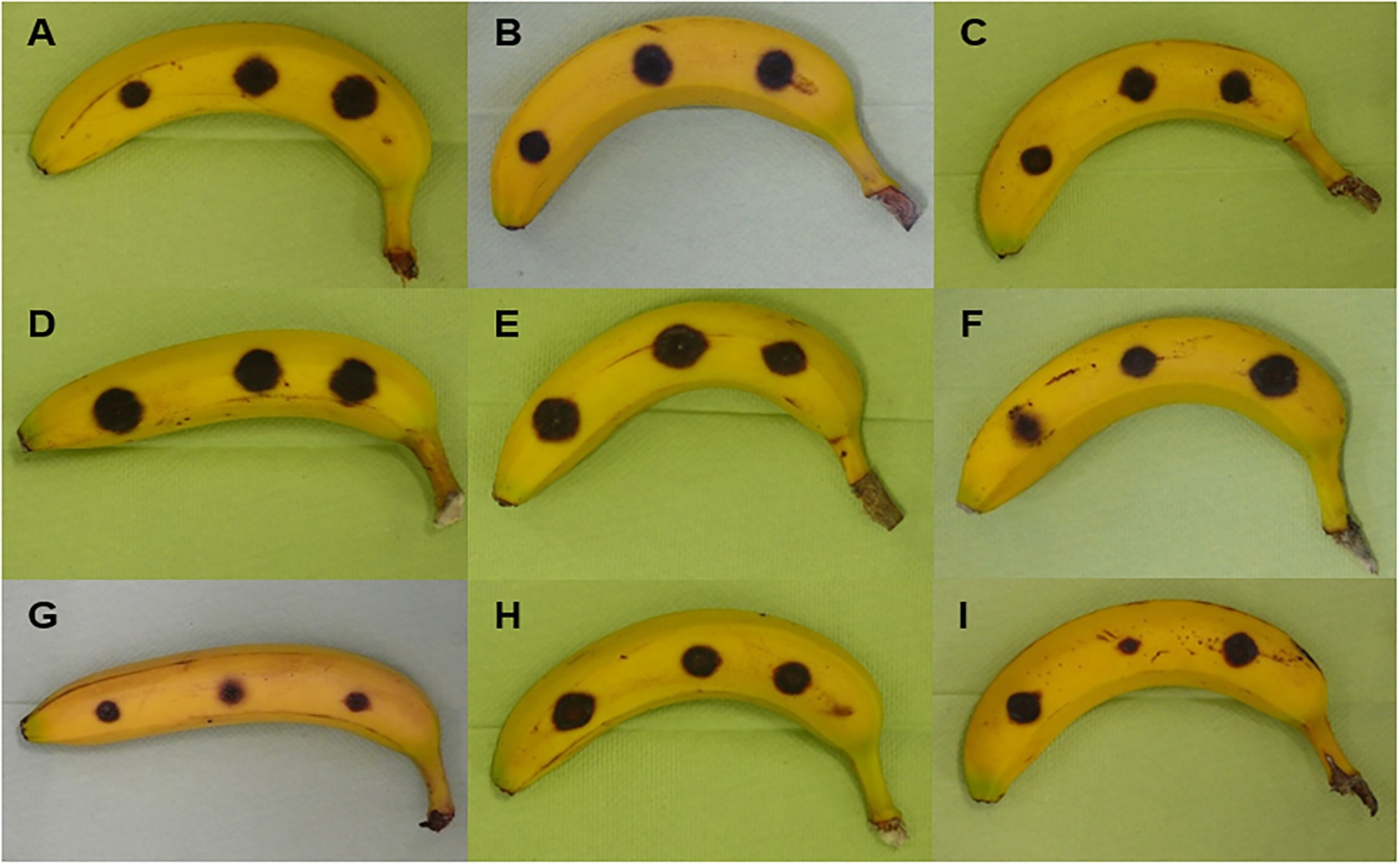
Visual results from the sealed box experiment show that volatile compounds from potential biocontrol fungi, Phomopsis sp. (d, e) and Fusarium proliferatum (f, g), did not visibly inhibit the development of anthracnose lesions caused by Colletotrichum musae on bananas compared to various controls (a-c, h, i).

Image adapted from: Cumagun et al. / CC BY (Source)

Key Findings

  • Researchers at the University of Göttingen, Germany, studied three endophytic strains to control a banana disease caused by the fungus Colletotrichum musae
  • The endophytes significantly reduced the growth of the harmful fungus in both laboratory and real-life tests
  • These endophytes could be a safer, environmentally friendly alternative to chemical fungicides, potentially reducing postharvest losses in bananas
Postharvest diseases cause significant losses in fruit and vegetable production worldwide. Traditionally, these diseases have been managed using chemical fungicides. However, extensive use of these chemicals has led to the development of resistant pathogens and raised concerns about human health and environmental safety[2]. In recent years, researchers have turned to biological control methods, such as using endophytes, which are microorganisms that live inside plants without causing harm. These endophytes can promote plant growth and enhance disease resistance, making them a promising alternative to chemical fungicides[2]. A recent study conducted by the University of Göttingen, Germany, investigated the potential of three endophytic strains—Phomopsis sp., Fusarium proliferatum, and Tinctoporellus epimiltinus—to control the growth of the pathogenic fungus Colletotrichum musae, which causes anthracnose disease in bananas[1]. Anthracnose is a significant issue in banana production, particularly in regions like Guadeloupe, where resistance to chemical treatments has been observed[3]. The researchers conducted both in vitro (laboratory-based) and in vivo (real-life) experiments to assess the effectiveness of these endophytes. They used two types of potato dextrose media (PDA)—commercial and natural—to determine if the growth medium affected the endophytes' ability to control C. musae. The findings showed that all three endophytes significantly reduced the growth of C. musae compared to the control. Interestingly, the type of medium did not significantly affect the size of the lesions caused by C. musae on banana fruits. Further analysis revealed that the interaction between the fungal strain and the medium was significant. On the commercial medium, there were no notable differences between the biocontrol abilities of the endophytes and the control treatments. However, on the natural medium, significant differences were observed between the fungal strains. Specifically, lesions on bananas incubated with Phomopsis sp. were slightly larger than those with F. proliferatum. The study also investigated the volatile compounds (VOCs) released by the endophytes, as these compounds can inhibit pathogen growth. Using gas chromatography-mass spectrometry (GC-MS), the researchers identified twelve volatile metabolites. Benzaldehyde was the most prominent volatile emitted from both commercial and plain media. Other compounds such as 2-undecanone, 2-nonanone, and phenylethyl-alcohol were detected in both media, while 1-decanol and acoradiene were unique to the commercial medium. Acoradiene was also exclusive to F. proliferatum. To understand how the different media affected the fungi's metabolism, the researchers used high-performance liquid chromatography with quadrupole time-of-flight mass spectrometry (HPLC-QTOF-MS) to analyze the metabolic footprints. They recorded 388 metabolic signals, with 80-90% showing significant differences between the two types of media. This indicates that the preparation of the potato dextrose medium can influence the metabolic activity of the fungi. The findings of this study suggest that the endophytic strains Phomopsis sp. and Fusarium proliferatum have the potential to reduce postharvest decay and losses in bananas. These endophytes could serve as environmentally friendly and sustainable alternatives to chemical fungicides, addressing the issue of pathogen resistance and minimizing health and ecological risks[2][3]. Further research and development are needed to optimize the application of these endophytes in commercial settings and to explore their effectiveness in other crops affected by postharvest diseases.

BiochemPlant ScienceMycology

References

Main Study

1) Metabolic profiling of endophytic fungi acting as antagonists of the banana pathogen Colletotrichum musae.

Published 24th January, 2025

https://doi.org/10.1371/journal.pone.0310442


Related Studies

2) Potential of microbial endophytes to enhance the resistance to postharvest diseases of fruit and vegetables.

https://doi.org/10.1002/jsfa.10829


3) Distribution of Thiabendazole-Resistant Colletotrichum musae Isolates from Guadeloupe Banana Plantations.

https://doi.org/10.1094/PDIS.1997.81.12.1378


Related Articles

An unhandled error has occurred. Reload 🗙