Understanding Plant Root Fungi: How They Produce and Use Helpful Enzymes

Jenn Hoskins
7th January, 2025

Understanding Plant Root Fungi: How They Produce and Use Helpful Enzymes

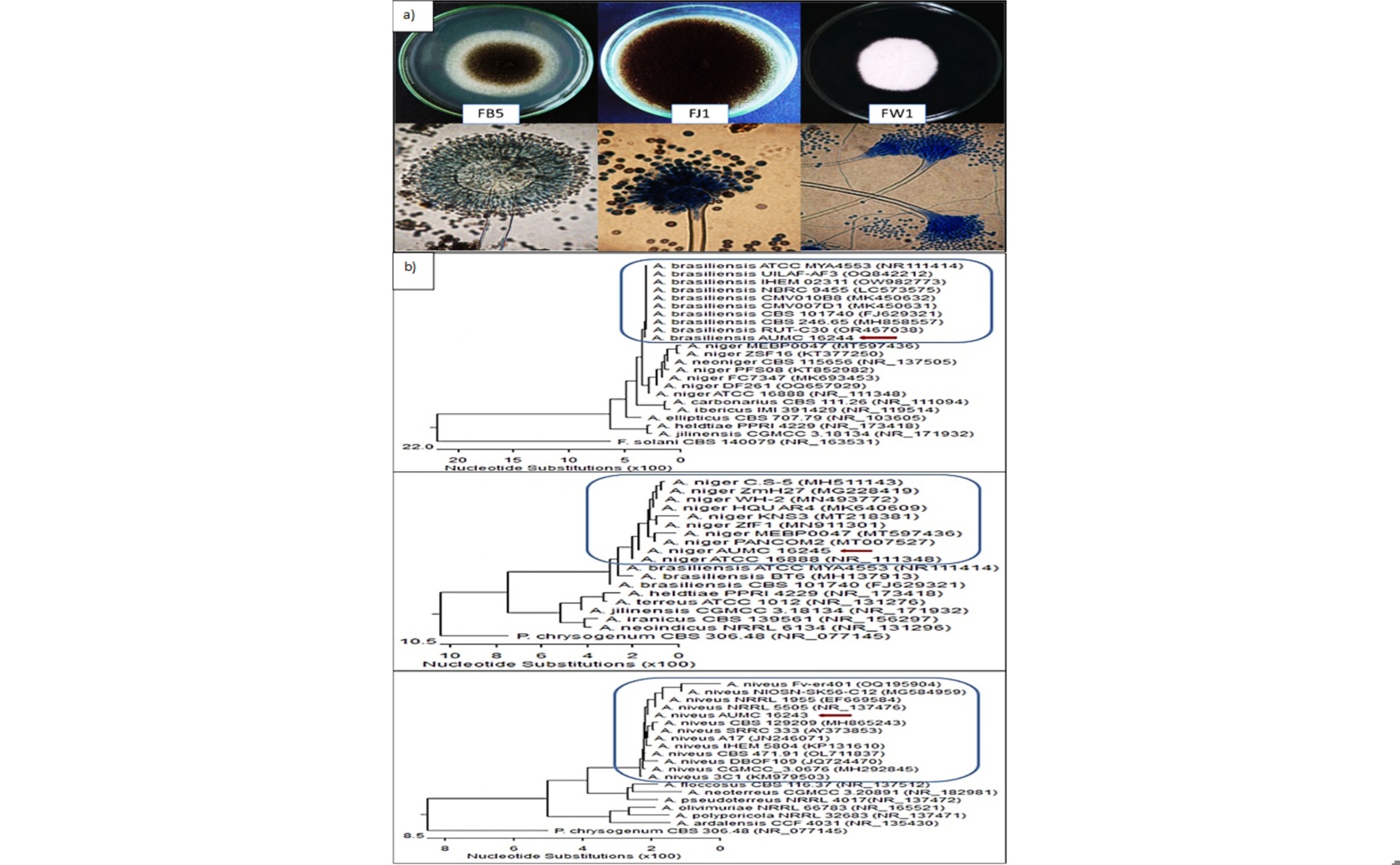
Morphological characterization (a) and phylogenetic analysis of 18S rRNA sequences (b) successfully identified the three most potent pectinase-producing fungal isolates for industrial application as Aspergillus brasiliensis, Aspergillus niger, and Aspergillus niveus.

Image adapted from: Mwaheb et al. / CC BY (Source)

Key Findings

  • Researchers at Fayoum University studied fungal pectinase production from plant rhizospheres in Fayoum Governorate, Egypt
  • The highest pectinase production was found in fungi from banana, jarawa, and wheat rhizospheres, with Aspergillus strains being the most active producers
  • The study optimized pectinase production and found that the enzyme was stable across a range of temperatures and pH levels
  • The pectinase was biocompatible with human skin cells and effective as a clothes bioscouring agent, increasing efficiency by 20%
Microorganisms are favored as enzyme sources due to their short lifespan, high production rate, affordability, and the absence of harmful chemicals in enzymes derived from plant and animal sources. Fungi, in particular, are efficient producers of bioactive compounds, including the industrially significant enzyme pectinase. A recent study conducted by Fayoum University[1] focused on the production, optimization, purification, biocompatibility, and application of fungal pectinase sourced from plant rhizospheres in Fayoum Governorate, Egypt. The study identified the highest pectinase degrading index (PDI) in fungal isolates from banana (FB5), jarawa (FJ2), and wheat (FW1) rhizospheres. Quantitative analysis revealed the highest pectinase production levels of 1603.67, 1311.22, and 1264.83 U/ml by FB5, FJ1, and FW1 fungal isolates, respectively. The most active pectinase-producing fungi were identified as Aspergillus niveus strain AUMC1624, Aspergillus niger strain AUMC16245, and Aspergillus brasiliensis strain AUMC16244. To optimize pectinase production, the study employed the one factor at a time (OFAT) protocol. This revealed that A. niger, A. niveus, and A. brasiliensis achieved maximum pectinase levels at 1% pectin concentration after 5, 7, and 7 days, respectively, at temperatures of 40, 45, and 45 °C. Partial purification of the pectinases was carried out using ammonium sulfate precipitation (ASP) and organic solvent precipitation (OSP) methods, with the highest activity observed at 40-60% saturation using the ASP method for A. niger. The thermostability characterization of A. niger pectinase indicated relative activities of 61.7, 69.0, 99.9, 91.3, and 90.6% at temperatures ranging from 30 to 70 °C, with pH optimization at pH 5-7. The enzyme's molecular weight was approximately 30 kDa. GC-mass analysis of the end products of pectinase included acetic acid ethyl ester, hexadecane carbonsaure methylase, and hexadecenoic acid. A noteworthy aspect of this study was the examination of the biocompatibility of the pectinase using a human skin cell line (HFb-4) for the first time, revealing a minimal half concentration (IC50) of 151.86 ± 0.76 U/ml. The biocompatible pectinase was then applied as a clothes bioscouring agent, achieving the highest bioscouring efficiency with a concentration of 1893.52 U/ml, resulting in a 20.0% increase in bioscouring. Previous studies have highlighted the significant role of pectinases in various industries, including food, textile, and paper[2][3][4]. The thermostable and alkaline nature of pectinases from Aspergillus niger, as shown in a study from Nepal[2], aligns with the findings of the current study, which demonstrated the broad temperature and pH stability of A. niger pectinase. Additionally, the need for cold-active pectinases in the clarification processes of wine and fruit juice production[5] contrasts with the current study's focus on thermostable enzymes, indicating the diverse applications and requirements of pectinases across different industries. The current study expands on the existing knowledge by not only optimizing and purifying pectinase production but also by demonstrating its biocompatibility and practical application in bioscouring. This comprehensive approach underscores the potential of fungal pectinases in various industrial applications, while also addressing concerns related to enzyme stability and biocompatibility.

BiotechPlant ScienceMycology

References

Main Study

1) Study of Different Cultivated Plants Rhizosphere Soil Fungi-Mediated Pectinase: Insights into Production, Optimization, Purification, Biocompatibility, and Application.

Published 6th January, 2025

https://doi.org/10.1007/s00248-024-02474-0


Related Studies

2) Alkaline thermostable pectinase enzyme from Aspergillus niger strain MCAS2 isolated from Manaslu Conservation Area, Gorkha, Nepal.

https://doi.org/10.1186/s40064-015-1286-y


3) Aspergillus enzymes involved in degradation of plant cell wall polysaccharides.

Journal: Microbiology and molecular biology reviews : MMBR, Issue: Vol 65, Issue 4, Dec 2001


4) Biopolymers and nanostructured materials to develop pectinases-based immobilized nano-biocatalytic systems for biotechnological applications.

https://doi.org/10.1016/j.foodres.2020.109979


5) Pectinase secreted by psychrotolerant fungi: identification, molecular characterization and heterologous expression of a cold-active polygalacturonase from Tetracladium sp.

https://doi.org/10.1186/s12934-019-1092-2


Related Articles

An unhandled error has occurred. Reload 🗙