New Antibiotics Show Promise Against Harmful Bacteria and Plant Diseases

Jenn Hoskins
12th December, 2024

New Antibiotics Show Promise Against Harmful Bacteria and Plant Diseases

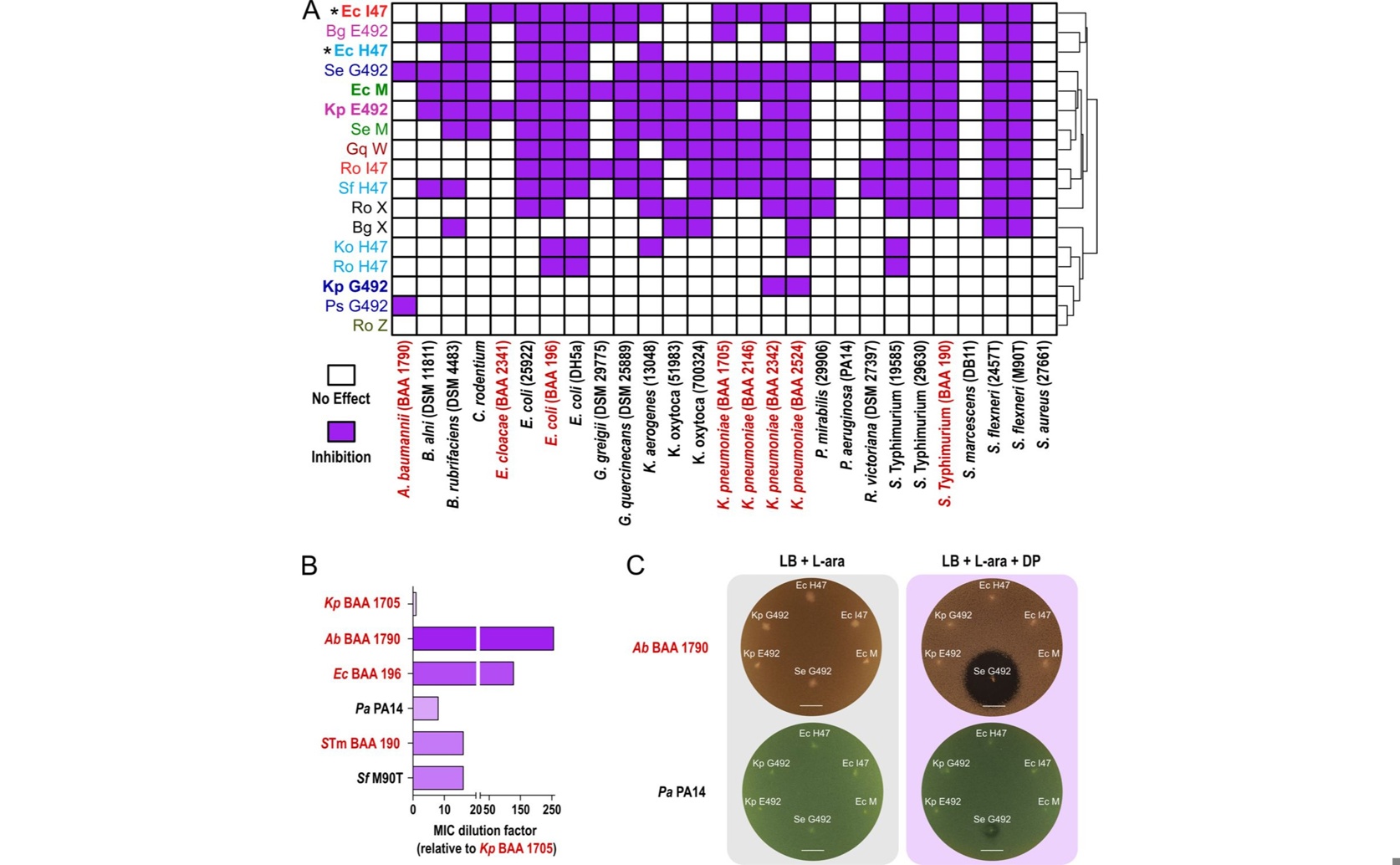
The newly discovered class IIb microcins display a broad range of inhibitory activities (a), providing the first evidence of potent, iron-dependent action against Gram-negative ESKAPE pathogens such as Acinetobacter baumannii and Pseudomonas aeruginosa (b, c).

Image adapted from: Mortzfeld et al. / CC BY (Source)

Key Findings

  • Researchers at the University of Massachusetts Chan Medical School discovered 12 new class IIb microcins in seven additional Enterobacteriaceae species
  • These new microcins showed antimicrobial activity against plant pathogens and Gram-negative ESKAPE pathogens, including Acinetobacter baumannii and Pseudomonas aeruginosa
  • The study suggests that class IIb microcin genes are more widespread than previously thought, opening up new possibilities for developing treatments against drug-resistant bacteria
Bacterial warfare is an ongoing battle in the microbial world, where bacteria inhibit and kill one another using a variety of compounds, including bacteriocins and antibiotics. These interactions are crucial for shaping the dynamics within microbial ecosystems. A recent study by the University of Massachusetts Chan Medical School[1] sheds new light on this microbial competition by discovering previously unknown class IIb microcins, expanding our understanding of these antimicrobial agents. Microcins are small proteins produced by some bacteria that possess antimicrobial activity. They play a significant role in interspecies competition, particularly among Enterobacteriaceae, a large family of bacteria that includes both harmless commensals and harmful pathogens[2]. These microcins have been shown to limit the growth of competing bacteria, especially during intestinal inflammation[2]. However, until now, only five class IIb microcins had been identified, all from specific strains of Escherichia coli and Klebsiella pneumoniae. The new study utilized a customized informatics-driven approach to screen bacterial genomes in public databases. This approach led to the discovery of 12 previously unknown class IIb microcins in seven additional Enterobacteriaceae species, including phytopathogens and environmental isolates. The researchers introduced three novel clades of microcins (MccW, MccX, and MccZ) and identified eight new variants of the previously known class IIb microcins. To validate the antimicrobial potential of these newly discovered microcins, the researchers heterologously expressed them in E. coli and tested their efficacy against various bacterial isolates. The results were promising, with the new microcins showing activity against plant pathogens from the genera Brenneria, Gibbsiella, and Rahnella. Notably, two of the newly discovered microcins exhibited activity against Gram-negative ESKAPE pathogens, such as Acinetobacter baumannii and Pseudomonas aeruginosa. This is significant because it is the first evidence that class IIb microcins can target bacteria outside of the Enterobacteriaceae family. The findings of this study are crucial as they highlight that class IIb microcin genes are more prevalent in the microbial world than previously recognized. This discovery opens up new possibilities for the development of synthetic hybrid microcins as viable tools to target clinically relevant drug-resistant pathogens. The potential of microcins to act as narrow-spectrum therapeutics to inhibit enteric pathogens and reduce enterobacterial blooms has been demonstrated in previous studies[2]. Moreover, engineered live biotherapeutic products using microcins have shown promise in selectively removing multidrug-resistant pathogens from the gastrointestinal tract without disrupting the resident microbiota[3]. The evolutionary advantage of regulated toxin production strategies in bacteria, such as those using quorum sensing or stress responses, has been well-documented[4]. These strategies enable bacteria to efficiently and effectively attack competitors in response to environmental cues. The discovery of new class IIb microcins adds another layer to our understanding of bacterial warfare and the evolutionary logic underlying these interactions. In conclusion, this study by the University of Massachusetts Chan Medical School significantly advances our knowledge of class IIb microcins and their role in microbial competition. By uncovering new microcins and demonstrating their antimicrobial potential, the researchers have paved the way for the development of innovative therapeutic strategies to combat drug-resistant pathogens. The findings underscore the importance of exploring the microbial world for novel antimicrobial agents and highlight the potential of engineered live biotherapeutic products in addressing pressing public health challenges.

MedicineBiotechPlant Science

References

Main Study

1) Novel class IIb microcins show activity against Gram-negative ESKAPE and plant pathogens.

Published 11th December, 2024

https://doi.org/10.7554/eLife.102912


Related Studies

2) Microcins mediate competition among Enterobacteriaceae in the inflamed gut.

https://doi.org/10.1038/nature20557


3) Microcin MccI47 selectively inhibits enteric bacteria and reduces carbapenem-resistant Klebsiella pneumoniae colonization in vivo when administered via an engineered live biotherapeutic.

https://doi.org/10.1080/19490976.2022.2127633


4) The evolution of strategy in bacterial warfare via the regulation of bacteriocins and antibiotics.

https://doi.org/10.7554/eLife.69756


Related Articles

An unhandled error has occurred. Reload 🗙