UV LED Disinfection as a New Treatment for Common Fish Pathogens

Jenn Hoskins
19th November, 2024

UV LED Disinfection as a New Treatment for Common Fish Pathogens

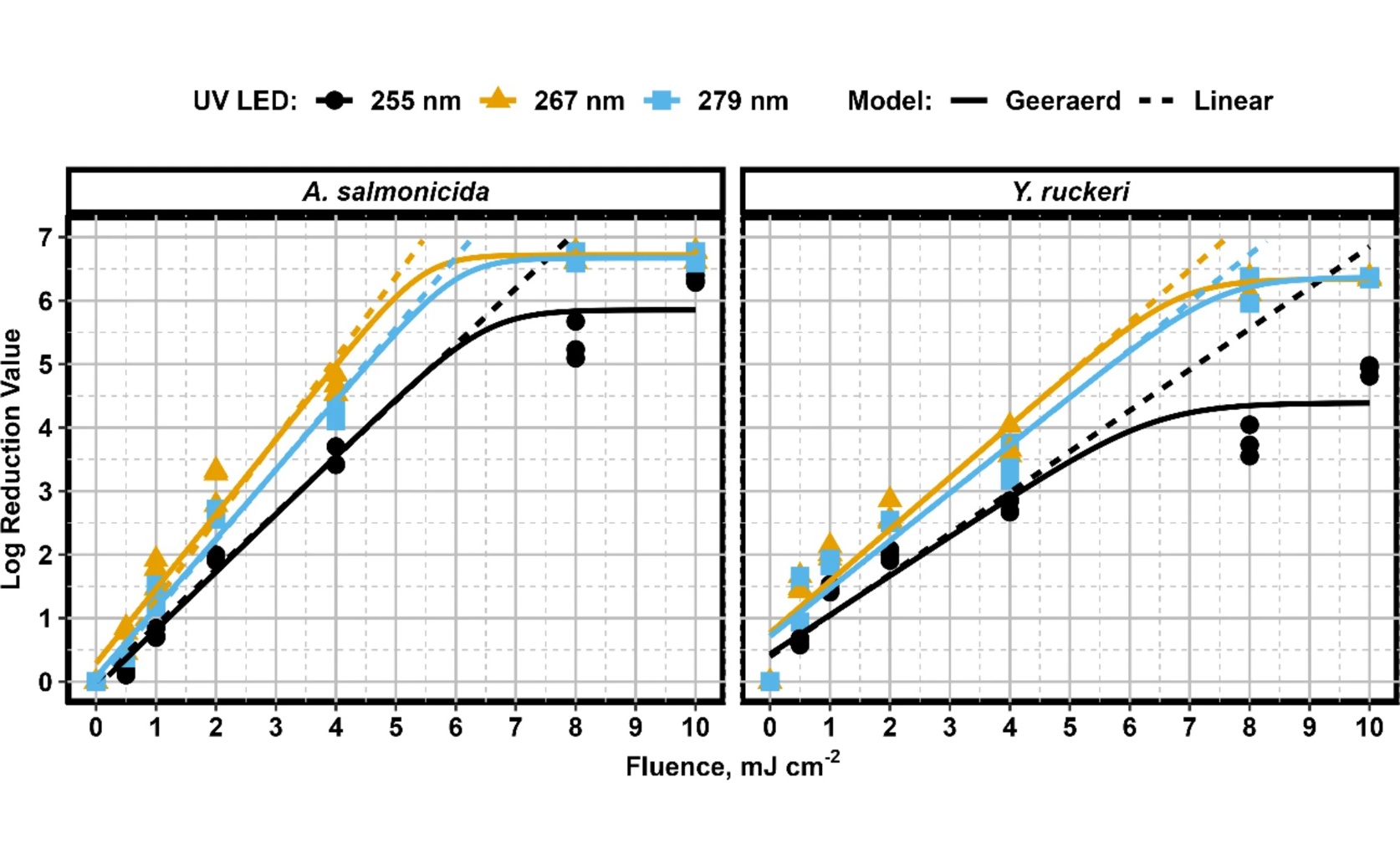
UV LED wavelengths of 267 nm and 279 nm inactivated the fish pathogens Aeromonas salmonicida and Yersinia ruckeri in pure cultures much more efficiently than the 255 nm wavelength, illustrating how this novel technology can be optimized for aquaculture disease control.

Image adapted from: Rauch et al. / CC BY (Source)

Key Findings

  • The study from Dalhousie University explored using UV LEDs to disinfect harmful bacteria in aquaculture
  • UV LEDs at 267 and 279 nm wavelengths were more effective than the 255 nm wavelength in killing the bacteria
  • UV LEDs worked well even in wastewater, making them a practical alternative to traditional mercury-based UV systems
Aquaculture, the farming of fish and other aquatic organisms, is a rapidly growing industry that faces significant challenges due to bacterial infections. Two common pathogenic bacteria affecting salmonid fish are Aeromonas salmonicida and Yersinia ruckeri. These bacteria can cause severe diseases leading to substantial economic losses. While vaccinations exist, they are not always practical or reliable on a large scale. Recent research from Dalhousie University[1] has explored the use of UV light emitting diodes (UV LEDs) as a more efficient and durable alternative to traditional mercury-based UV systems for disinfecting these pathogens. Yersinia ruckeri, the causative agent of enteric redmouth disease (ERM), is a well-known pathogen in the aquaculture industry[2]. This bacterium can cause severe symptoms in fish, such as subcutaneous hemorrhages around the mouth, exophthalmia, and inflammation of internal organs. Traditional methods for controlling Y. ruckeri include biochemical, serological, and molecular detection techniques, as well as vaccination strategies. However, these methods can be costly and complex to implement on a large scale. Similarly, Aeromonas salmonicida is another significant bacterial pathogen in salmonid aquaculture. Both A. salmonicida and Y. ruckeri have been effectively inactivated using UV radiation from mercury-based systems, but these systems are energy-intensive and fragile, limiting their use to closed or semi-closed production systems[3]. This limitation has driven the search for more robust and energy-efficient disinfection technologies. The study conducted by Dalhousie University investigated the use of UV LEDs at three different wavelengths (255, 267, and 279 nm) for the disinfection of A. salmonicida and Y. ruckeri. The researchers tested the effectiveness of these UV LEDs in both pure cultures and in a wastewater matrix, which simulates the challenging conditions often found in aquaculture settings. The results demonstrated that all tested UV LEDs were effective in disinfecting both A. salmonicida and Y. ruckeri. However, the 267 and 279 nm wavelengths outperformed the 255 nm wavelength in both pure cultures and the wastewater matrix. This finding is significant because it indicates that UV LEDs, particularly at specific wavelengths, can be a viable alternative to traditional mercury-based UV systems. One of the challenges addressed in the study was the presence of particulate matter in wastewater, which can reduce the effectiveness of UV treatment. Despite this, the study found that all wavelengths of UV LEDs were still effective in disinfecting the pathogens, although the upper limit of treatment for A. salmonicida was slightly reduced in the presence of particulate matter. This study builds on previous research into water disinfection methods for recirculation aquaculture systems (RAS)[3]. RAS involves the reuse of water at high recirculation rates, making effective water disinfection crucial to prevent the proliferation of pathogens. Previous studies have compared various photolytic, photochemical, and photocatalytic processes for water disinfection in RAS. The current study's focus on UV LEDs aligns with these efforts by providing a more durable and energy-efficient disinfection method that can be adapted to challenging environments. The findings from Dalhousie University are particularly impactful for aquaculture producers. By demonstrating the effectiveness of UV LEDs in disinfecting key pathogens, this research offers a promising alternative to traditional disinfection methods. UV LEDs have several advantages, including lower energy consumption, the ability to be powered by batteries, and adaptability to various environments. These characteristics make UV LEDs a practical solution for improving disease control in aquaculture. In summary, the study from Dalhousie University provides valuable insights into the use of UV LEDs for disinfection in aquaculture. By effectively inactivating A. salmonicida and Y. ruckeri, UV LEDs offer a durable and energy-efficient alternative to traditional mercury-based UV systems. This research represents a significant step forward in the development of novel technologies for disease control in the aquaculture industry.

HealthBiotechMarine Biology

References

Main Study

1) UV LED disinfection as a novel treatment for common salmonid pathogens.

Published 18th November, 2024

https://doi.org/10.1038/s41598-024-79347-6


Related Studies

2) Yersinia ruckeri, the causative agent of enteric redmouth disease in fish.

https://doi.org/10.1186/s13567-015-0238-4


3) A comparison of photolytic, photochemical and photocatalytic processes for disinfection of recirculation aquaculture systems (RAS) streams.

https://doi.org/10.1016/j.watres.2020.115928


Related Articles

An unhandled error has occurred. Reload 🗙