Comparing Machine Learning Methods for Estimating Soil Water Movement

Jenn Hoskins
17th November, 2024

Comparing Machine Learning Methods for Estimating Soil Water Movement

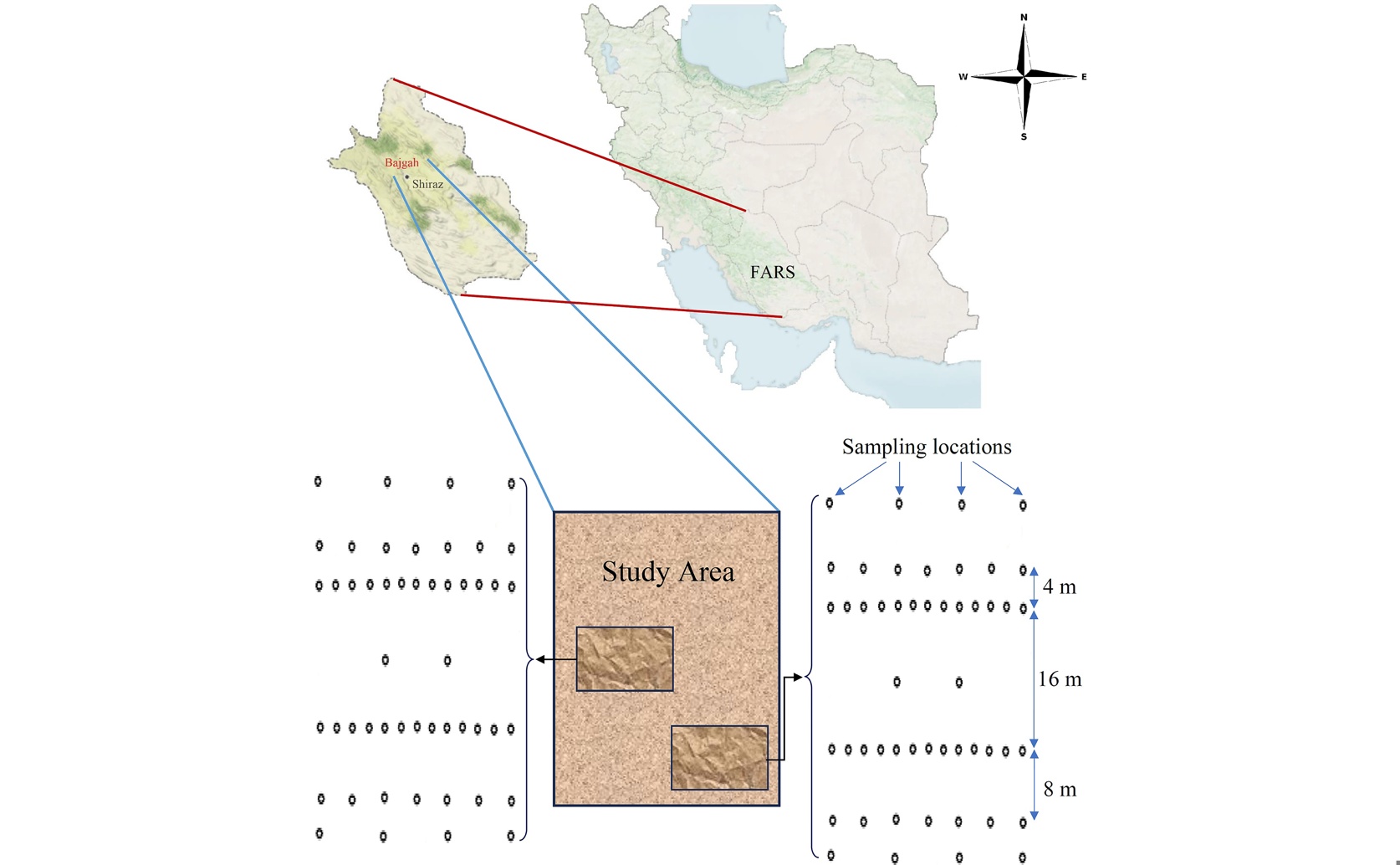
This map shows the 100 experimental locations within the Bajgah region of Iran where soil data was collected to develop and test various machine learning models for predicting soil hydraulic conductivity in the study.

Image adapted from: Moosavi et al. / CC BY (Source)

Key Findings

  • Researchers from Shiraz University developed machine learning models to predict soil hydraulic conductivity (Kfs) using easily measurable soil attributes
  • The study found that neural network models, especially PSO-NNs, provided more accurate predictions than traditional regression methods
  • These advanced models can significantly improve soil management practices like irrigation and erosion control by enhancing the prediction of water and chemical movement in soil
Soil hydraulic conductivity (Kfs) is a crucial factor in hydrological modeling frameworks, impacting water and chemical movement within the soil. Accurate prediction of Kfs can significantly enhance soil management practices, such as irrigation, drainage, and erosion control. However, traditional methods for measuring Kfs are labor-intensive and time-consuming. To address this challenge, researchers from Shiraz University conducted a study to develop predictive models for Kfs using machine learning approaches[1]. The study focused on utilizing easily measurable soil attributes to predict Kfs. These attributes included bulk density (BD), initial water content (Wi), saturated water content (Ws), mean weight diameter (MWD), geometric mean diameter (GMD) of aggregates, pH, electrical conductivity (EC), and calcium carbonate equivalent (CCE). The researchers collected 100 measurements from the Bajgah Agricultural Experimental Station to develop and test their models. Several machine learning approaches were employed, including radial basis functions (RBFNNs), multilayer perceptron (MLPNNs), hybrid genetic algorithm (GA-NNs), and particle swarm optimization (PSO-NNs) neural networks. These models were compared against the traditional multiple linear regression (MLR) model using statistical indices such as root mean square error (RMSE), mean absolute percentage error (MAPE), and correlation coefficient (R). The findings revealed that all neural network models outperformed the traditional regression model, with PSO-NNs providing the most accurate and robust predictions (R = 0.958; RMSE = 0.343; MAPE = 9.47). The performance of the models was ranked as follows: PSO-NNs, GA-NNs, MLPNNs, RBFNNs, and MLR. This indicates that PSO-NNs are particularly efficient in predicting Kfs, making them a valuable tool for soil management practices. These results align with previous studies that have demonstrated the efficacy of neural networks in predicting soil properties[2]. For instance, a study conducted in Fars Province, Iran, compared stepwise multiple linear regression (SMLR), MLPNNs, and RBFNNs for predicting hydraulic conductivity at various tensions. The study found that MLPNNs provided the most accurate predictions, followed by RBFNNs and SMLR[2]. This supports the current study's findings that neural networks, particularly MLPNNs and RBFNNs, are effective in predicting soil hydraulic properties. Furthermore, the use of RBFNNs in predicting biological parameters has also shown promising results. A study on the growth rate of Monascus ruber fungus demonstrated that RBFNNs outperformed traditional polynomial models in predicting growth rates based on environmental factors such as temperature, water activity, and pH[3]. This highlights the versatility and robustness of RBFNNs in various predictive modeling contexts. The current study's use of advanced neural network models like PSO-NNs and GA-NNs represents a significant advancement in the field of soil science. These models leverage optimization algorithms to enhance prediction accuracy, offering a powerful alternative to traditional regression methods. However, the researchers recommend further evaluations to quantify potential uncertainties and validate the models' applicability in different soil conditions and geographical locations. In conclusion, the study conducted by Shiraz University demonstrates the potential of machine learning approaches, particularly PSO-NNs, in accurately predicting near-saturated hydraulic conductivity (Kfs) using easily measurable soil attributes. This advancement can significantly improve soil management practices, contributing to more efficient water and chemical movement within the soil. The findings build on previous research, reinforcing the efficacy of neural networks in predictive modeling and highlighting their broader applicability in soil science and beyond.

AgricultureEnvironmentSustainability

References

Main Study

1) Comparing machine learning approaches for estimating soil saturated hydraulic conductivity.

Published 14th November, 2024

https://doi.org/10.1371/journal.pone.0310622


Related Studies

2) Predicting saturated and near-saturated hydraulic conductivity using artificial neural networks and multiple linear regression in calcareous soils.

https://doi.org/10.1371/journal.pone.0296933


3) Modelling fungal growth using radial basis function neural networks: the case of the ascomycetous fungus Monascus ruber van Tieghem.

Journal: International journal of food microbiology, Issue: Vol 117, Issue 3, Jul 2007


Related Articles

An unhandled error has occurred. Reload 🗙