Tracking Potassium and Sodium in Living Plants with a Tiny Sensor

Jim Crocker
26th October, 2024

Tracking Potassium and Sodium in Living Plants with a Tiny Sensor

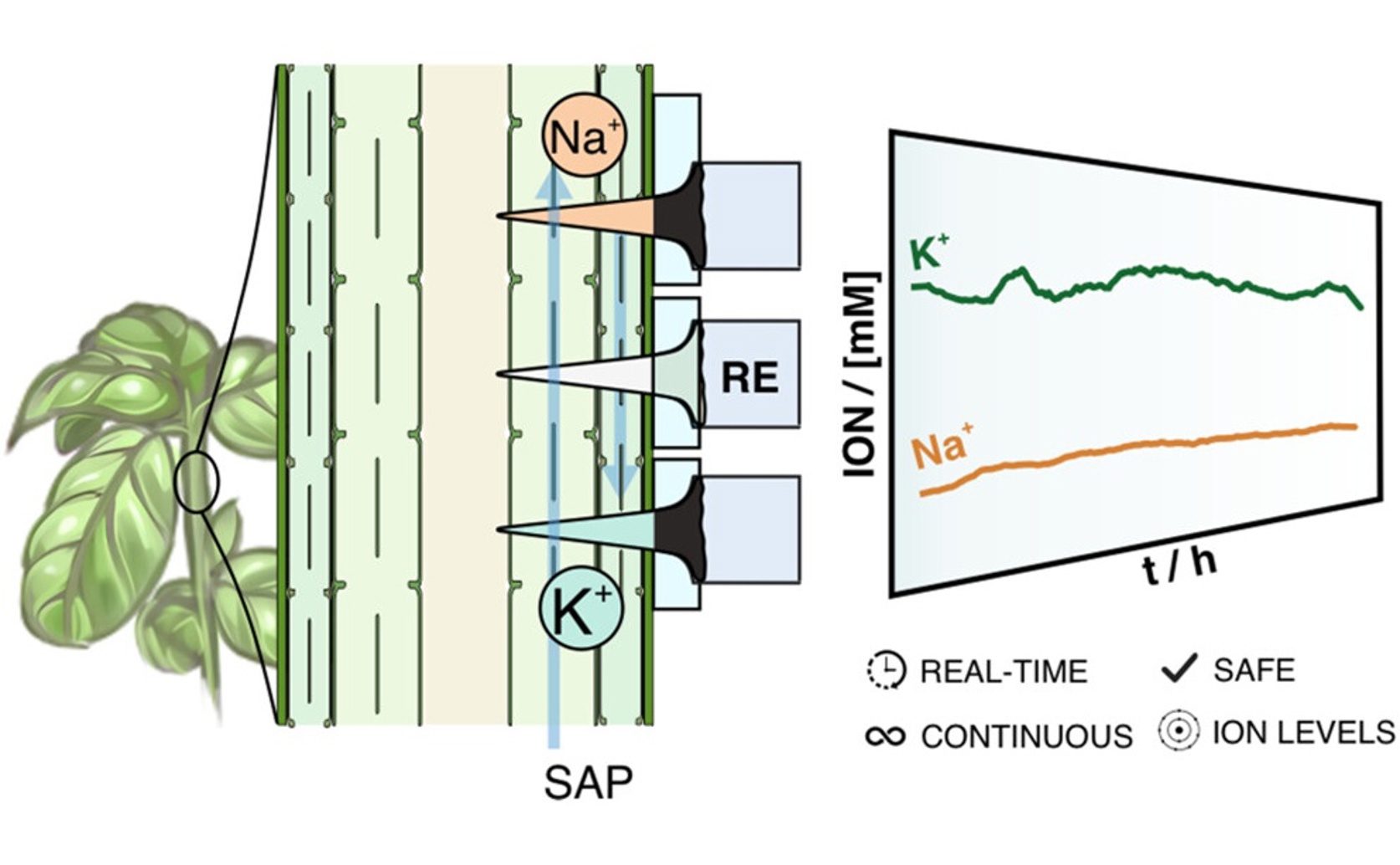
Graphical Abstract from study.

Image adapted from: Wang et al. / CC BY (Source)

Key Findings

  • Researchers at KTH Royal Institute of Technology developed microneedle sensors for real-time, nondestructive monitoring of potassium and sodium in plants
  • These sensors provide accurate readings within 5 seconds and can be used multiple times without damaging the plant
  • The sensors successfully track ion movement in plants, offering valuable insights for optimizing growth conditions and early stress detection
Potassium and sodium ions (K+ and Na+) are essential for plant growth and health. However, traditional methods to measure these ions involve extracting plant sap, which can harm the plant and provide delayed or inconsistent results. Researchers at the KTH Royal Institute of Technology have developed a new potentiometric dual microneedle sensor that allows for nondestructive, real-time, and continuous monitoring of K+ and Na+ concentrations in living plants[1]. This innovative approach could revolutionize how we monitor plant health, offering significant advancements in smart agriculture. The study introduces microneedle sensors that can be inserted into the plant stem without causing significant damage. These sensors have a response time of less than 5 seconds and show a close-to-Nernstian slope, which indicates their high sensitivity and accuracy. The sensors are resilient, withstanding up to five insertions, and provide consistent and reversible measurements. They can operate continuously for 24 hours and cover the expected physiological levels of K+ and Na+ in plants, ranging from 5-50 mM for Na+ and 50-120 mM for K+. The accuracy of these microneedle sensors was validated by comparing their readings to those obtained through ion chromatography, a standard reference method. The sensors successfully tracked the transportation of K+ and Na+ from the hydroponic solution to the plant stem within 5-10 minutes. This capability highlights the sensors' potential for providing real-time information on ion concentrations, which is crucial for optimizing plant growth conditions and early detection of stress. This new approach builds on previous research in the field of plant monitoring and biosensing. Traditional biosensing platforms often lack the accuracy and timeliness needed to monitor plant growth effectively[2]. Microneedles, due to their unique dimensions and shapes, have shown significant advantages in sensing, detection, and drug delivery in plants. They can serve as effective tools for plant diagnosis and treatment, addressing the inefficiencies and pollution issues associated with conventional methods like spraying and administering drugs[2]. Continuous monitoring of chemical signals in plants is essential because plants respond to stress with a range of chemical signals that are time-dependent[3]. Single-point measurements often fail to capture these dynamic changes. The microneedle sensors' ability to provide continuous, real-time data addresses this challenge, offering a more accurate picture of the plant's health status and stress responses. Furthermore, the development of wearable and implantable bioelectronic devices for plants, as reviewed in previous studies, has paved the way for advanced tools to monitor and modulate plant physiology[4]. These devices can be used in basic plant science and agricultural applications, optimizing growth conditions and improving crop yields. The new microneedle sensors fit into this broader context of biohybrid systems, where plants are integrated with smart materials and electronics to enhance their functionality. The study also highlights the importance of accurate sap collection methods for studying plant physiology. Traditional methods like K2-EDTA exudation can result in contamination and less accurate measurements[5]. The new microneedle sensors offer a nondestructive alternative, providing precise and real-time data without the need for sap extraction, thus preserving the plant's integrity. In conclusion, the potentiometric dual microneedle sensor developed by the KTH Royal Institute of Technology represents a significant advancement in plant monitoring technology. By offering nondestructive, real-time, and continuous monitoring of K+ and Na+ concentrations, these sensors address the limitations of traditional methods and provide valuable insights into plant health and stress responses. This innovation has the potential to transform smart agriculture, enabling more efficient and sustainable farming practices.

BiotechBiochemPlant Science

References

Main Study

1) Unveiling Potassium and Sodium Ion Dynamics in Living Plants with an In-Planta Potentiometric Microneedle Sensor.

Published 25th October, 2024

https://doi.org/10.1021/acssensors.4c01352


Related Studies

2) Recent advances of microneedles biosensors for plants.

https://doi.org/10.1007/s00216-023-05003-z


3) Continuous monitoring of chemical signals in plants under stress.

https://doi.org/10.1038/s41570-022-00443-0


4) Plant Bioelectronics and Biohybrids: The Growing Contribution of Organic Electronic and Carbon-Based Materials.

https://doi.org/10.1021/acs.chemrev.1c00525


5) Collection of the phloem sap, pros and cons.

https://doi.org/10.1080/15592324.2019.1618181


Related Articles

An unhandled error has occurred. Reload 🗙