How Struvite and Humic Acid Affect Fertilizer Efficiency in Nonacidic Soil

Greg Howard
3rd October, 2024

How Struvite and Humic Acid Affect Fertilizer Efficiency in Nonacidic Soil

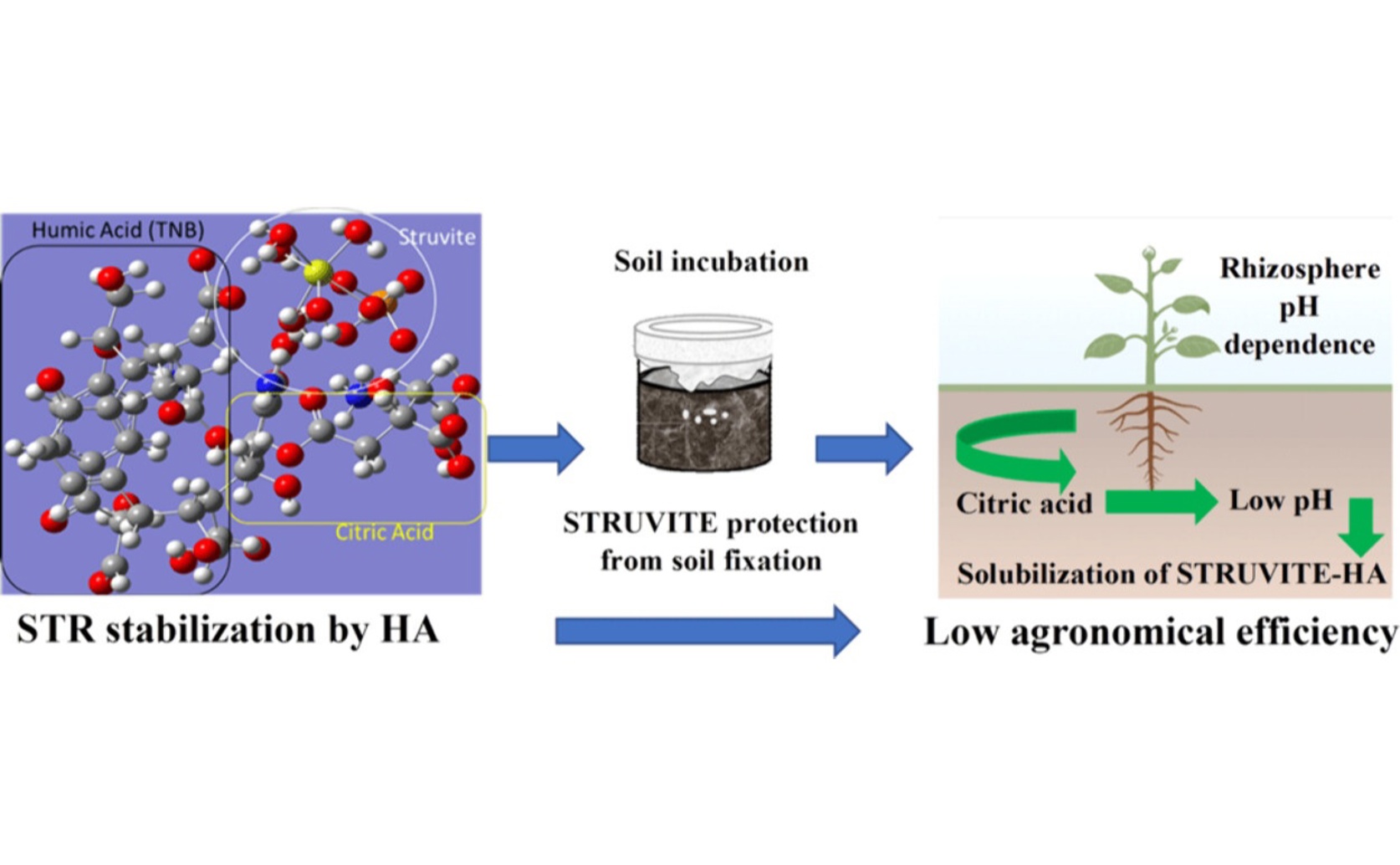
Graphical Abstract from study.

Image adapted from: Erro et al. / CC BY (Source)

Key Findings

  • The study from the University of Navarra explored using humic acid from peat to improve the efficiency of struvite fertilizer
  • Soil tests showed that struvite with humic acid had more readily available phosphorus compared to traditional fertilizers
  • However, plant growth tests revealed that struvite alone was more effective than struvite with humic acid in enhancing plant growth
Phosphorus is an essential element for plant growth, but its efficient use and management remain critical challenges. Traditional phosphate fertilizers like single superphosphate (SSP) often suffer from issues related to phosphate fixation in soils, reducing their effectiveness. Recent advances have explored alternative phosphate sources and modifications to improve fertilizer efficiency. One such study from the University of Navarra investigates the role of humic acid extracted from peat (AHt) in enhancing the fertilizing efficiency of struvite (STR)[1]. Struvite (MgNH₄PO₄·6H₂O) is a mineral that can be recovered from waste streams and has shown promise as a sustainable phosphorus source for agriculture. Previous studies have demonstrated that struvite can be as effective as traditional fertilizers like single superphosphate (SSP) in supplying phosphorus to plants[2][3]. However, there is ongoing research to further enhance its performance. The University of Navarra study explored whether incorporating humic acid extracted from peat (AHt) into struvite could improve its fertilizing efficiency. Humic acids are organic compounds known for their ability to chelate nutrients and improve soil properties, potentially making phosphorus more available to plants. The study aimed to compare the performance of struvite (STR), struvite with humic acid (STR-AHt), and SSP in both soil incubation and plant growth experiments. Characterization techniques confirmed the successful incorporation of AHt into STR. The soil incubation study revealed that the phosphorus pool distribution for STR and SSP was similar, but STR-AHt showed a higher proportion of labile phosphorus after 90 days. Specifically, the labile phosphorus increased from 10-15% in SSP and STR to 25% in STR-AHt. This suggested that STR-AHt could potentially offer more readily available phosphorus in soil over time. However, the plant assays with barley and tomato provided a different perspective. In these trials, STR outperformed SSP in terms of shoot phosphorus content, aboveground biomass, and residual soil phosphorus. Surprisingly, STR-AHt did not show any improvement over STR alone. This discrepancy between the soil incubation results and plant growth outcomes highlights the complexity of nutrient dynamics in the rhizosphere—the zone of soil surrounding plant roots. Mechanistic assays indicated that rhizosphere pH played a critical role in the observed results. Molecular modeling suggested that the stabilization of STR with AHt might reduce phosphorus release, thereby decreasing the fertilizing potential of STR-AHt. This finding aligns with the plant trial results, where STR-AHt did not enhance plant growth compared to STR. The study's findings emphasize the importance of considering the rhizosphere environment when evaluating fertilizer efficiency. While the incorporation of humic acid into struvite appeared promising in soil incubation studies, its performance in actual plant growth scenarios did not meet expectations. This underscores the need for comprehensive testing that includes both soil and plant assays to fully understand the implications of fertilizer modifications. The research also ties into broader efforts to improve phosphorus management and sustainability. Previous studies have shown the potential of organic complexed superphosphate (CSP) fertilizers, which use humic acids to inhibit phosphate fixation in soils, thereby increasing phosphorus availability to plants[4]. Similarly, the recovery and reuse of struvite from waste streams have been explored as sustainable alternatives to traditional phosphate fertilizers[3][5]. The current study adds to this body of knowledge by investigating another modification—humic acid incorporation—though with mixed results. In conclusion, the University of Navarra study provides valuable insights into the complexities of enhancing struvite fertilizing efficiency with humic acid. While the soil incubation results were promising, the plant assays highlighted the critical role of the rhizosphere and the need for holistic approaches in fertilizer research. This work contributes to the ongoing quest for sustainable and efficient phosphorus management in agriculture.

AgricultureEnvironmentBiochem

References

Main Study

1) Interactions between Struvite and Humic Acid and Consequences on Fertilizer Efficiency in a Nonacidic Soil.

Published 2nd October, 2024

https://doi.org/10.1021/acs.jafc.4c05472


Related Studies

2) Greenhouse evaluation of struvite and sludges from municipal wastewater treatment works as phosphorus sources for plants.

Journal: Journal of agricultural and food chemistry, Issue: Vol 55, Issue 20, Oct 2007


3) Nutrient management via struvite precipitation and recovery from various agroindustrial wastewaters: Process feasibility and struvite quality.

https://doi.org/10.1016/j.jenvman.2018.02.027


4) Organic complexed superphosphates (CSP): physicochemical characterization and agronomical properties.

https://doi.org/10.1021/jf204821j


5) Phosphorus recovery and recycling - closing the loop.

https://doi.org/10.1039/d0cs01150a


Related Articles

An unhandled error has occurred. Reload 🗙