Cold Plasma Boosts Antioxidant Recovery from Used Coffee Grounds

Greg Howard
6th August, 2024

Cold Plasma Boosts Antioxidant Recovery from Used Coffee Grounds

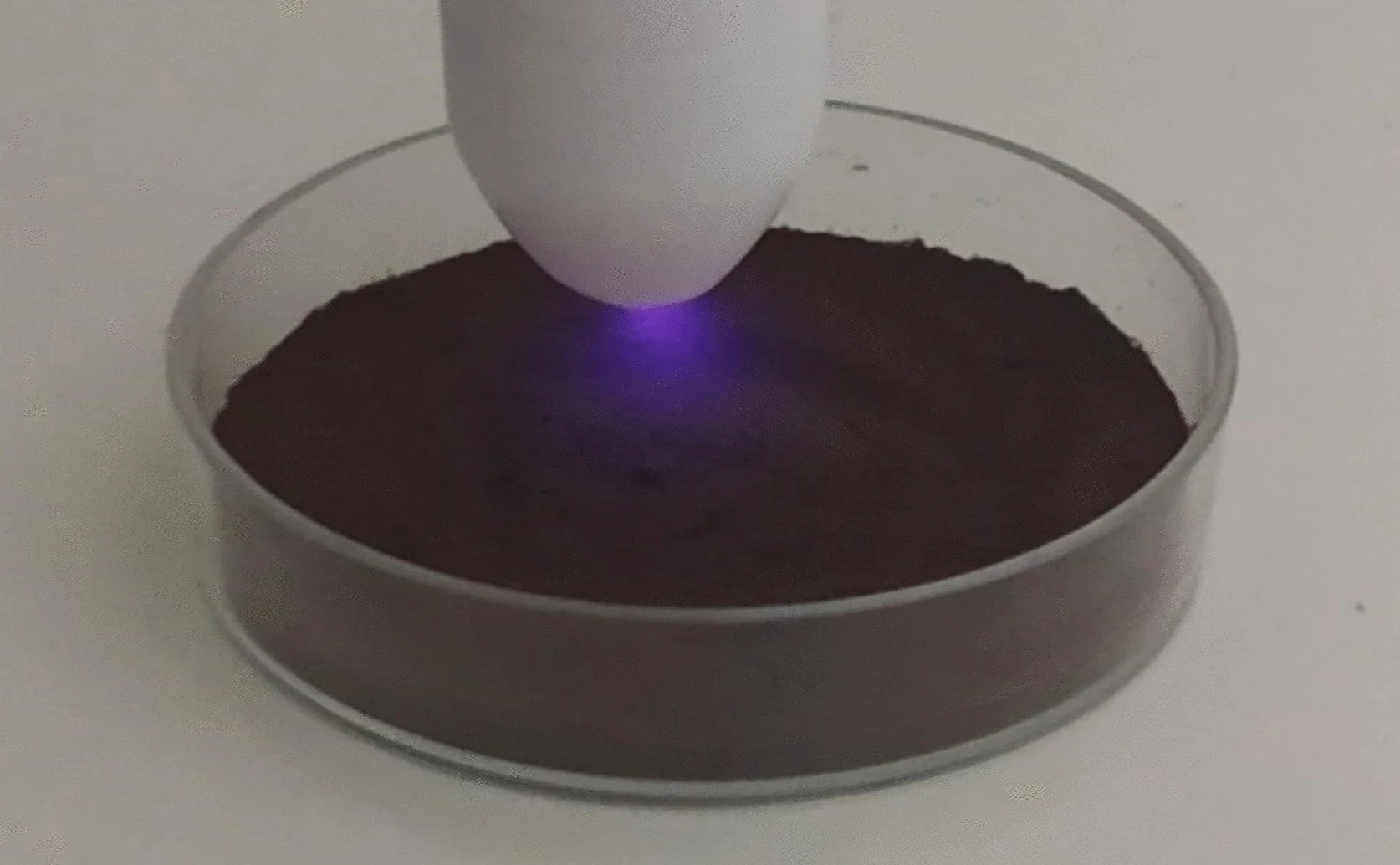
The cold atmospheric plasma experimental setup shown here was optimized to pretreat spent coffee grounds (Coffea arabica), resulting in a significant enhancement in the recovery of phenolic antioxidants and caffeine compared to untreated controls.

Image adapted from: Kyriakoudi et al. / CC BY (Source)

Key Findings

  • Researchers at Aristotle University of Thessaloniki used cold atmospheric plasma (CAP) to enhance the extraction of bioactive compounds from spent coffee grounds (SCGs)
  • The optimal CAP treatment conditions were identified as a 1 mm SCGs layer thickness, 16 mm distance from the plasma source, and a 15-minute treatment duration
  • This CAP pretreatment significantly increased the recovery of phenolic compounds, caffeine, and chlorogenic acid, along with improved antioxidant activity in SCGs
Spent coffee grounds (SCGs) are a rich source of bioactive compounds, including phenolic compounds, caffeine, and chlorogenic acid. Efficient extraction of these compounds can offer significant health benefits due to their antioxidant properties. The recent study conducted by researchers at Aristotle University of Thessaloniki[1] explores the use of cold atmospheric plasma (CAP) as a pretreatment method to enhance the extraction of these valuable compounds from SCGs. This study aims to optimize the CAP treatment conditions to maximize the recovery of bioactive compounds. The problem at hand is the inefficient extraction of phenolic compounds and other bioactives from SCGs using conventional methods. The study addresses this issue by employing CAP, a non-thermal technology that has shown promise in food processing for its ability to inactivate microbes and enhance extraction processes without compromising the quality of the product[2]. In this study, the researchers investigated the impact of various CAP treatment conditions on the total phenol content, in vitro antioxidant activity, as well as caffeine and chlorogenic acid content of SCGs. The conditions examined included the thickness of the SCGs layer, the distance between the plasma source and the SCGs layer, and the duration of CAP treatment. Using response surface methodology (RSM), the team optimized these parameters to determine the best conditions for maximizing the extraction yield. The optimal CAP treatment conditions identified were a SCGs layer thickness of 1 mm, a distance of 16 mm between the plasma source and the SCGs layer, and a treatment duration of 15 minutes. Under these conditions, the CAP-treated SCGs were subjected to ultrasound-assisted extraction (USLE) using ethanol as the solvent. This combination of CAP pretreatment followed by USLE resulted in a significant increase in the recovery of bioactive compounds from SCGs. The results of the study showed a notable enhancement in the total phenolic content and antioxidant activity of the SCGs. Specifically, the total phenolic content increased from 19.0 ± 0.7 to 24.9 ± 1.4 mg GAE/100 g dry SCGs. The antioxidant activity, measured using different assays, also showed significant improvements: ADPPH increased from 106.7 ± 5.01 to 112.3 ± 4.3 μmol Trolox/100 g dry SCGs, AABTS from 106.7 ± 5.01 to 197.6 ± 5.8 μmol Trolox/100 g dry SCGs, and ACUPRAC from 17938 ± 157 to 18299 ± 615 μmol Trolox/100 g dry SCGs. Additionally, the caffeine content increased from 799.1 ± 65.1 mg to 1064 ± 25 mg/100 g dry SCGs, and the chlorogenic acid content from 79.7 ± 15.3 mg to 111.3 ± 3.3 mg/100 g dry SCGs. The findings of this study are consistent with previous research that has demonstrated the effectiveness of non-thermal technologies in enhancing the extraction of bioactive compounds. For instance, the use of ultrasound-assisted solid-liquid extraction (USLE) has been shown to be effective in extracting phytochemicals from SCGs, with optimal conditions being determined through statistical experimental design[3]. Similarly, the CUPRAC method has been developed to measure the total antioxidant activity of dietary polyphenols and vitamins, providing a reliable index for antioxidant capacity[4]. The current study builds on these findings by integrating CAP as a pretreatment step, thereby further enhancing the extraction efficiency. Moreover, the use of CAP in food processing has been validated by other studies that have demonstrated its efficacy in microbial inactivation and preservation of food quality. For example, microwave-integrated cold plasma treatments have been shown to effectively inhibit microbial growth in onion powder without affecting its antioxidant activity or quercetin concentration[5]. Similarly, dielectric barrier discharge (DBD)-ACP has been shown to inactivate E. coli in apple juice while maintaining the quality attributes of the juice[2]. These studies support the potential of CAP as a versatile and effective technology for food processing and bioactive compound extraction. In conclusion, the study by Aristotle University of Thessaloniki demonstrates that CAP pretreatment significantly enhances the recovery of bioactive compounds from SCGs. By optimizing the CAP treatment conditions, the researchers achieved higher yields of phenolic compounds, caffeine, and chlorogenic acid, along with increased antioxidant activity. This innovative approach offers a promising solution for the efficient extraction of valuable bioactives from SCGs, contributing to the sustainable utilization of coffee waste.

HealthSustainabilityBiochem

References

Main Study

1) Impact of Cold Atmospheric Plasma Pretreatment on the Recovery of Phenolic Antioxidants from Spent Coffee Grounds

Published 5th August, 2024

https://doi.org/10.1007/s12161-024-02661-2


Related Studies

2) Application of a Dielectric Barrier Discharge Atmospheric Cold Plasma (Dbd-Acp) for Eshcerichia Coli Inactivation in Apple Juice.

https://doi.org/10.1111/1750-3841.14045


3) Development and validation of ultrasound-assisted solid-liquid extraction of phenolic compounds from waste spent coffee grounds.

https://doi.org/10.1016/j.ultsonch.2016.05.005


4) Novel total antioxidant capacity index for dietary polyphenols and vitamins C and E, using their cupric ion reducing capability in the presence of neocuproine: CUPRAC method.

Journal: Journal of agricultural and food chemistry, Issue: Vol 52, Issue 26, Dec 2004


5) Microbial decontamination of onion powder using microwave-powered cold plasma treatments.

https://doi.org/10.1016/j.fm.2016.10.006


Related Articles

An unhandled error has occurred. Reload 🗙