Unique Bacteria and Fungi Pathways in Honey Bees, Honey, and Flowers

Jenn Hoskins
31st July, 2024

Unique Bacteria and Fungi Pathways in Honey Bees, Honey, and Flowers

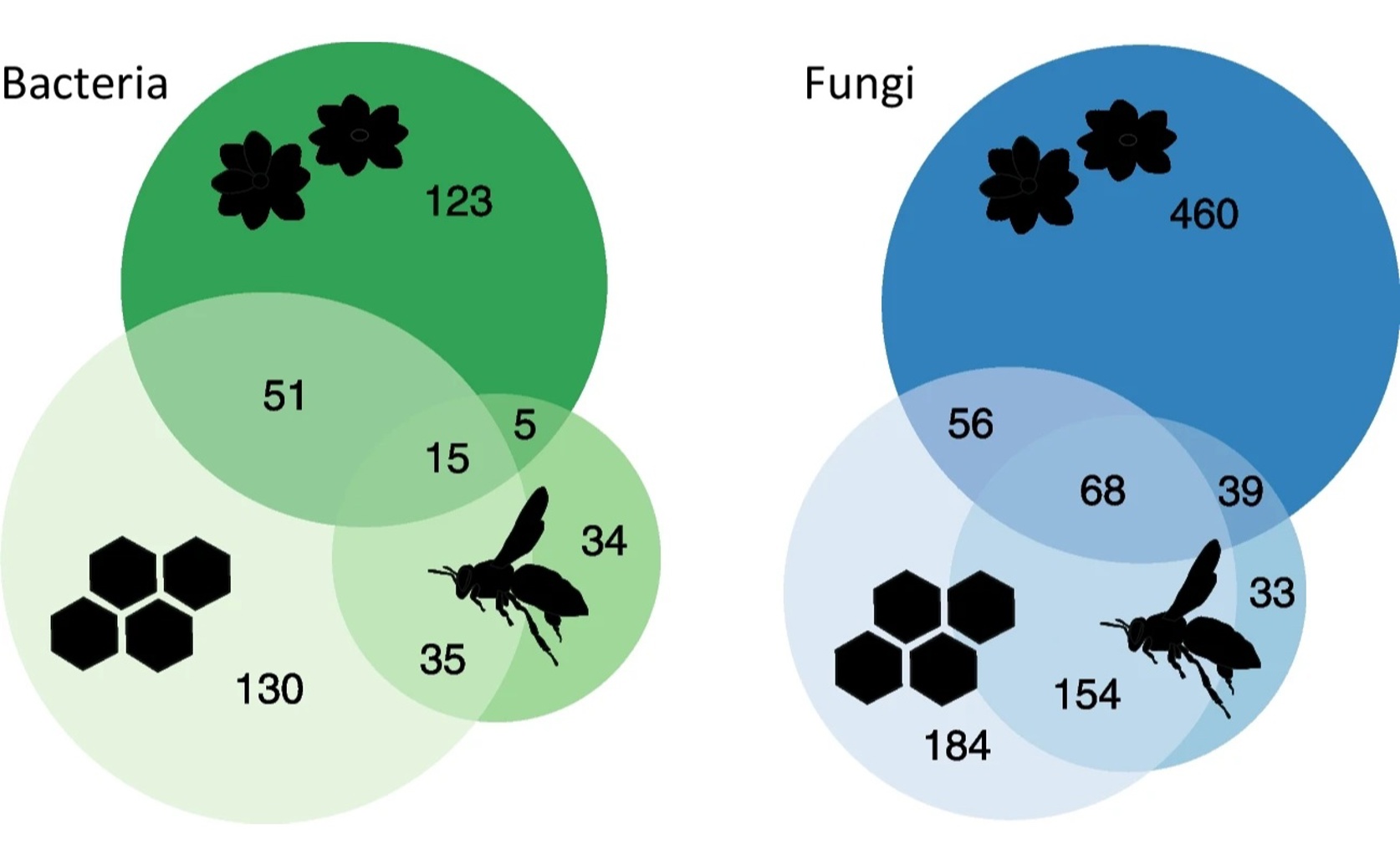
Fungal communities are widely shared between the honey bee (Apis mellifera) and honey, whereas bacterial communities are largely distinct among bees, honey, and flowers, revealing fundamentally different sharing patterns between the two microbial groups.

Image adapted from: Tiusanen et al. / CC BY (Source)

Key Findings

  • The study took place in Finland and examined how bacteria and fungi are shared among honey bees, honey, and flowers
  • Bacterial communities in honey bees, honey, and flowers are significantly different from each other
  • Fungal communities in honey bees and honey are similar but differ from those in flowers
  • Bacteria are acquired by honey bees indirectly from flowers through honey, while fungi are directly transmitted from flowers to honey bees
Understanding the intricate relationships between pollinators, plants, and microbes is crucial for appreciating the functioning of ecosystems. A recent study conducted by the University of Helsinki[1] sheds light on how bacteria and fungi are shared and transmitted within pollination communities, specifically focusing on the honey bee Apis mellifera. This study's findings offer significant insights into the microbiota of honey bees, honey, and flowers, and how these microbial communities interact and influence each other. Microbiota, the communities of microbes such as bacteria and fungi, play essential roles in ecosystem functioning. Pollinators like honey bees facilitate the transfer of these microbes among flowering plants, themselves, and their nests. To investigate this microbial exchange, researchers collected samples from honey bees, honey (representing hive microbiota), and flowers three times during the summer in Finland. They identified the bacterial and fungal communities through DNA metabarcoding and also examined plant DNA in honey to understand the impact of honey bees' flower choices on their microbiota. The study revealed that the bacterial communities of honey bees, honey, and flowers are significantly different from each other. In contrast, the fungal communities in honey bees and honey are quite similar but differ from those found in flowers. This suggests that while bacteria and fungi are shared among these components, their established microbiota remain distinct. Furthermore, the time of summer and the sampling area influence all these microbial communities, highlighting the dynamic nature of these interactions. For flowers, the plant identity has the most substantial impact on the composition of both bacterial and fungal communities. This aligns with earlier findings that flowers act as hubs for microbial transmission among bees[2]. The study also identified different dispersal pathways for bacteria and fungi. Bacteria are acquired directly from honey and indirectly from flowers through honey, whereas fungi are directly transmitted to honey bees from flowers. This nuanced understanding of microbial transmission pathways is crucial for comprehending how pollinator microbiota are formed and maintained. Previous research has shown that newly emerged worker bees initially lack gut bacteria and gain characteristic communities within a few days[3]. This study further supports the idea that the hive environment and interactions with nurse bees play a critical role in establishing the core gut microbiota of honey bees. The current study expands on this by demonstrating that while microbial sharing occurs among honey bees, honey, and flowers, it plays a minor role in the established microbiota of honey bees. The concept of bee-angiosperm mutualisms being underpinned by microbial partners has been proposed as a foundational aspect of terrestrial ecosystems[4]. This new study reinforces this idea by highlighting the complex interactions between honey bees, plants, and their associated microbes. By understanding these relationships, we can better appreciate the ecological significance of microbial communities in pollination networks. In summary, the University of Helsinki's study provides valuable insights into the microbial dynamics within pollination communities. It underscores the distinctiveness of the microbiota of honey bees, honey, and flowers, while also elucidating the different pathways through which bacteria and fungi are transmitted. These findings contribute to our understanding of the intricate relationships that sustain ecosystem functioning and highlight the importance of considering microbes as active participants in pollination networks.

BiochemAnimal ScienceMycology

References

Main Study

1) Distinct Communities and Differing Dispersal Routes in Bacteria and Fungi of Honey Bees, Honey, and Flowers

Published 30th July, 2024

https://doi.org/10.1007/s00248-024-02413-z


Related Studies

2) Flowers and Wild Megachilid Bees Share Microbes.

https://doi.org/10.1007/s00248-016-0838-1


3) Routes of Acquisition of the Gut Microbiota of the Honey Bee Apis mellifera.

https://doi.org/10.1128/AEM.01861-14


4) Microbes, the 'silent third partners' of bee-angiosperm mutualisms.

https://doi.org/10.1016/j.tree.2023.09.001


Related Articles

An unhandled error has occurred. Reload 🗙