New Root-Fungus Partnership Discovered in Indo-Pacific Seagrass

Greg Howard
30th July, 2024

New Root-Fungus Partnership Discovered in Indo-Pacific Seagrass

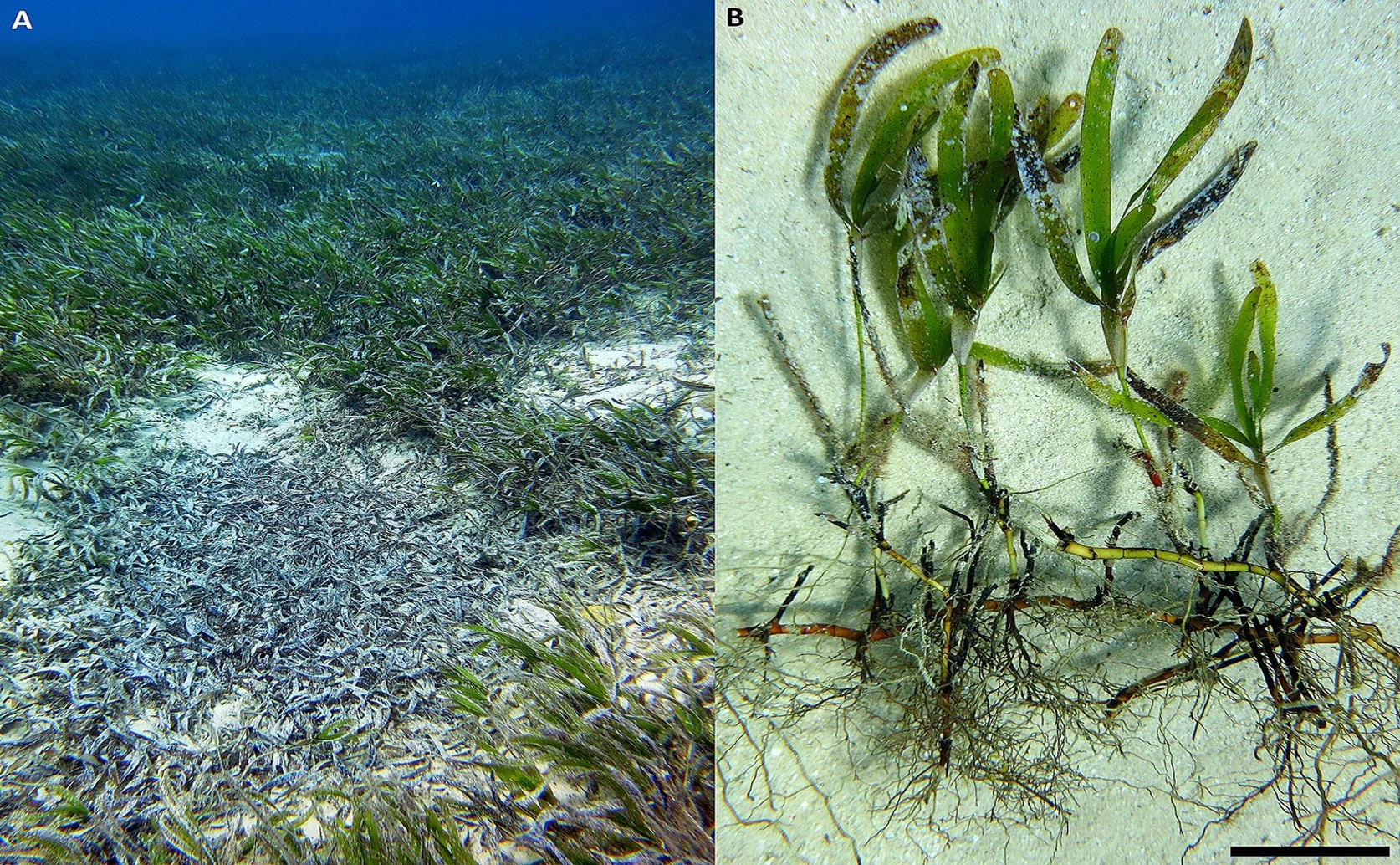
The Indo-Pacific seagrass Thalassodendron ciliatum forms dense underwater meadows where it accumulates organic matter (a) and possesses a complex root system (b), which is the site of the newly described epiphytic fungal symbiosis.

Image adapted from: Vohník et al. / CC BY (Source)

Key Findings

  • Researchers discovered a novel root-fungus symbiosis in the seagrass Thalassodendron ciliatum from the Gulf of Aqaba in the Red Sea
  • The roots of T. ciliatum host dark septate (DS) fungi, which form extensive hyphal mantles on the root surface, particularly on thinner roots involved in nutrient uptake
  • The presence of melanin in DS hyphae suggests these fungi might help seagrasses conserve organic detritus, potentially aiding in blue carbon sequestration
Symbioses between plants and fungi are well-documented on land but remain underexplored in marine environments. A recent study conducted by the Czech Academy of Sciences sheds light on a novel root-fungus symbiosis in the Indo-Pacific seagrass Thalassodendron ciliatum[1]. This discovery builds on previous findings that highlight the importance of fungal associations in plant health and ecosystem functioning. Seagrasses are vital to coastal ecosystems, serving as habitats, hatcheries, and protectors against erosion[2]. While much is known about their ecological roles, their relationships with fungi have been largely overlooked. Previous research on the Mediterranean seagrass Posidonia oceanica revealed a specific root-fungus symbiosis with the ascomycete Posidoniomyces atricolor. This study aimed to explore whether similar symbiotic relationships exist in other seagrass species. Using stereomicroscopy, light and scanning electron microscopy, and DNA cloning, researchers investigated the root-fungus symbiosis in Thalassodendron ciliatum from the Gulf of Aqaba in the Red Sea. They discovered that, like P. oceanica, T. ciliatum's roots host dark septate (DS) fungi, which form extensive hyphal mantles on the root surface. These DS hyphae are more frequently found on thinner roots involved in nutrient uptake from the seabed. However, unlike P. oceanica, the mycobiont in T. ciliatum does not colonize the host intraradically and occurs on roots with root hairs. The study's DNA cloning revealed a diverse array of fungi, mostly parasites or saprobes of uncertain origin. This makes the exact identity of the mycobiont in T. ciliatum still unknown. The presence of melanin in DS hyphae, which slows down decomposition, suggests that these fungi might help seagrasses conserve organic detritus in their rhizosphere. This could contribute to blue carbon sequestration, a process where carbon is stored in oceanic and coastal ecosystems, thus playing a role in mitigating climate change. Previous studies have shown that fungi can have both beneficial and detrimental effects on plant fitness in terrestrial ecosystems[2]. For instance, the coevolution of mycorrhizal fungi and plant roots has been crucial for the success of land plants, with different types of mycorrhizal associations evolving over millions of years[3]. The discovery of similar symbiotic relationships in marine plants like seagrasses suggests that fungi could also play significant roles in these ecosystems. Moreover, the study aligns with findings that certain fungi, such as those in the Rhizoscyphus ericae aggregate, exhibit diverse lifestyles, including forming mycorrhizae and acting as root endophytes[4]. The identification of DS fungi in T. ciliatum adds another layer to our understanding of fungal diversity and their ecological roles in marine environments. To study fungal communities, researchers often use specific primers to amplify fungal DNA while excluding plant DNA. This technique has been valuable in examining the structure of ectomycorrhizal communities and detecting fungal pathogens in plants[5]. Similar methods were employed in this study to identify the fungal taxa associated with T. ciliatum, highlighting the importance of advanced molecular techniques in uncovering hidden symbiotic relationships. In conclusion, the discovery of a novel root-fungus symbiosis in Thalassodendron ciliatum underscores the potential prevalence and ecological significance of fungal associations in seagrasses. This study not only expands our knowledge of marine fungal diversity but also opens new avenues for research into the functioning and importance of these symbioses in coastal ecosystems. Further studies are needed to fully understand the roles these fungi play and their contributions to blue carbon sequestration and overall seagrass health.

Plant ScienceMarine BiologyMycology

References

Main Study

1) Novel epiphytic root-fungus symbiosis in the Indo-Pacific seagrass Thalassodendron ciliatum from the Red Sea

Published 29th July, 2024

https://doi.org/10.1007/s00572-024-01161-9


Related Studies

2) Characterization of the Mycobiome of the Seagrass, Zostera marina, Reveals Putative Associations With Marine Chytrids.

https://doi.org/10.3389/fmicb.2019.02476


3) Coevolution of roots and mycorrhizas of land plants.

https://doi.org/10.1046/j.1469-8137.2002.00397.x


4) The root-symbiotic Rhizoscyphus ericae aggregate and Hyaloscypha (Leotiomycetes) are congeneric: Phylogenetic and experimental evidence.

https://doi.org/10.1016/j.simyco.2018.10.004


5) ITS primers with enhanced specificity for basidiomycetes--application to the identification of mycorrhizae and rusts.

Journal: Molecular ecology, Issue: Vol 2, Issue 2, Apr 1993


Related Articles

An unhandled error has occurred. Reload 🗙