Basil Plants Boost Tomato Healing Through Scent Signals in Mixed Gardens

Jim Crocker
23rd July, 2024

Basil Plants Boost Tomato Healing Through Scent Signals in Mixed Gardens

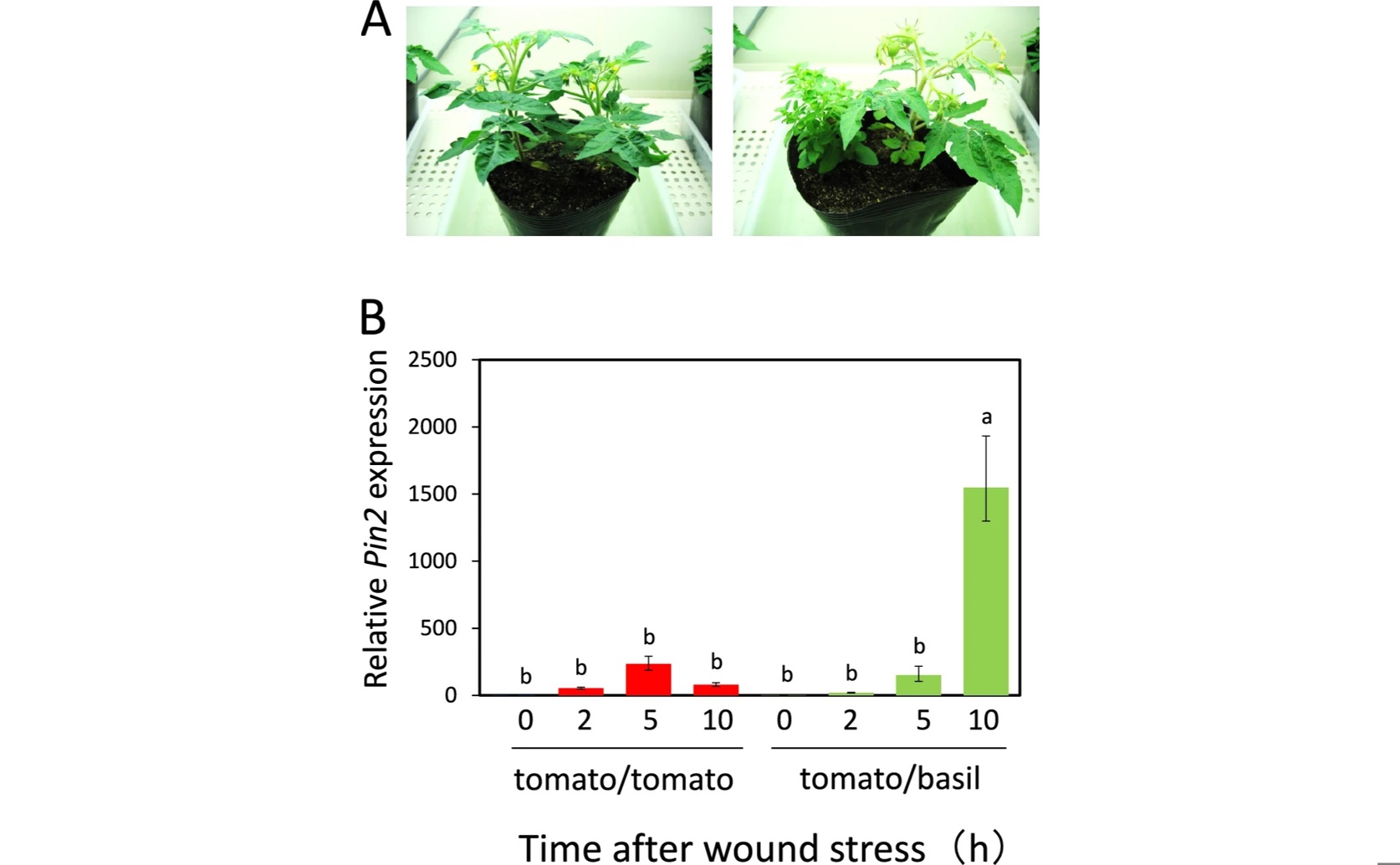
Companion planting with basil (Ocimum basilicum var. minimum) (a) primes the defense system of tomato (Solanum lycopersicum) plants, resulting in a significantly faster and stronger expression of the wound-response gene Pin2 following injury compared to tomatoes grown alone (b).

Image adapted from: Yoshida et al. / CC BY (Source)

Key Findings

  • Researchers at Kagoshima University found that basil plants enhance the wound response in tomato plants
  • Basil releases volatile compounds that prime tomato plants for a faster and stronger reaction to wounding
  • Exposure to basil essential oil boosts defense-related gene expression and increases resistance to herbivores in tomatoes
In the quest to develop more sustainable agricultural practices, companion planting has emerged as a promising strategy. Recent research conducted by Kagoshima University has provided new insights into how companion plants like basil can enhance the wound response in tomato plants through complex biochemical signaling[1]. The study focused on the effects of basil (Ocimum basilicum var. minimum) on the wound response in tomato plants (Solanum lycopersicum cv. 'Micro-Tom'). The researchers discovered that the presence of basil plants significantly enhanced the expression of Pin2, a gene that responds specifically to mechanical wounding, in tomato leaves. This enhanced response was attributed to the volatile compounds released by basil, which seemed to prime the tomato plants for a faster and stronger reaction to wounding stress. To delve deeper into the molecular mechanisms, the researchers exposed tomato plants to an essential oil (EO) prepared from basil leaves. This exposure replicated the wound response priming effect observed in the mixed planting system. Specifically, the basil EO enhanced the expression of genes related to jasmonic acid, mitogen-activated protein kinase (MAPK), and reactive oxygen species (ROS) signaling pathways in the tomato plants. These pathways are crucial for plant defense responses. The study also showed that basil EO led to increased ROS accumulation in wounded tomato leaves, further bolstering their defense mechanisms. The priming effect of basil EO was not limited to tomatoes. When tested on Arabidopsis plants, the EO similarly enhanced the wound response, indicating that the observed effects might be broadly applicable across different plant species. Loss-of-function analysis revealed that MAPK genes are pivotal in controlling these priming effects, highlighting their essential role in the defense signaling network. Interestingly, the study also demonstrated practical benefits. Tomato leaves pre-exposed to basil EO showed reduced growth of Spodoptera litura larvae compared to control leaves, suggesting that basil can enhance plant resistance to herbivores through volatile signaling. These findings align with earlier studies on plant defense mechanisms. For instance, previous research has shown that thiamine can prime plants like Arabidopsis for faster and stronger activation of defense responses by promoting the accumulation of signaling components such as hydrogen peroxide[2]. Similarly, the accumulation of inactive proteins of MAPKs, such as MPK3 and MPK6, has been linked to enhanced defense responses in primed plants[3]. The current study from Kagoshima University builds on these findings by demonstrating that volatile compounds from companion plants can also prime defense responses through similar biochemical pathways. Moreover, the concept of using companion plants to enhance crop protection has been explored in various contexts. For example, planting marigolds next to tomato plants has been shown to slow the population growth of glasshouse whiteflies, likely due to the release of volatile compounds like limonene[4]. The current study extends this concept by providing a molecular understanding of how companion plants like basil can prime defense responses in target plants. In conclusion, the research from Kagoshima University highlights the potential of using companion plants to enhance crop resilience through volatile signaling. By understanding the molecular mechanisms underlying these effects, we can develop more effective and sustainable agricultural practices that reduce the reliance on chemical pesticides and promote plant health.

HerbsBiochemPlant Science

References

Main Study

1) Companion basil plants prime the tomato wound response through volatile signaling in a mixed planting system.

Published 22nd July, 2024

https://doi.org/10.1007/s00299-024-03285-w


Related Studies

2) Vitamin B1-induced priming is dependent on hydrogen peroxide and the NPR1 gene in Arabidopsis.

Journal: Plant physiology, Issue: Vol 143, Issue 2, Feb 2007


3) Mitogen-activated protein kinases 3 and 6 are required for full priming of stress responses in Arabidopsis thaliana.

https://doi.org/10.1105/tpc.108.062158


4) Companion planting with French marigolds protects tomato plants from glasshouse whiteflies through the emission of airborne limonene.

https://doi.org/10.1371/journal.pone.0213071


Related Articles

An unhandled error has occurred. Reload 🗙